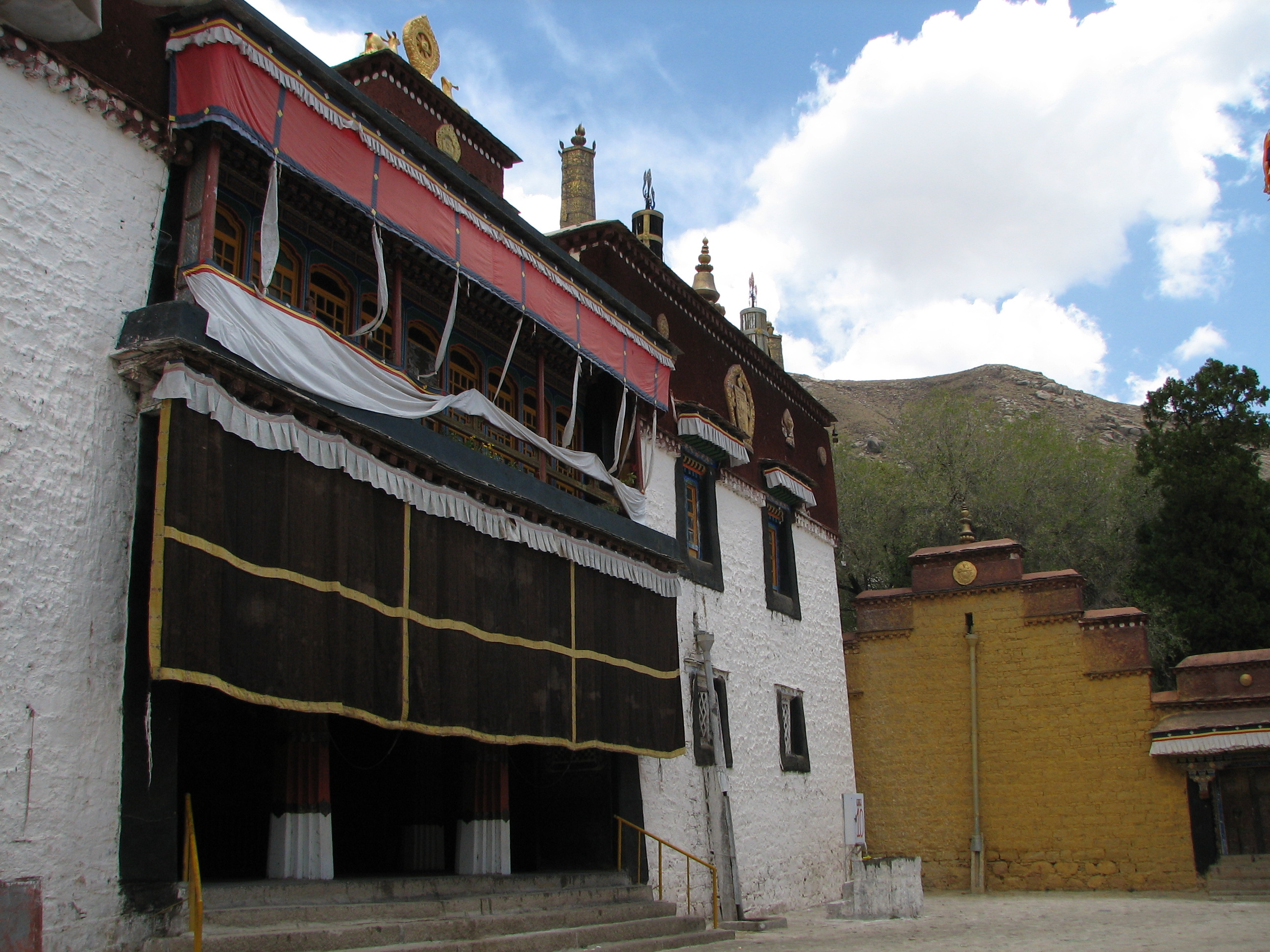
Sera Monastery
Every afternoon in the debating courtyard of Sera Monastery, monks clap their hands with a crack that carries across the compound. The sound is deliberate - a punctuation mark in a centuries-old tradition of philosophical argument. One monk stands, posing a question on Buddhist doctrine. Another sits, defending his position. The questioner lunges forward with each challenge, bringing his right hand down onto his left with a slap that signals the urgency of the point. Get the answer wrong and a wave of derision follows. Get it right and the debate simply sharpens. This is not theater. It is how monks at Sera have studied for six hundred years, and the courtyard where it happens is one of the most distinctive classrooms on Earth.
Wild Roses and a Vision in the Sky
Sera takes its name from the wild roses - sera in Tibetan - that covered the hillside when the monastery was founded in 1419 by Jamchen Chojey Sakya Yeshe, a disciple of the great reformer Je Tsongkhapa. The site, 1.25 miles north of the Jokhang in Lhasa, was chosen because Tsongkhapa had experienced a vision there: the full text of the Prajnaparamita's twenty verses on emptiness, captioned across the sky, followed by a rain of the syllable "AA" descending from above. Twelve years later, his student fulfilled the prophecy by establishing Sera as a seat of Mahayana learning. Together with Drepung and Ganden, Sera became one of the "great three" Gelug university monasteries, institutions that shaped Tibetan Buddhism for centuries. At its peak, the complex encompassed 28 acres and housed thousands of monks across three colleges: the Je, the Me, and the Ngakpa.
Three Colleges, Three Purposes
Sera's educational structure was rigorous and specific. The Je and Me colleges trained monks through a twenty-year program of tsennyi - philosophical knowledge - that concluded with a geshe degree, the highest academic qualification in Tibetan Buddhism. The Ngakpa college, the oldest of the three, was devoted exclusively to tantric ritual. Each college had its own abbot and a council of ten lamas. Sera Je, the largest college, measured a substantial area and featured a gilded copper statue of Hayagriva, the horse-headed protector deity, said to have been sculpted by the college's founder Lodro Rinchen himself. The assembly hall displayed frescoes of the Buddha's life, and its walls held the thrones of both the Dalai Lamas and Panchen Lamas. Before 1959, the monastery belonged to the Gelug Order and was one of the largest in Lhasa. Sera Je alone counted 5,629 monks that year.
1959 and the Road to Bylakuppe
The 1959 Lhasa uprising brought catastrophe. Sera suffered severe damage: colleges were destroyed, hundreds of monks were killed, ancient texts were lost, and works of art accumulated over centuries were obliterated. Survivors faced a harrowing choice. Many fled across the Himalayas in winter, joining the exodus that followed the Dalai Lama to India. None of the monks from the Ngakpa Dratsang, the Tantric College, survived. The remaining monks of the Je and Me colleges eventually settled at Bylakuppe in Karnataka state, where the Indian government allotted forest land for a Tibetan resettlement. In 1970, 197 Sera Je monks and 103 Sera Me monks established a parallel monastery. They built an assembly prayer hall that could accommodate 1,500 monks, completed in 1978. Today, more than 5,000 monks live at the Bylakuppe monastery, and a newer, larger assembly hall accommodating 3,500 has been added. Sera now exists in two forms: the original "Tibetan Sera" in Lhasa and the "New Sera" of the diaspora.
The Hermitages Above
Sera is more than its central complex. Scattered across the surrounding hills are hermitages that predate the monastery itself. Pabongkha, the largest and most important, sits in the Nyangbran Valley on the slopes of Mount Parasol. Its origins go back over 1,300 years to Songtsen Gampo, who built a fort there in the 7th century - one of the first buildings in the Lhasa area. It may predate even the Jokhang. Keutsang Hermitage, perched precariously on a hillside above Lhasa's principal cemetery, was once the meditation cave of Tsongkhapa himself, though the original cave collapsed in a landslide and was rebuilt at a safer location. Pilgrims walk the Sera Mountain Circumambulation Circuit, visiting these hermitages during the annual "Sixth-Month Fourth-Day" celebrations. From Sera Utse, the peak hermitage directly behind the monastery, the view encompasses the entire Lhasa Valley - a landscape that has produced scholars, debaters, and the particular kind of argument that begins with a clap.
From the Air
Sera Monastery is located at 29.669N, 91.133E on the northern outskirts of Lhasa at approximately 3,700m elevation, about 1.25 miles north of the Jokhang. The complex covers 28 acres at the base of Pubuchok Mountain. Hermitages are scattered across the hills above. Lhasa Gonggar Airport (ZULS) is approximately 60km to the southwest. Expect high-altitude conditions and variable mountain weather.