Serpent Mound: The 1,400-Foot Snake Nobody Can Explain
Someone built a quarter-mile snake in Ohio and didn't leave a note. Serpent Mound stretches 1,400 feet along a ridge in Adams County - an earthwork serpent with coiled tail, undulating body, and open mouth that appears to be swallowing an oval that might be an egg, or the sun, or something we'll never understand. The snake is aligned with celestial events: its head points to the summer solstice sunset; other coils align with equinox and solstice positions. No burials have been found in it, no artifacts, no clear purpose. The civilization that built it - probably the Fort Ancient culture, roughly 1000 CE - left no written records. The snake remains, enormous and inexplicable, waiting for questions we haven't learned to ask.
The Form
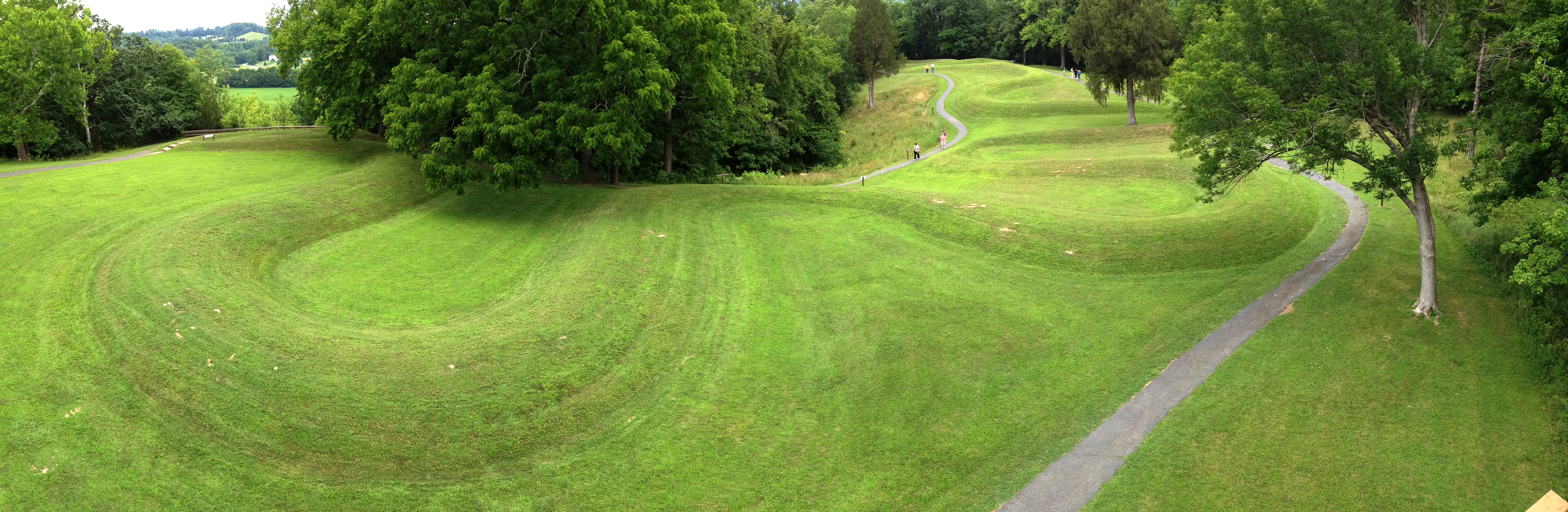
The serpent is built of yellow clay and ash on a foundation of stone. It averages 20 feet wide and 4 feet high, following the contours of a ridge above Brush Creek. The tail is tightly coiled; the body curves in seven undulations; the head is triangular with an open mouth surrounding an oval object. Viewed from the ground, the form is nearly invisible - just a low ridge of earth. From the air or from the observation tower built in 1908, the serpent reveals itself. It's the largest surviving effigy mound in North America, built to be seen from above in an era when no humans could fly.
The Mystery
Who built Serpent Mound? We're not sure. Early archaeologists attributed it to the Adena culture (500 BCE - 200 CE), but radiocarbon dating in 1996 suggested the Fort Ancient culture (1000 CE - 1550 CE). Later studies have questioned this, suggesting the mound might be older and rebuilt by later peoples. Why was it built? Unknown. Effigy mounds elsewhere served as burial sites; Serpent Mound contains no burials. It might be ceremonial, astronomical, territorial, or something else entirely. The cultures that built Ohio's mounds left no written records. We interpret their works through our assumptions, which may be completely wrong.
The Astronomy
Serpent Mound's alignments are striking. The head points toward the summer solstice sunset - the longest day of the year, when the sun sets at its northernmost point. Other coils align with solstice and equinox positions. The oval in the serpent's mouth might represent the sun being swallowed. Or not. We impose our knowledge of astronomy on ancient works and assume the builders shared our interests. They might have; celestial observation was important to many ancient cultures. They might have had entirely different purposes we haven't considered. The alignments remain; the meaning doesn't.
The Preservation
Serpent Mound nearly didn't survive. By the 1880s, farming and erosion had damaged sections. Frederic Ward Putnam of Harvard's Peabody Museum raised funds to purchase and preserve the site in 1887 - one of the first archaeological preservation efforts in America. The site became an Ohio state memorial in 1900. Restoration work in 1908 rebuilt damaged sections, possibly altering the original form. The observation tower was added, and the site became a tourist destination. Modern archaeology has been more cautious - preserving what remains rather than reconstructing what might have been.
Visiting Serpent Mound
Serpent Mound is located in Adams County, Ohio, about 80 miles east of Cincinnati. The site includes an observation tower, museum, and walking trails along the mound (walking on the mound itself is prohibited). Solstice events draw crowds; the summer solstice sunset alignment is the most popular. The museum interprets Ohio's mound-building cultures and the site's archaeology. Hours are seasonal; check before visiting. Adams County has limited services; Hillsboro and Portsmouth offer lodging and dining. The site is part of the Hopewell Ceremonial Earthworks, a UNESCO World Heritage Site since 2023. Visit at sunset for the best light on the serpent's form; visit on solstice to see what the builders might have seen.
From the Air
Located at 39.02°N, 83.43°W in Adams County, Ohio. From altitude, Serpent Mound is visible as an unmistakable serpentine form on a ridge above Brush Creek - the only earthwork of its kind visible from any altitude. The coiled tail, undulating body, and triangular head with oval are clearly distinguishable. The surrounding terrain is hilly and forested; the creek winds through a valley below. The observation tower and museum are visible adjacent to the mound. This is the best-preserved large effigy mound in North America, built to be seen from above by a culture that couldn't see it from above.