Serra da Cutia National Park
Somewhere in the remote western reaches of Rondonia, where the Cautario and Soteiro rivers thread through unbroken canopy, a line was drawn in 2001. On one side, chainsaws and cattle. On the other, 283,500 hectares of Amazon rainforest that Brazil declared off-limits. Serra da Cutia National Park exists because the alternative was watching this corner of the basin disappear entirely, consumed by the same forces that have stripped Rondonia of more forest than any other Amazonian state.
A Line Against the Chainsaw
Rondonia has long been ground zero for Amazon deforestation. Highway BR-364, completed in the 1980s, opened the state to waves of settlers, and the pattern repeated itself across thousands of square kilometers: forest fell, pasture replaced it, and indigenous communities were pushed aside or killed outright. Ranchers murdered indigenous people to seize their land. By the turn of the millennium, the destruction had become so total that Brazil's government moved to protect what remained. Serra da Cutia was part of that response, established on August 1, 2001, and placed under the management of the Chico Mendes Institute for Biodiversity Conservation, known as ICMBio. The park sits within a broader mosaic of protected areas and indigenous territories that together form the Guapore-Itenez-Mamore Ecological Corridor, linking conservation units along the Brazilian-Bolivian border.
Life in the Low Canopy
The park occupies low-lying jungle, its elevations ranging from 140 to 525 meters above sea level. This is not dramatic mountain terrain; it is the quiet, relentless density of lowland Amazonia. More than 1,000 plant species crowd the forest floor, the understory, and the canopy above. Over 250 species of birds call through the trees. Below the branches, more than 50 species of reptiles patrol the ground and waterways, including two species of crocodilian and a considerable diversity of snakes. Forty-one species of amphibians inhabit the wet margins between land and water. The rivers themselves hold at least 143 species of fish, including the catfish Pimelodella, which is endemic to the park's waterways.
Monkeys, Cats, and Giants
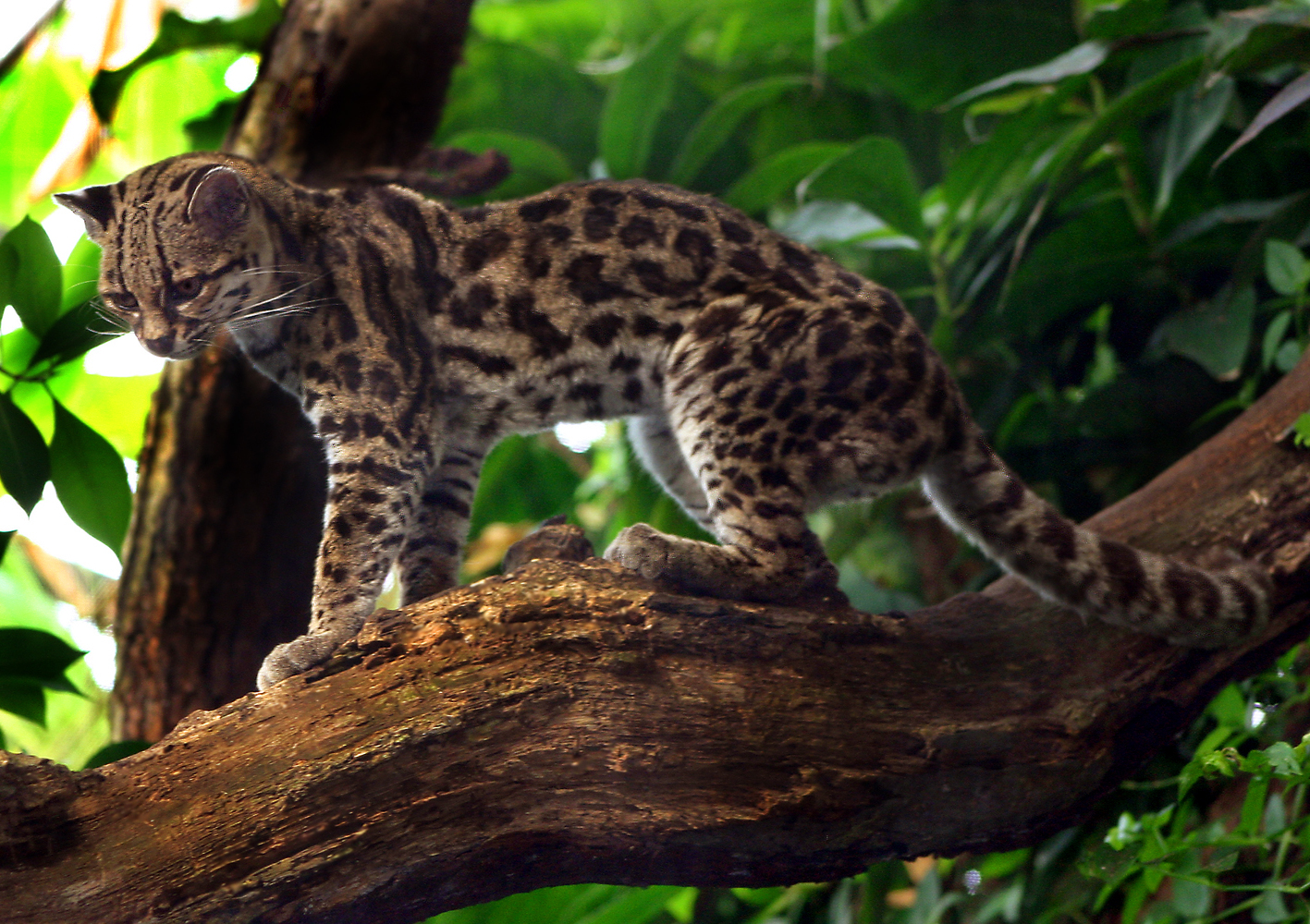
The mammals of Serra da Cutia read like a field guide to Amazonian wildlife at its most charismatic. Brown-mantled tamarins move through the mid-canopy in family groups, while spider monkeys swing across wider gaps in the upper branches. Squirrel monkeys chatter in troops, red howler monkeys broadcast their presence for kilometers, and tufted capuchins crack nuts with deliberate intelligence. The predators are here too: jaguars, the apex hunters of the neotropics, alongside the smaller and more elusive margay and the powerful puma. Giant anteaters lumber through the forest on their knuckles, tongues built for dismantling termite mounds. Giant otters, among the most social and vocal of all Amazon mammals, hunt fish in cooperative family groups along the park's rivers. Peccaries, brocket deer, agoutis, and the diminutive Neotropical pygmy squirrel round out a mammal community that thrives precisely because it has somewhere left to live.
The Weight of Remoteness
Getting to Serra da Cutia is, by design, difficult. There is no public transportation, no visitor infrastructure, no ranger station waiting at a trailhead. The park sprawls across portions of the municipalities of Costa Marques and Guajara-Mirim, deep in Rondonia's western interior. The climate is unforgiving for the unprepared: 1,500 millimeters of rain fall annually, temperatures swing between 18 and 32 degrees Celsius, and tropical diseases are a real concern. Yellow fever vaccination is essential. Mosquitoes carrying malaria and dengue are present. The isolation that makes the park ecologically valuable also makes it personally demanding. And yet that remoteness is precisely what has kept Serra da Cutia intact while the forest around it fell. In a state where deforestation has been catastrophic, the park's inaccessibility has served as its most effective defense.
From the Air
Located at 11.68S, 64.33W in western Rondonia, Brazil. The park is a vast expanse of unbroken Amazon canopy visible from cruising altitude, contrasting sharply with the deforested pastureland surrounding it. Nearest significant airports include Porto Velho (SBPV) approximately 350 km northeast and Guajara-Mirim (SBGM) roughly 100 km west. Best viewed at 15,000-25,000 feet where the forest boundary against cleared land is dramatically visible.