Seson-ji: The Temple Whose Pagoda Walked Away
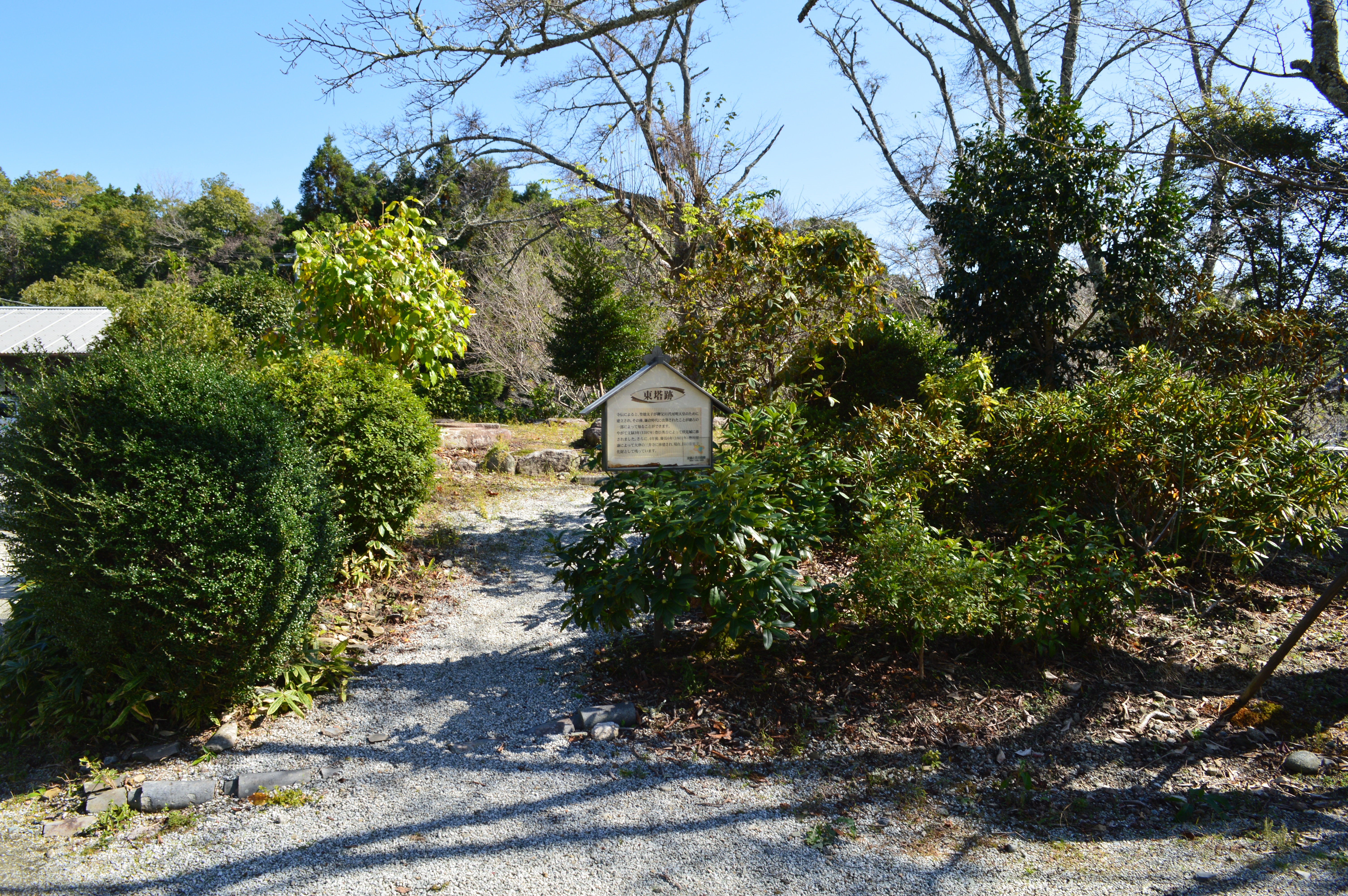
The foundation stones are still there. Two neat rectangles of dressed rock sit in the temple grounds of Seson-ji in the town of Oyodo, Nara Prefecture -- one marking where the east pagoda stood, one marking the west. The west pagoda burned in the wars of the late 16th century. The east pagoda survived, but it is no longer here. In 1594, Toyotomi Hideyoshi had it dismantled and hauled away to Fushimi Castle. Seven years later, Tokugawa Ieyasu moved it again, this time to Mii-dera temple near Lake Biwa, where it stands to this day as an Important Cultural Property of Japan. The pagoda has been gone for over four centuries. Seson-ji keeps its empty foundations tidy anyway, the stones arranged exactly as they were when the structure was new, a monument to what was taken.
Forty-Eight Temples, One Prince
Tradition credits Prince Shotoku with founding 48 Buddhist temples during his lifetime in the late 6th and early 7th centuries. Seson-ji -- originally known as Yoshino-ji -- is counted among them, and archaeological evidence supports the claim. Roof tiles excavated at the site date to the Asuka period, and the original layout followed the Yakushi-ji style with twin three-story pagodas flanking a central hall. This was an ambitious architectural plan for a mountain temple in the Yoshino district, suggesting significant imperial patronage. The temple sits in the Hiso neighborhood of Oyodo, and its precincts were designated a National Historic Site of Japan in 1927. Today it belongs to the Soto school of Japanese Zen, with a statue of Amida Nyorai as its principal image, but its history spans nearly every major Buddhist school that has passed through Japan.
Scholars from Three Kingdoms
During the Nara period, the temple -- then known as Yoshino-ji Hiso-san-ji -- became an international center of Buddhist scholarship. The monk Dao-xuan, an immigrant from Tang China, was entrusted with the temple's care, bringing with him the intellectual traditions of the Chinese Buddhist establishment. The monk Shin'ei from the Korean kingdom of Silla also took up residence and spent twenty years studying the Tripitaka, the vast canon of Buddhist scripture. A temple in rural Nara Prefecture thus became a meeting point for the Buddhist traditions of China, Korea, and Japan -- a convergence that reflected the cosmopolitan character of the broader Nara period, when Japan absorbed cultural and religious influences from across East Asia with extraordinary openness.
Logs That Glowed Like Lightning
The temple's most remarkable legends involve light. During the Heian period, the temple was renamed Genko-ji -- the Temple of Manifested Light -- after accounts that its principal statues were emitting a mysterious glow. The Nihon Shoki, Japan's oldest official chronicle, records two origin stories for these statues. During the reign of Emperor Kinmei, a camphor log washed ashore in Izumi Province shining "like sunlight," and the emperor ordered a craftsman to carve two Buddhist statues from it, one of which became the Amida at Yoshino-ji. A separate entry describes the reign of Empress Suiko, when a log that emitted light like lightning washed ashore in Tosa Province and gave off a "wonderful fragrance" when burned -- the first recorded mention of agarwood in Japanese chronicles. The empress ordered a statue of Kannon Bosatsu carved from this fragrant wood and enshrined at Yoshino-ji. Whether these are miracle stories or embellished accounts of rare timber arriving from distant shores, they made the temple famous across the Heian court. Fujiwara Michinaga, Emperor Seiwa, and Emperor Uda all visited.
Five Names, Five Lives
Few temples in Japan have reinvented themselves as often as this one. It began as Yoshino-ji in the Asuka period, became Yoshino-ji Hiso-san-ji in the Nara period, was renamed Genko-ji in the Heian period, became Hiso-ji after reconstruction in 1279, and was briefly called Rittenho-ji when Emperor Go-Daigo visited during the turbulent Nanboku-cho period. Each name marks a turning point. The reconstruction of 1279 brought restoration by the monk Eison and a shift to the Shingon Risshu school. After the pagoda was removed by Hideyoshi and the temple fell into decline, it was restored through its sub-temple Horin-ji and converted to the Jodo sect. When Horin-ji burned in 1731, the temple pivoted once more, converting to the Soto Zen school in 1751 and becoming independent. The modern Main Hall sits directly atop the foundation of the ancient Lecture Hall, its floor surrounded by the original foundation stones -- new architecture built literally on old ground.
What the Stones Remember
Seson-ji today is a quiet temple in a quiet town. The Main Hall is modest. The Inner Gate and the Taishi-do, a hall dedicated to Prince Shotoku, are designated Nara Prefectural Important Cultural Properties. But the most compelling features may be the most understated: the pagoda foundation stones. The east pagoda foundations show precisely where each pillar stood, the center stone still in place, a perfect archaeological record of a Kamakura-period structure that now stands sixty miles away at Mii-dera. The west pagoda foundations tell the same spatial story for a structure that no longer exists at all. The temple is a seven-minute drive or forty-minute walk from Muda Station on the Kintetsu Yoshino Line, an easy detour for anyone visiting the cherry blossoms of nearby Mount Yoshino. Most visitors come for the blossoms. Seson-ji offers something different: the patience of stone, the persistence of a temple that has lost its pagodas, changed its name five times, switched Buddhist schools four times, and still holds its ground.
From the Air
Located at 34.40°N, 135.83°E in the town of Oyodo, Nara Prefecture, Japan, in the Yoshino River valley south of the Nara basin. The temple grounds are modest and not visually prominent from altitude, but the Yoshino district is identifiable by the river valley and the mountainous terrain of the Kii Peninsula to the south. Mount Yoshino's cherry blossom groves are visible nearby to the southeast. Nearest major airports are Kansai International Airport (RJBB) approximately 42 nautical miles northwest, and Osaka Itami Airport (RJOO) about 32 nautical miles north-northwest. The Kintetsu Yoshino rail line is visible tracking through the valley. Terrain rises sharply to the south into the Omine Mountains.