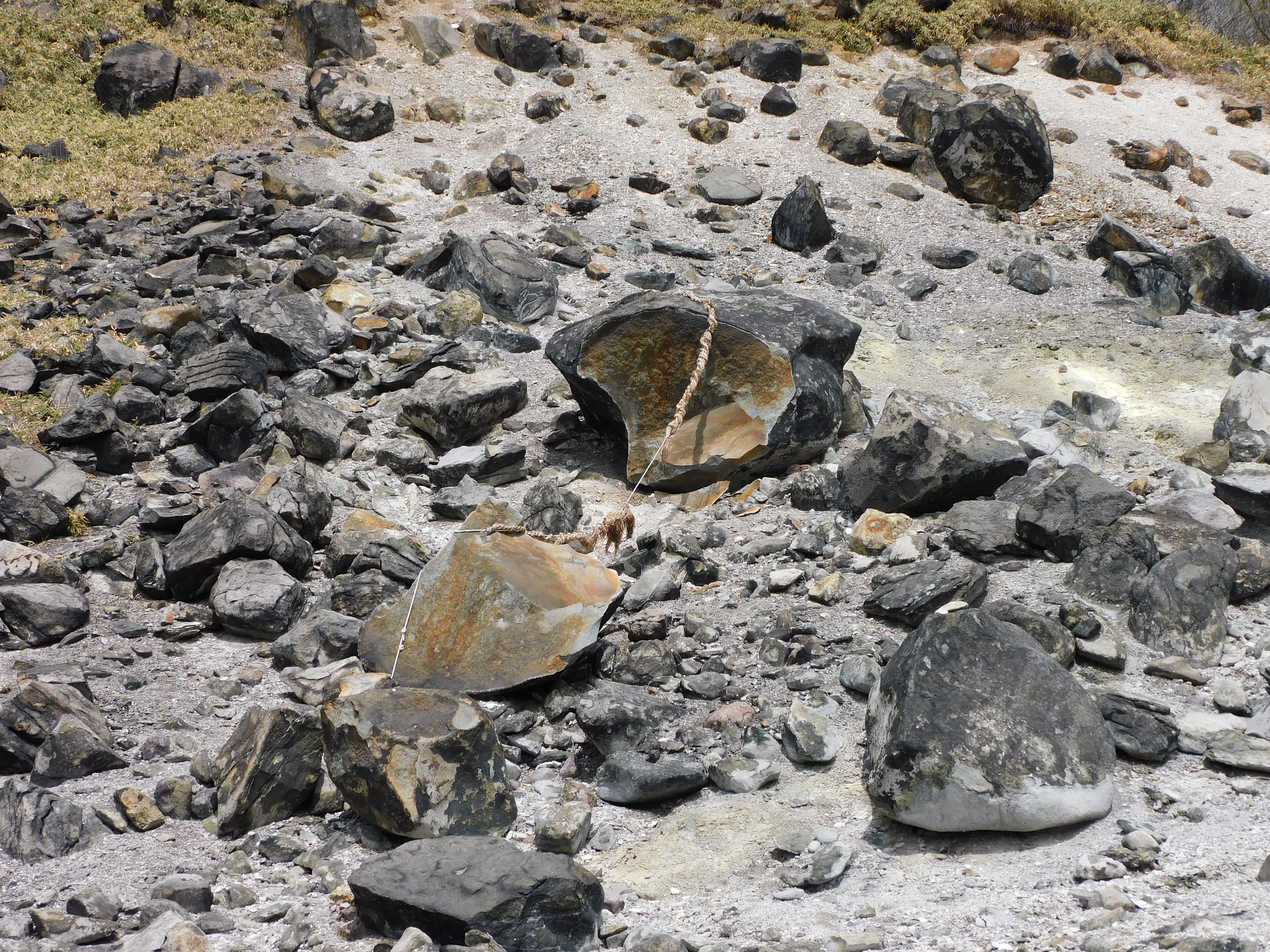
Sessho-seki: The Stone That Killed Everything It Touched
On March 5, 2022, a boulder split in half in the volcanic mountains of Nasu, and the internet panicked. The stone was the Sessho-seki -- the Killing Stone -- and according to a legend stretching back to the 12th century, it contained the trapped spirit of Tamamo-no-Mae, a nine-tailed fox who had disguised herself as the most beautiful woman in the imperial court to murder Emperor Konoe. When the warrior Miura-no-suke killed the fox, her corpse transformed into this stone, and the stone killed everything that touched it -- birds landing on its surface, insects crawling across it, butterflies drifting too close. For nine hundred years, the boulder sat in a field of sulfurous volcanic vents, leaking both toxic gas and supernatural dread. Then it cracked open. Three weeks later, Shinto priests arrived to perform an exorcism, waving haraegushi wands over the broken halves and offering prayers to keep the fox spirit contained. The cracks had been visible for years, likely caused by rainwater seeping into the rock and freezing. But in a country where mythology and landscape are inseparable, the natural explanation did little to ease the unease.
The Fox in the Palace
The legend begins in the court of Emperor Konoe during the 12th century. A woman of extraordinary beauty and intellect appeared among the courtiers, calling herself Tamamo-no-Mae. She could answer any question, quote any text, and her skin seemed to glow with its own light. The emperor became infatuated. But Tamamo-no-Mae was no human -- she was a kitsune, a nine-tailed fox spirit, working in service of an evil daimyo who plotted to kill the emperor and seize the throne. When the court astrologer exposed her true form, the fox fled. The emperor dispatched the warrior Miura-no-suke to hunt her down. According to the otogi-zoshi tales, the chase ended in the volcanic plains of Nasu, where Miura-no-suke killed the fox with arrows. Her body did not decay. Instead, it hardened into stone -- a stone so saturated with malice that it radiated death to anything living that approached.
Infinite Hell's Doorstep
The Killing Stone sits in a barren, sulfur-stained landscape near the summit of the Nasu volcanic range, where fumaroles vent hydrogen sulfide and other toxic gases from the earth below. The area around the stone is largely devoid of vegetation, the ground stained yellow and white by mineral deposits. Dead insects accumulate on the rocks. When the poet Matsuo Basho visited in 1689 during his famous journey recorded in Oku no Hosomichi -- The Narrow Road to the Deep North -- he observed that dead butterflies and bees lay so thick on the ground around the boulder that the sand beneath was invisible. The volcanic gases provided a perfectly rational explanation for the deaths, but the legend had already fused with the landscape. Science and myth occupied the same ground, and neither could dislodge the other. Rows of Jizo statues -- small stone Buddhist figures -- stand near the Sessho-seki, placed there over centuries to comfort the spirits of the dead and protect the living from the stone's malevolence.
The Priest Who Talked the Fox Down
Centuries after the fox's death, the story gained a second chapter. A Buddhist priest named Genno was traveling through the Nasu mountains when he stopped to rest near the Killing Stone. The spirit of Tamamo-no-Mae appeared and threatened him. Rather than flee, Genno performed exorcism rituals and spoke to the spirit about her own salvation, urging her to consider the Buddhist path. According to the tale, Tamamo-no-Mae was moved by his compassion. She relented, swearing never to haunt the stone again. This episode became the basis for a celebrated Noh play titled Sessho-seki, attributed to the playwright Hiyoshi Sa'ami, in which the drama of the fox's rage and the priest's calm compassion plays out in the stylized, mask-wearing tradition of Japanese theater. The story endures across Japanese culture -- from Kido Okamoto's novel Tamamo-no-Mae to manga and anime adaptations that continue to retell the fox spirit's legend for new audiences.
The Day the Stone Broke
The split was discovered on March 5, 2022, when visitors found the Sessho-seki cleaved neatly into two large pieces with a rope that had been draped across the intact stone now lying on the ground between the halves. Geologists noted that cracks had been visible in the boulder for several years, and rainwater seeping into those fissures and freezing during winter likely caused the fracture. The explanation satisfied scientists but not social media. Within days, the story went viral worldwide, with commentary ranging from nervous humor to genuine superstition about the fox spirit's release. On March 26, 2022, the local government organized a formal ceremony at the site. Shinto priests performed purification rituals, waving haraegushi wands and offering prayers over the broken stone to appease the spirit and, as the official language put it, pacify the beast. A mist reportedly descended over the site during the ceremony, adding one more layer to a legend that refuses to stay in the past.
From the Air
Located at 37.10°N, 140.00°E in the volcanic highlands of Nasu, Tochigi Prefecture, within Nikko National Park. The Sessho-seki sits in a barren, sulfur-stained area near the Nasu volcanic vents, visible as a pale patch amid darker forested slopes. Best viewed at 3,000-5,000 feet AGL from the east. The Nasu volcanic cluster (Mount Chausu, Mount Sanbonyari) rises immediately to the northwest with visible steam plumes. Fukushima Airport (RJSF) lies approximately 35 nautical miles to the northeast. Caution: volcanic gas emissions in the area, and mountain weather can reduce visibility rapidly. The Nasu Ropeway station and Nasu Highland resort area are visible on the lower slopes to the southeast.