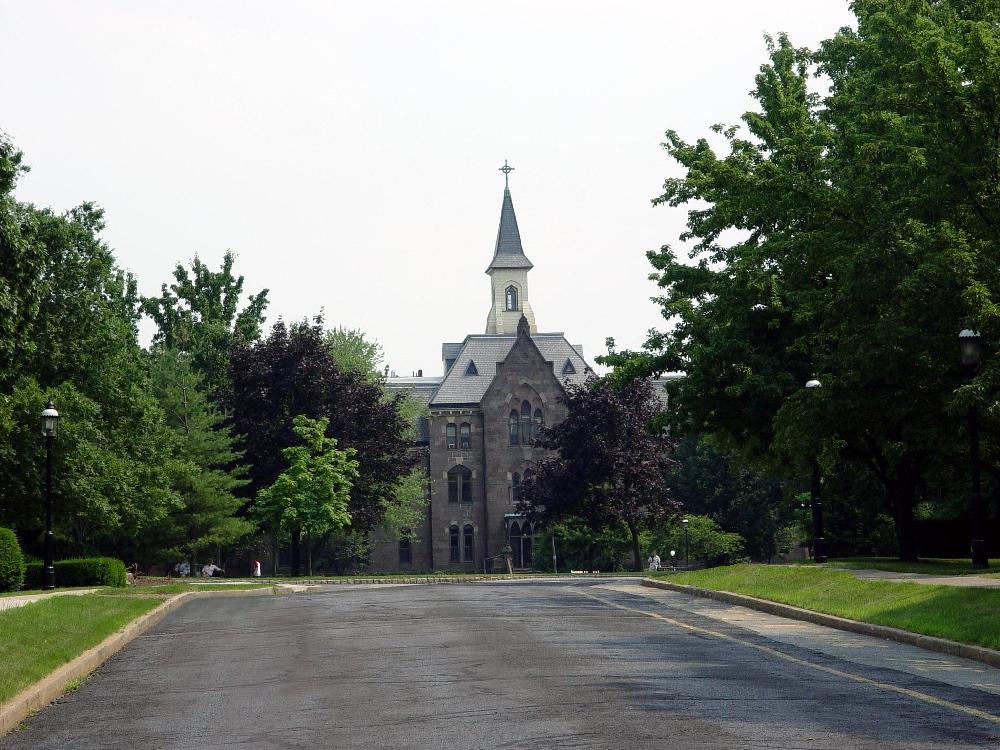
Seton Hall University
The motto on the Seton Hall seal reads Hazard Zet Forward — a phrase pulled from Norman French and archaic English that translates, roughly, as 'at whatever risk, yet go forward.' Students who step on the seal engraved in the middle of the university green are said to risk not graduating on time. Whether or not they believe the superstition, the motto itself captures something real about the institution: Seton Hall has spent 170 years going forward through circumstances that would have stopped a less stubborn place.
The Bishop's College
Bishop James Roosevelt Bayley founded the college in 1856, three years after the Diocese of Newark was established by Pope Pius IX. He named it after his aunt, Saint Elizabeth Ann Seton — the first native-born American to be canonized. The goal was practical: New Jersey's growing Catholic population needed an institution for higher learning. The campus that grew on 58 acres of suburban land in South Orange combined Roman, neo-Gothic, and modern architectural styles. Presidents Hall, the oldest surviving building, was completed in 1867 in brownstone neo-Gothic. A stained glass depicting Saint Elizabeth Ann Seton, commissioned by Bayley himself in 1866, still stands inside. The Chapel of the Immaculate Conception, designed by architect Jeremiah O'Rourke — who later designed the Cathedral of Newark — was built in 1863 and dedicated in 1870.
Growth and Disruption
The twentieth century brought enrollment growth, institutional expansion, and periodic crisis. The college became a university in 1950. The School of Law opened in 1951 under Miriam T. Rooney, who was not only Seton Hall's first female dean but the first woman to lead an ABA-accredited law school in the United States. In 1948 the university received its FCC license for WSOU-FM, which would later be rated among the top college radio stations in the country. Buildings went up, were renamed, and in some cases had their names quietly removed when the people they honored fell from grace — Dennis Kozlowski of Tyco International had a hall named after him until his criminal conviction in 2005; Robert Brennan had the recreation center until securities fraud ended that arrangement too.
Boland Hall
On January 19, 2000, at 4:30 in the morning, an arson fire tore through Boland Hall, a freshman dormitory. Three students died. Fifty-eight were injured. The fire — one of the deadliest dormitory fires in recent American history — began while most of the building's residents were asleep. A three-and-a-half-year investigation ended with the arrest and guilty pleas of two freshmen, Sean Ryan and Joseph LePore, who were sentenced to five years in a youth correctional facility. The student body responded by creating 'The Remember Seal' — a dedicated area in front of Boland Hall — and the university instituted stronger fire safety protocols across campus. The fire's weight still sits in the institution's memory.
Pirates Basketball and the Edge of a Championship
Seton Hall athletics built its identity around basketball. The Pirates won the 1953 National Invitation Tournament and came within a single overtime basket of the 1989 NCAA championship, losing to Michigan 80–79 in one of the tournament's most memorable finals. The basketball program plays its home games at the Prudential Center in Newark — too large for the South Orange campus, and a testament to how seriously New Jersey takes its team. The university's sports culture extends well beyond the court: varsity programs in baseball, soccer, swimming, and golf, alongside club teams in hockey, rugby, and lacrosse, shape the rhythm of undergraduate life.
A University in Motion
Seton Hall today spans multiple campuses: the main 58-acre grounds in South Orange, a law school housed in a 22-story Newark skyscraper at One Newark Center, and an Interprofessional Health Sciences campus in Nutley dedicated to nursing and health professions. The university confers degrees in 70 academic fields across nine schools and colleges. Its enrollment — roughly 5,800 undergraduates and 4,400 graduate students — reflects more than a century and a half of stubborn, hazardous forward motion.
From the Air
Located at 40.7431°N, 74.2466°W in South Orange, New Jersey, approximately 14 miles west of Manhattan. The campus sits along South Orange Avenue near the Watchung ridgeline, served by the South Orange station on NJ Transit's Morris & Essex Line. Newark Liberty International Airport (EWR) is about 9 miles east. Recommended viewing altitude is 2,000–3,000 feet MSL. The neo-Gothic brownstone towers of Presidents Hall and the Chapel of the Immaculate Conception are the most architecturally distinctive features of the 58-acre campus.