Seven Falls
Each waterfall has a name, given in alphabetical order rather than by position: Bridal Veil, Feather, Hill, Hull, Ramona, Shorty, and Weimer. Together they form Seven Falls, Colorado's only waterfall on the National Geographic list of international waterfalls, a distinction earned not by sheer height but by something rarer -- seven distinct cascades tumbling through a granite box canyon so narrow that at one point its walls stand just feet apart. Author Susan Joy Paul described them as "seven leaps of plunge, cascade, punchbowl, fan, and horsetail spray." The canyon itself, carved by South Cheyenne Creek along the Front Range southwest of downtown Colorado Springs, has been called "The Grandest Mile of Scenery" in Colorado.
Pillars and Profiles
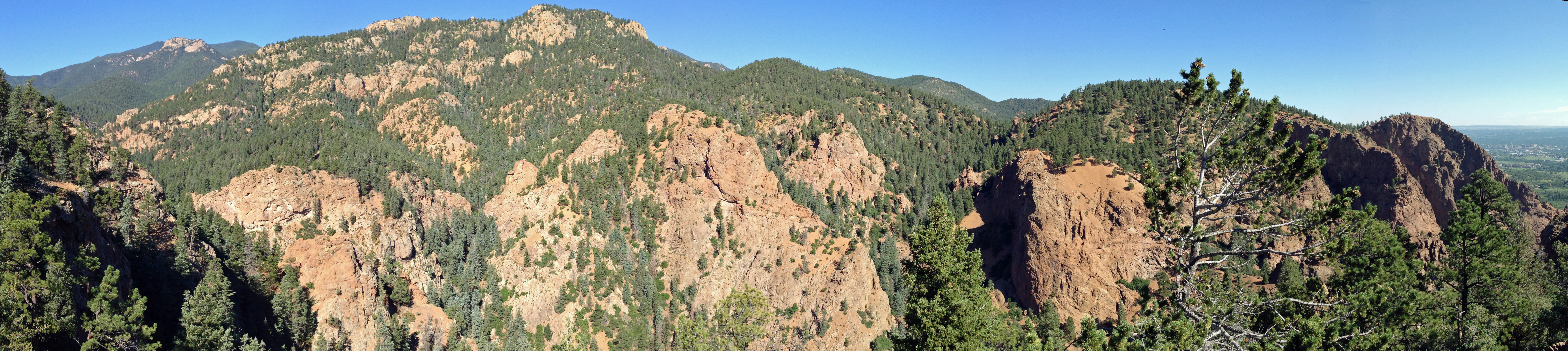
The approach to Seven Falls sets the stage. Just inside the entrance stand the Pillars of Hercules, massive rock formations rising from the canyon floor. Across from them, erosion has carved a profile in the stone that locals call the George Washington. At this point the canyon walls nearly touch. Beyond, ponderosa pine, Douglas fir, juniper, and blue spruce cling to the granite slopes, and the air fills with the sound of falling water. A staircase of 224 steps climbs from the base of the falls to the peak, while a wheelchair-accessible elevator ascends to the Eagle's Nest observation platform. From the top, two trails branch out: one winding to Inspiration Point, where poet Helen Hunt Jackson found the views that shaped her verse, and a shorter path to Midnight Falls near the headwaters of South Cheyenne Creek.
A Toll Road Through Paradise
Nathaniel Colby homesteaded this stretch of South Cheyenne Canyon in December 1872, then sold the land rights nine months later for $1,000 to the Colorado Springs Land Company. In 1882, naturalist James Hull purchased the property, fearing that logging operations would ruin the scenic area. Hull built a stairway to the top of the falls and carved a road through the canyon. Visitors arrived by horse, burro, and carriage, paying a toll to enter. The trail to Inspiration Point opened in 1883. After Hull's death in 1890, the property passed to his sons, assessed by the county at $80,000 and estimated to be worth more than $200,000. In 1905, mine owner Callidore Dwight Weimer purchased it for $250,000. One of the seven falls now bears his name.
Light in the Canyon
Al Hill, a Colorado College student and Texas oilman, bought Seven Falls in 1946 and reimagined it for the modern era. In 1947, he installed lights throughout the canyon, extending visiting hours into the night. That first Christmas, Hill opened the illuminated canyon free of charge to the people of Colorado Springs, with a charity collecting donations -- a tradition that became annual. The Hill family built the Eagle's Nest observation platform and blasted into the mountainside for the elevator shaft, later updated in 1992. In December 2002, a dynamic Martin Architectural lighting system bathed the cascades in shifting colors. Seven Falls became known as the only fully lit canyon in the world, its waterfalls glowing against dark granite walls like something from a dream.
Twice Destroyed, Twice Reborn
Water gives, and water takes away. A flood in 1965 wiped out the Seven Falls park entirely. The attraction was rebuilt, only to face nature's fury again. In mid-September 2013, five days of heavy rain hammered the southwest side of Colorado Springs. The torrent reduced seven falls to five. Trees went down, mud filled the park, and the road was destroyed. The park closed, its entrances blocked. For 68 years, the Hill family had stewarded the falls. In April 2014, The Broadmoor hotel announced it had purchased Seven Falls. After extensive restoration, The Broadmoor reopened the attraction on August 13, 2015, adding shuttle bus service from remote parking and Restaurant 1858, a fine dining establishment at the foot of the cascades -- named for the year South Cheyenne Canyon was first explored by settlers.
Canyon Chorus
The wildlife at Seven Falls keeps its own schedule. Hummingbirds dart among the spray, their iridescent feathers catching the canyon light. The American Dipper -- also called the Water Ouzel -- bobs on rocks before plunging into the creek to walk along the bottom, a songbird that swims. Brook and rainbow trout hold steady in the cold pools below the falls. Above, the granite walls that have channeled South Cheyenne Creek for millennia continue their slow work, shaping the seven cascades that draw visitors today just as they drew James Hull more than 140 years ago.
From the Air
Seven Falls is located at 38.78N, 104.88W in South Cheyenne Canyon, southwest of downtown Colorado Springs. The falls sit in a narrow granite box canyon along the Front Range. From altitude, look for the deep canyon cut southwest of the Colorado Springs urban area. Nearest airport is Colorado Springs Airport (KCOS). The canyon is tight and enclosed, so the falls themselves are not visible from high altitude, but the canyon drainage is identifiable. Pikes Peak rises prominently to the west.