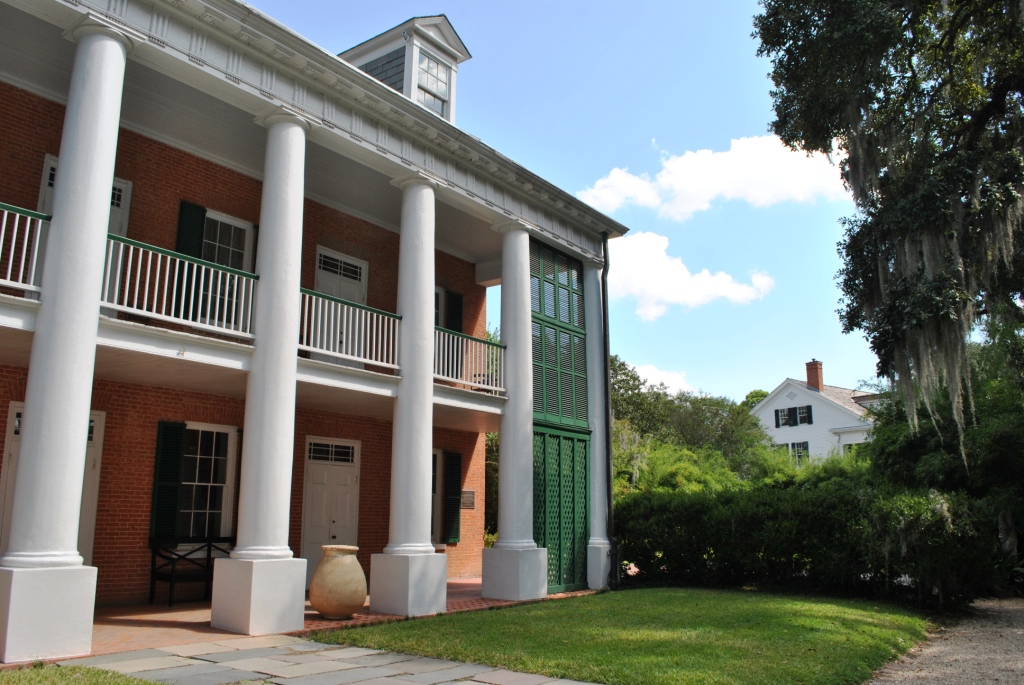
Shadows-on-the-Teche
The man who saved Shadows-on-the-Teche was, by most accounts, a magnificent eccentric. William Weeks Hall painted in the art studio on the ground floor, threw lavish parties on the second-floor gallery, and welcomed guests ranging from Cecil B. DeMille to Walt Disney to Henry Miller, who later wrote about the visit in his travelogue The Air-Conditioned Nightmare. When Hall died in 1958, he donated the entire property to the National Trust for Historic Preservation, ensuring that the red-brick plantation house his great-grandparents had built in 1834 would outlast the family that nearly lost it. Perched twenty feet above the banks of Bayou Teche in New Iberia, Louisiana, Shadows-on-the-Teche is a National Historic Landmark that holds within its sixteen rooms a story about wealth, enslavement, war, resilience, and the complicated question of what it means to preserve the past.
Columns Above the Bayou
The house arrived at the peak of Greek Revival architecture in America, and it shows. Eight full-height Tuscan columns of white-plastered brick march across the south facade, supporting a second-floor gallery topped by a Doric frieze. Three pedimented dormers punctuate the gabled roof, flanked by symmetrical brick chimneys. The builders kept ornamentation deliberately spare, letting the handmade red brick speak for itself, a style that made Shadows-on-the-Teche reportedly only the third brick house on Bayou Teche at the time of its construction. Around back, a two-level open loggia enclosed on three sides offers triple brick archways on the ground floor, with narrow staircases and double white columns rising to the second level. Inside, the traditional Creole floor plan unfolds: three rooms across the front, two flanking the rear loggia, no interior hallways. The dining room's black-and-white checkered marble floor still anchors the center of the house, while cypress doors painted to simulate oak and fireplaces finished to look like marble reveal a frontier culture aspiring to European refinement.
Sugar, Slaves, and Sorrow
David and Mary Weeks built Shadows-on-the-Teche as a town house for social life and entertainment, one piece of a plantation empire spanning four properties across the Acadiana region. But David Weeks never enjoyed the finished house. Chronically ill during its construction, he traveled to New England seeking medical attention and died there in August 1834, the same year the house was completed. Tragedy compounded. Mary remarried lawyer John Moore but kept her children's inheritance separate under Louisiana law, property that included 164 enslaved people bequeathed by her first husband's will. In 1856, their daughter Frances Mary and two grandchildren perished in the Last Island hurricane while vacationing on the barrier island. The children were brought home and buried on the grounds of Shadows-on-the-Teche, where their graves remain today. The household was economically and physically dependent on the labor of enslaved people, and the family's political commitment to slavery would cost them dearly.
Union Officers in the Parlor
When Louisiana seceded from the Union in 1861, John Moore served as a delegate to the secession convention, a political stance that made the household a target during the Civil War. Federal troops requisitioned the property, and Union officers quartered themselves inside the house. Mary Weeks died in December 1863 at Shadows-on-the-Teche while part of it still served as officers' quarters. After the war, the eldest Weeks son, William F. Weeks, partially restored the family's fortunes during Reconstruction, but the recovery was incomplete. When he died in 1895, the property passed to his daughters Lily and Harriet, who were forced to sell off surrounding land to cover living expenses. The original 158-acre estate shrank to just two and a half acres, the house itself barely surviving the family's long financial decline.
The Bohemian Heir
William Weeks Hall, the last private owner, transformed what remained. An artist and preservationist, Hall laid out the gardens that still define the property: boxwood hedges and aspidistra walks threaded among live oaks, bamboo, camellias, and azaleas. He built a summer house in 1928 as a garden focal point, designing it to echo the arches of the main house's rear loggia. He excavated and organized the voluminous family papers he found stored throughout the house, eventually donating the archive to researchers. And he opened his doors to a remarkable parade of cultural figures: writer Lyle Saxon, etiquette arbiter Emily Post, filmmaker Cecil B. DeMille, and animator Walt Disney all visited. Henry Miller spent time there and wrote about it with characteristic irreverence. Hall understood that the house's value lay not just in its architecture but in its accumulated human story.
Reckoning with the Full Story
When Hall donated Shadows-on-the-Teche to the National Trust for Historic Preservation before his death in 1958, he preserved a property whose layers of history resist simple celebration. The house is beautiful, its Greek Revival lines still commanding above the bayou. The gardens remain a lush counterpoint to the brick severity. The Weeks family cemetery holds four generations, the last burial being Hall himself. But this is also a place built by enslaved labor, sustained by sugar profits extracted from enslaved people, and defended politically by secessionists. In 2022, the Iberia African American Historical Society opened a center for research and learning within Shadows-on-the-Teche, adding a dimension of interpretation that the property's earlier stewards never attempted. The underground brick cistern at the northeast corner, six feet deep, eleven feet wide, and capable of holding over 4,000 gallons, endures as a quiet artifact of the self-sufficient plantation world. Shadows-on-the-Teche today asks visitors to hold beauty and injustice in the same gaze.
From the Air
Shadows-on-the-Teche sits at approximately 30.004N, 91.816W in New Iberia, Louisiana, along the banks of Bayou Teche. The red-brick house with its white columned facade is visible at low altitude. Nearest airports include Acadiana Regional Airport (KARA) roughly 10 nm to the east and New Iberia Airport (Acadiana Regional). The Bayou Teche corridor is a useful visual navigation reference, winding through the town. Best viewed at 1,000-2,000 feet AGL.