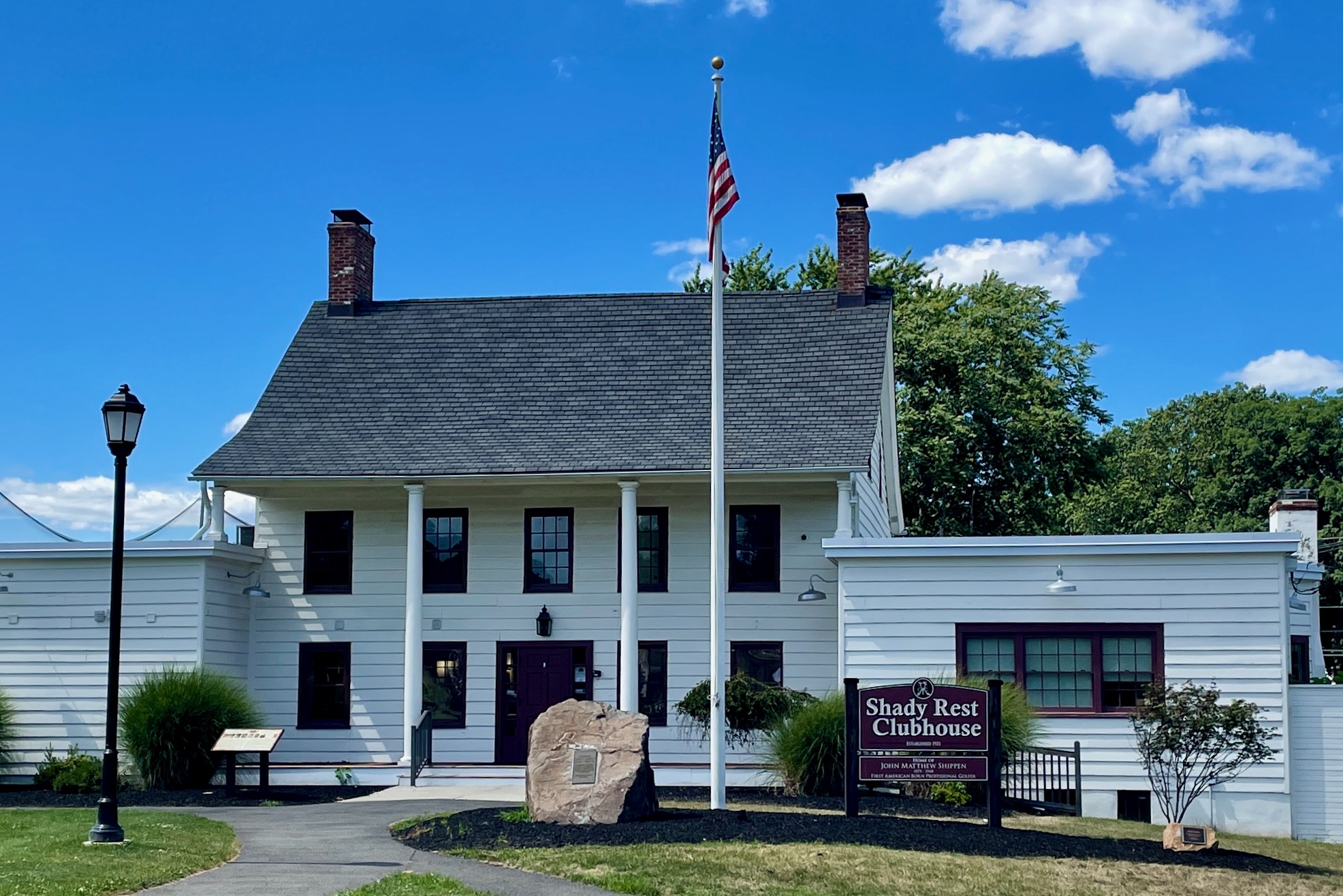
Shady Rest Country Club
Nicknames reveal what formal names conceal. Shady Rest Country Club in Scotch Plains, New Jersey was known informally as 'The Mecca of Entertainment on the East Coast' — and on summer nights in the 1930s and 1940s, that was not an exaggeration. Duke Ellington played there. Ella Fitzgerald. Billie Holiday. Cab Calloway, Count Basie, Louis Armstrong. The club's ballroom drew musicians making the circuit from New York City, and the crowd that packed the room understood what it meant to have a place like this at all.
Why It Had to Exist
Shady Rest was established in 1921 with a clear and necessary purpose: to provide a recreational and cultural space for African Americans in an era when most country clubs, golf courses, and leisure venues were entirely closed to them. It offered golf, tennis, and horseback riding within an environment built on welcome rather than exclusion. The nine-hole golf course had been built in 1900 by the Westfield Country Club and was designed by David Smith Hunter, a Scottish golf professional. When Shady Rest took it over, the course became the site of some of the most significant moments in the history of Black American sport.
The First Golf Professional
In 1931, John Shippen arrived at Shady Rest as the club's golf professional and groundskeeper. He would live there for more than thirty years, in an apartment on the third floor of the clubhouse. Shippen had been the first American professional golfer and, in 1896, the first African American to compete in the U.S. Open — an event his participation very nearly prevented from happening when white players threatened to boycott. He finished fifth. That history followed him to Shady Rest, where his presence gave the club a gravity no other venue could claim. On July 4 and 5, 1925, the club had hosted the first National Colored Golf Tournament — won by Harry Jackson, with Shippen finishing second — an event filmed on newsreel by Fox Films and significant enough to directly inspire the formation of the United Golfers Association the following year.
Where Althea Gibson Learned Golf
Tennis came to Shady Rest through a different door. In the 1940s and 1950s, six clay courts occupied what is now the ninth-hole green, and the club became a center for regional African American tennis — hosting the Eastern Open Championship in 1948, sanctioned by the American Tennis Association, and serving for a time as that organization's headquarters. Althea Gibson was a regular presence. She was known at Shady Rest as a tennis player — a coach and role model to younger members — before she picked up a golf club on the club's course. That interest grew into a professional golf career on the LPGA Tour, making Gibson one of the first women to compete professionally in two different major sports. Shady Rest can claim a role in that transformation.
What Remained
The township of Scotch Plains acquired the property in 1938 and converted it to a public golf course in 1964, renaming it Scotch Hills Country Club. In 2021, the name was restored: Shady Rest Country Club. The following year, on July 7, 2022, the site was added to the National Register of Historic Places for its significance in entertainment, ethnic heritage, recreation, and social history from 1921 to 1964. In 2024 it was added to the New Jersey Black Heritage Trail. The clubhouse still stands — John Shippen's bedroom on the third floor, the Villa Casanova speakeasy in the basement — and the nonprofit Preserve Shady Rest is raising funds to restore those spaces and open a museum. The 2247-yard course still plays at par 33, largely as Hunter laid it out more than a century ago.
From the Air
Located at 40.6561°N, 74.3725°W in Scotch Plains, Union County, New Jersey, roughly 20 miles southwest of Manhattan. The golf course and clubhouse sit on Jerusalem Road and are visible from low altitude as a green open space within suburban development. Newark Liberty International Airport (EWR) is approximately 12 miles northeast. Recommended viewing altitude is 1,500–2,500 feet MSL. The surrounding Watchung Hills provide geographic context.