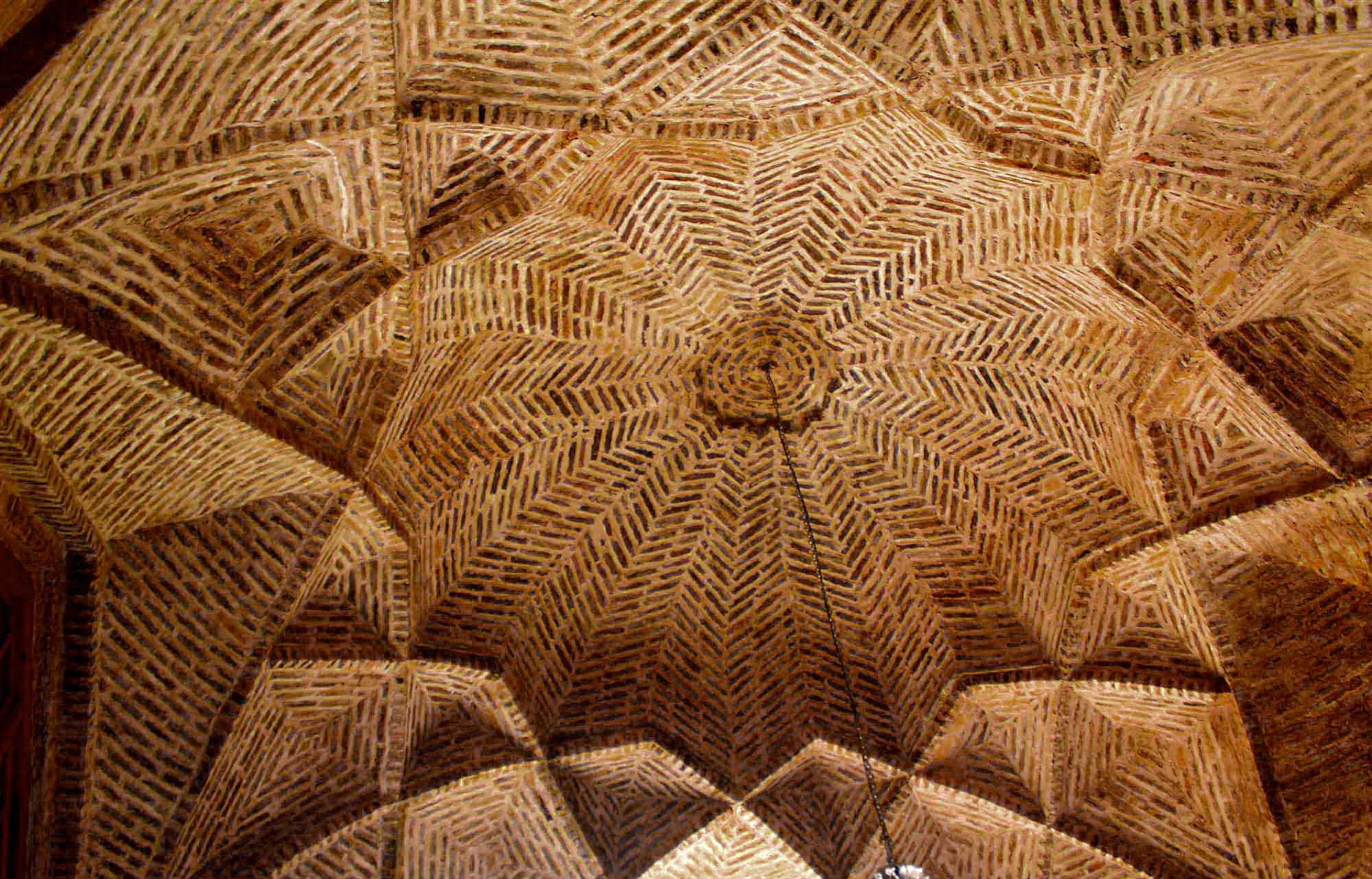
Shah Abbasi Caravansarai, Nishapur
Shah Abbas I wanted exactly 999 caravansarais. Not a thousand -- that number lacked poetry. According to tradition, when his builders completed one too many, the Safavid ruler ordered one destroyed to preserve the count. Whether the story is legend or fact, the ambition behind it was real: between 1588 and 1629, Abbas the Great commissioned a network of fortified roadside inns stretching across Persia, designed to shelter merchants, protect trade goods, and project Safavid authority along routes that had carried silk, spices, and ideas for millennia. The caravansarai he built in central Nishapur still stands, its fired-brick walls enclosing a courtyard where travelers once bedded down alongside their camels and cargo.
An Empire Built on Infrastructure
Abbas the Great understood that trade routes required more than roads. Merchants crossing the Iranian plateau faced bandits, harsh weather, and stretches of desert where the nearest settlement might be days away. A caravansarai solved all three problems at once: thick walls for defense, a sheltered courtyard for animals and goods, and rooms arranged around the perimeter for sleeping. Abbas built them at intervals of roughly a day's travel, creating a chain of safe harbors that made long-distance commerce not just possible but reliable. The Nishapur caravansarai served the eastern reaches of his empire, anchoring the vital Khorasan corridor that connected Persia's heartland to Central Asia. It was infrastructure as statecraft -- every inn bearing the shah's name, every traveler reminded of whose authority made their journey safe.
Brick, Mortar, and Muqarnas
The caravansarai was constructed primarily of fired brick bonded with mortar of gypsum and sand, materials chosen for their durability against the earthquakes and arid conditions common to the Khorasan region. The entrance portal features decorative brickwork with arched niches, a Safavid signature that announced the building's importance before a traveler even stepped inside. The eastern and western iwans -- the tall, arched alcoves that define Persian architectural space -- are distinguished by their own brickwork facades. Inside the vestibule, a muqarnas-vaulted ceiling breaks light into honeycomb geometry, the kind of mathematical ornamentation that Nishapur's own Omar Khayyam would have appreciated. Trees grow within the central courtyard, providing shade in summer as they have for four centuries.
From Silk Road Stop to Living Museum
The caravansarai's original purpose faded with the trade routes it served. Overland commerce gave way to maritime shipping, and the great Silk Road gradually fell silent. But the building endured. Listed as a national heritage site of Iran with registration number 1230, it was preserved while many of its 998 siblings crumbled or were repurposed beyond recognition. Today the interior rooms that once housed merchants and their wares have been converted into handicraft shops and two museums, making the building a showcase for the same tradition of skilled artisanship that once filled its courtyard with bales of silk and bolts of cotton. In 2023, the caravansarai became part of a broader recognition when an ensemble of 54 Persian caravanserais was inscribed on UNESCO's World Heritage List, honoring these structures as evidence of a pre-industrial travel system that connected cultures across continents.
Nishapur's Layered History
The caravansarai sits in the center of a city whose history runs far deeper than the Safavid era. Nishapur was founded by the Sassanian king Shapur I in the third century and grew into one of the great cities of the medieval Islamic world, rivaling Baghdad and Cairo under the Tahirid and Seljuk dynasties. It was a center for turquoise mining, ceramic production, and textile trade. The Mongol invasion of 1221 devastated the city, but Nishapur rebuilt, as it always has. The caravansarai is one layer in that long accumulation -- a Safavid structure on Seljuk ground, in a city founded by Sassanians, along a route first traced by merchants who predated all of them. Walking through its courtyard today, past handicraft vendors and museum displays, you are stepping through a doorway that four hundred years of travelers stepped through before you.
From the Air
Located at 36.197N, 58.802E in central Nishapur, Razavi Khorasan province, Iran. The caravansarai's rectangular courtyard structure is identifiable from low altitude within the city's urban fabric. The nearest major airport is Mashhad Shahid Hasheminejad International Airport (ICAO: OIMM), approximately 120 km to the east. Nishapur sits on a semi-arid plateau at roughly 1,200 meters elevation, with the Binalud mountain range to the north. The city's position along historic east-west trade routes is evident from the air in the linear arrangement of roads and rail corridors.