Shah Mosque (Isfahan)
Eighteen million bricks and 475,000 tiles. Those are the numbers behind the Shah Mosque in Isfahan, but numbers alone cannot convey what Shah Abbas I set in motion when he ordered its construction in 1611. The mosque sits at the south end of Naqsh-e Jahan Square, one of the largest public squares in the world, and it announces itself through a portal rising 27.5 meters into the dry Iranian sky. Step through that entrance, though, and something strange happens. The building turns. A 45-degree rotation in the vestibule quietly redirects every visitor from the axis of the square toward the qibla, the direction of Mecca. It is one of the most elegant solutions in the history of religious architecture, and almost nobody notices it happening.
An Empire Rebuilt in Tile
When Shah Abbas moved his capital from Qazvin to Isfahan in 1598, he was not simply relocating a court. He was remaking a state. Persia had been fractured by competing power centers, from the Qizilbash military to provincial governors who governed as they pleased. Abbas chose Isfahan for its strategic advantages: the Zayandeh River provided water in an arid landscape, the central location put distance between his throne and Ottoman aggression to the west, and control of the Persian Gulf gave him leverage over the Dutch and British East India Companies, whose trade routes were reshaping global commerce. The Naqsh-e Jahan Square, whose name translates to "Exemplar of the World," became the physical center of this ambition. Construction on the square began around 1590. The Shah Mosque followed in 1611, delayed partly by the need to purchase the surrounding land. It would not be finished until around 1630, after Abbas himself had died and his successor, Shah Safi, saw the final inscriptions set in place.
The Geometry of Devotion
The mosque's most celebrated design feature is invisible from the outside. Naqsh-e Jahan Square runs roughly north-south, but Mecca lies to the southwest. A mosque built on the square's axis would force worshippers to pray in the wrong direction. Architect Ali Akbar Isfahani solved the problem with a large vestibule that bends the interior alignment approximately 45 degrees. Scholar Donald Wilber argued this was not merely practical but deliberate showmanship: by setting the prayer hall on a different axis, the architects ensured that the mosque's massive dome, 52 meters tall and 25 meters across, remained visible above the entrance portal from the square. Had everything been aligned on a single axis, the portal would have hidden the dome entirely. The result is a building that presents one face to the public square and another to God, each optimized for its audience.
Seven Colors on a Single Tile
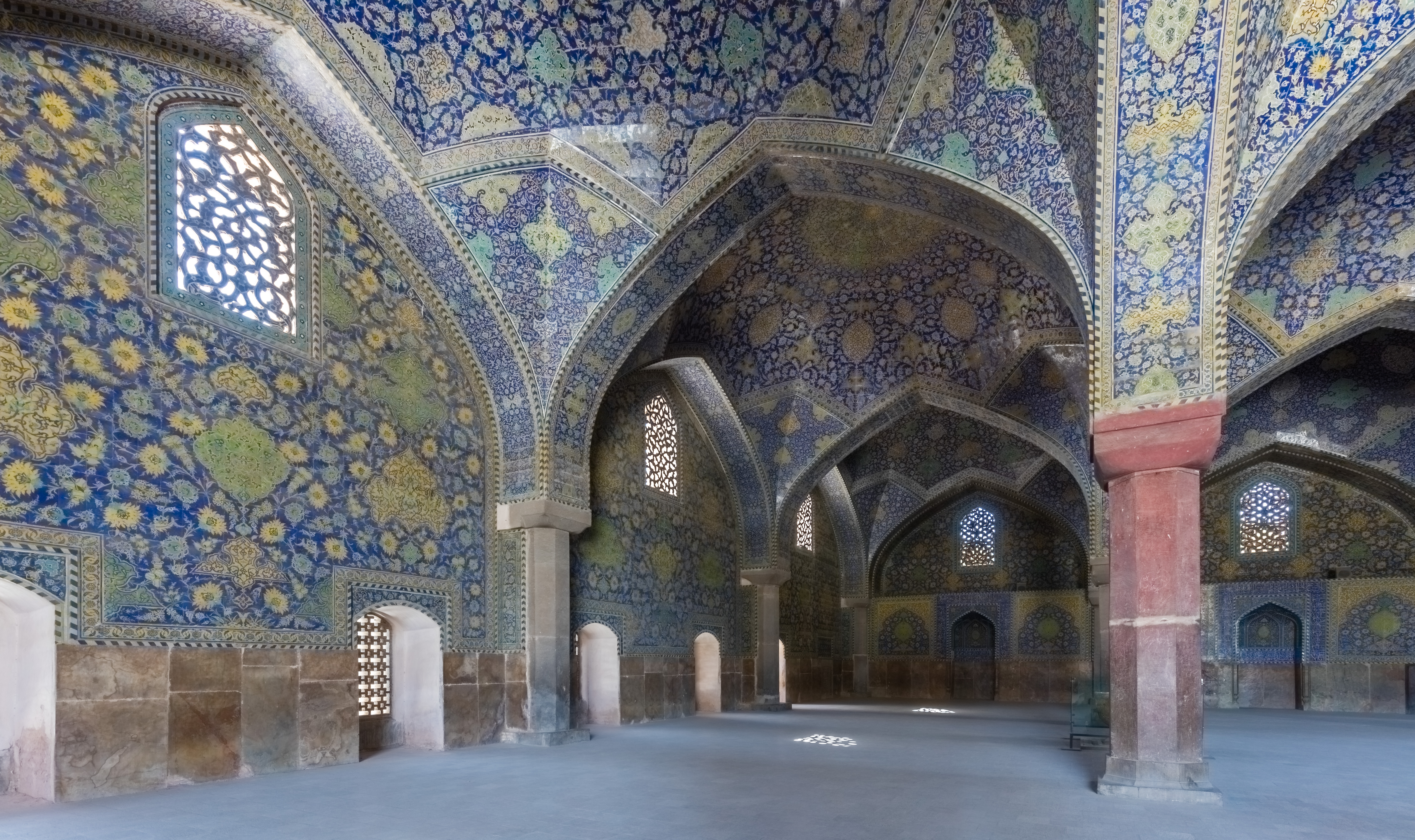
Before the Shah Mosque, Persian tilework meant tile mosaic: artisans cut tiny pieces from monochrome tiles and assembled them by hand into intricate patterns. The process was slow and expensive. The Shah Mosque introduced the haft rangi method on a grand scale, painting seven colors onto individual tiles before firing them. Dark blue, light blue, white, black, yellow, green, and beige come together in the entrance portal's finest work. The technique was faster and cheaper, which mattered for a project of this scale. But speed came with trade-offs. Contemporary writers and modern scholars generally consider the tilework of the nearby Sheikh Lotfollah Mosque, built with traditional mosaic methods, to be superior in beauty. The 17th-century French traveler Jean Chardin offered a different perspective, noting that Isfahan's dry climate made the colors more vivid and the contrasts sharper than anything European kilns could achieve. Walk through the mosque's four-iwan courtyard and the dominant impression is blue, deep and unrelenting, except in the winter prayer halls, where later restorers introduced tiles of yellow-green.
A Building Still in Conversation
The Shah Mosque has never stopped being worked on. The calligrapher Ali Reza Abbasi, who also inscribed the Lotfollah Mosque, designed the epigraphic compositions that frame the entrance. Marble dadoes were added to the interior walls in 1638, years after the main construction was complete. Centuries of weather and earthquakes took their toll. A major restoration project began in 2010, but in 2022, damage to the dome was discovered, caused by errors in the restoration itself. Iranian officials announced the corrective repairs were completed in June 2024. The mosque appears on Iran's 20,000-rial banknote and has been a UNESCO World Heritage Site as part of the Naqsh-e Jahan Square ensemble. It employs the four-iwan plan common to Iranian congregational mosques since the Seljuk period, with four minarets, two madrasas, and winter prayer halls flanking the main domed chamber. Rather than the traditional call to prayer from minaret tops, the Shah Mosque uses a guldasta, a small aedicule atop the west iwan, following the Persian tradition that tall minarets were unsuitable for the adhan.
The View from Above
From altitude, the Shah Mosque's dome dominates the southern edge of the square, its turquoise surface a sharp counterpoint to the beige and brown of Isfahan's rooftops. The four minarets mark the mosque's footprint clearly, with the pair at the entrance portal standing 33.5 meters tall. The 45-degree rotation between the entrance and the prayer hall is plainly visible from above, the two axes of the building diverging like a subtle geometric puzzle laid out across the ground. Isfahan spreads outward from the Zayandeh River, and the mosque's location on the square places it at the heart of a city that Shah Abbas designed to be the heart of an empire.
From the Air
Located at 32.655°N, 51.678°E in central Isfahan, Iran. The turquoise dome is visible from altitude at the south end of Naqsh-e Jahan Square. Nearest major airport is Isfahan Shahid Beheshti International Airport (OIFM), approximately 25 km to the northeast. The Zayandeh River provides a clear east-west visual reference through the city. Best viewed in clear weather when the tilework colors contrast with the surrounding arid landscape.