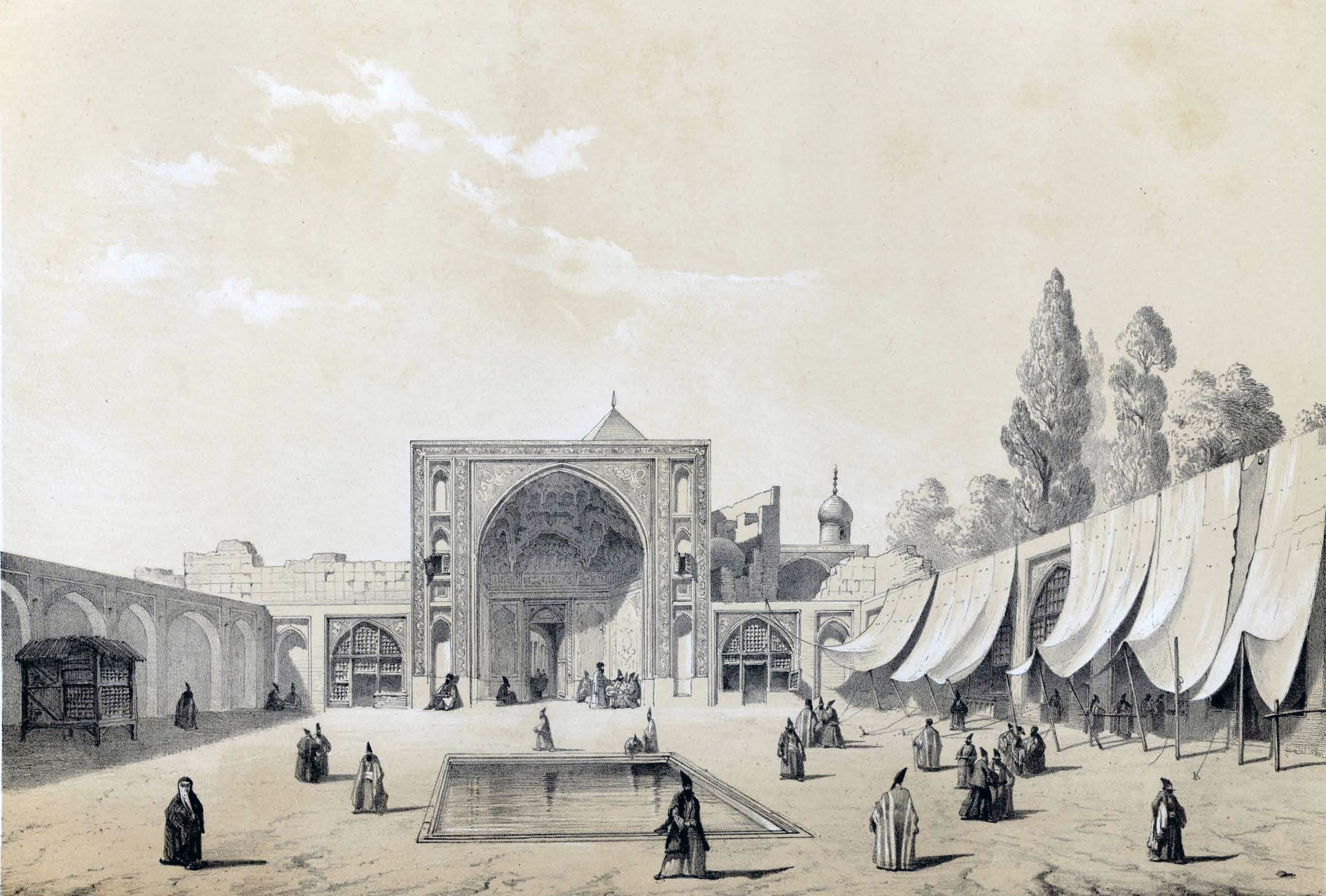
Shah Mosque (Tehran)
Eighteen million bricks. Four hundred seventy-five thousand tiles. These were the materials Fath-Ali Shah Qajar, the second shah of the Qajar dynasty, poured into a mosque designed to announce one message: we belong here. The Qajar family was new to power, and the Shah Mosque, rising from the northern edge of Tehran's Grand Bazaar, was built to make their authority feel ancient and inevitable. At the time of its completion, it was considered the most significant architectural monument in the capital.
A Dynasty's Declaration
The mosque shares architectural DNA with the Vakil Mosque in Shiraz and the Soltani Mosque in Borujerd, all part of a campaign to scatter symbols of Qajar legitimacy across Iran. Its courtyard opens onto several passageways leading into the Grand Bazaar, making it inseparable from the commercial life of the city. Two shabestans, underground prayer halls, extend beneath the structure, offering cool refuge from Tehran's summers. The mosque was added to the Iran National Heritage List on September 23, 1984, but its significance has always been less about architecture than about what happened within its walls.
Sugar, Flogging, and Revolution
On December 11, 1905, the governor of Tehran ordered the public flogging of seventeen prominent bazaar merchants in the mosque's main courtyard. Their offense: the rising price of sugar. The humiliation was intended as punishment, but it became a catalyst. The bazaaris shut their doors in protest. The Grand Bazaar fell silent. What followed was a cascade of public anger that, combined with other grievances, ignited the Persian Constitutional Revolution. The Shah Mosque had been built to project royal authority. Instead, it became the place where that authority was first openly defied.
The Assassination of a Prime Minister
On March 7, 1951, Prime Minister Haj Ali Razmara arrived at the Shah Mosque for a memorial service. He was pro-British and deeply unpopular. As he crossed the grand courtyard, he was shot dead. The assassin was linked to the Feda'iyan-e Eslam, a religious organization with close ties to the merchant class and the clergy. The killing rearranged Iranian politics. Under the subsequent premiership of Mohammad Mosaddegh, the assassin was freed and pardoned by parliament, declared a Soldier of Islam. After the 1953 coup that toppled Mosaddegh, the assassin was re-arrested, tried, and executed in 1955. The mosque's courtyard had hosted a single act of violence that exposed the fractures running through Iranian society.
Names and Their Weight
The mosque has carried different names under different regimes. Originally the Shah Mosque, it was also known as the Soltani Mosque, meaning "royal." After the 1979 Islamic Revolution, it was less commonly renamed the Imam Mosque, though the older name persists in common usage. Names accumulate here the way history does: in layers, each one covering but not erasing what came before. The tiles still gleam. The courtyard still opens onto the bazaar. Merchants still pass through on their way to trade, walking across stones where flogged men fell and a prime minister died.
From the Air
The Shah Mosque is located at 35.676N, 51.422E within the northern section of Tehran's Grand Bazaar complex. From the air, look for the mosque's dome and minarets amid the vast rooftop expanse of the bazaar, one of the largest covered markets in the world. Mehrabad International Airport (OIII) is approximately 9 km to the west-northwest. Imam Khomeini International Airport (OIIE) is about 55 km to the south. Best viewed at 3,000-5,000 feet AGL to see the mosque in its bazaar context.