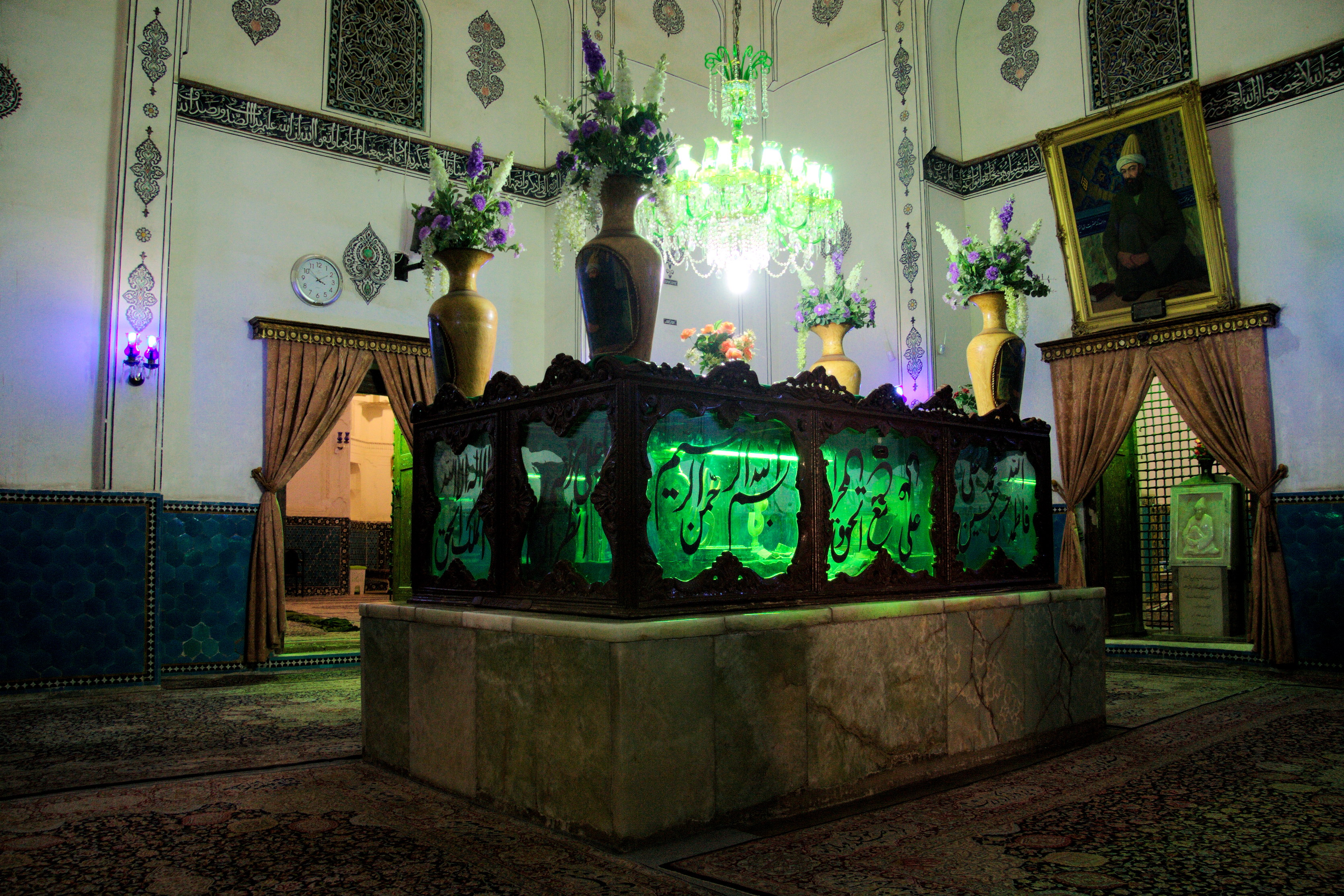
Shah Nematollah Vali Shrine
Count the stars on the dome and you will find something mathematicians rarely encounter in Islamic art: an eleven-pointed star, nested among rings of five, seven, nine, and twelve-pointed companions. The blue girih-tiled dome of the Shah Nematollah Vali Shrine in Mahan, Kerman Province, has confounded and delighted visitors for centuries, its geometric precision a silent argument for the mystical order its occupant spent a lifetime pursuing. Shah Nematollah Vali, the Sufi poet and mystic who died in 1431 reportedly past the age of one hundred, chose this corner of southeastern Iran to live, meditate, and eventually be buried. Five years after his death, a shrine rose over his grave. Nearly six hundred years later, pilgrims still come.
A Mystic's Final Rest
Shah Nematollah Vali was no ordinary holy man. A poet of the Ni'matullahi Sufi order that still bears his name, he spent decades traveling through the Islamic world before settling in Mahan, a small town at the base of the mountains southeast of Kerman. His teachings emphasized love, unity, and the inner path to God -- ideas that attracted followers from across Persia and beyond. When the Bahmanid ruler Ahmed I Vali erected the original sanctuary chamber in 1436, it was already a place of pilgrimage. That first construction anchored what would become a sprawling complex: four courtyards, a reflecting pool, twin minarets sheathed in turquoise tile, and a mosque that successive dynasties expanded and embellished for centuries. Within the complex, a small room marks where Nematollah Vali once spent forty consecutive days and nights in prayer and meditation. Locals call it the Chelleh Khaneh -- the Forty Nights' House.
The Dome That Shah Abbas Rebuilt
In 1601, Shah Abbas I of the Safavid dynasty turned his attention to Mahan. The great empire-builder, who was simultaneously reshaping Isfahan into one of the world's most magnificent cities, ordered extensive renovations of the shrine. His most striking contribution was the reconstruction of the tiled blue dome, which contemporary accounts described as "one of the most magnificent architectural masterpieces in old Persia." The turquoise tilework catches desert light in a way that shifts throughout the day, from pale morning silver to deep afternoon cobalt. Beneath the dome, the girih pattern descends in concentric rings of pointed stars -- five, seven, nine, twelve, eleven, nine, and ten -- each band calculated with mathematical exactitude. That eleven-pointed ring remains one of the rarest configurations in all of Islamic geometric art, a quiet anomaly that rewards close observation.
Courtyards of Power and Devotion
Each courtyard tells the story of whoever built it. The Atabaki courtyard came from Ali Asghar Khan Atabak, chancellor to the nineteenth-century Qajar king Naser al-Din Shah, while the Vakil-ol-Molki courtyard bears the name of Mohammad Esmaeil Ebrahim Khan Nouri. During the Qajar period, the shrine's popularity surged, and the additional courtyards were practical necessities as much as acts of patronage -- more pilgrims required more space. The twin minarets that now define the shrine's silhouette also date from this era. Moving from the street toward the interior, visitors pass through a succession of spaces that narrows and quiets: from the Atabaki courtyard through the Vakil-ol-Molki courtyard, past the Modir-ol-Molki portico, into the shrine itself, then through the Shah Abbasi portico and the Mirdamad and Hosseiniyeh courtyards beyond. Seven ancient wooden doors mark the transitions, each one carved with the craftsmanship of its particular century.
Tiles, Plaster, and the Desert Light
What strikes visitors most is the density of ornamentation. Plasterwork and tile decorations cover nearly every surface of the meditation room where Nematollah Vali prayed. Calligraphy wraps the walls in flowing Naskh and angular Kufic scripts, Quranic verses and mystical poetry intertwined. The Chelleh Khaneh was badly damaged by a flood in 1932, but restorers rebuilt it faithfully, preserving both the spatial dimensions and the decorative vocabulary of the original. Outside, the reflecting pool doubles the minarets against the sky, creating the kind of symmetry that Iranian architects have prized since the Achaemenid period. Mahan sits at roughly 1,800 meters elevation in a landscape where green is rare and water precious. Against that arid backdrop, the shrine's turquoise tiles and garden courtyards feel almost miraculous -- an oasis of color and geometry where the desert yields to human devotion.
From the Air
Located at 30.06N, 57.29E near the town of Mahan in Kerman Province, southeastern Iran. The shrine complex sits at approximately 1,800 meters (5,900 feet) elevation against a mountainous backdrop. The turquoise dome and twin minarets are visible landmarks from the air. Kerman Airport (OIKK) lies roughly 35 km to the northwest. Approach from the west for the best view of the complex against the mountain backdrop. The surrounding terrain is arid desert with scattered irrigated gardens.