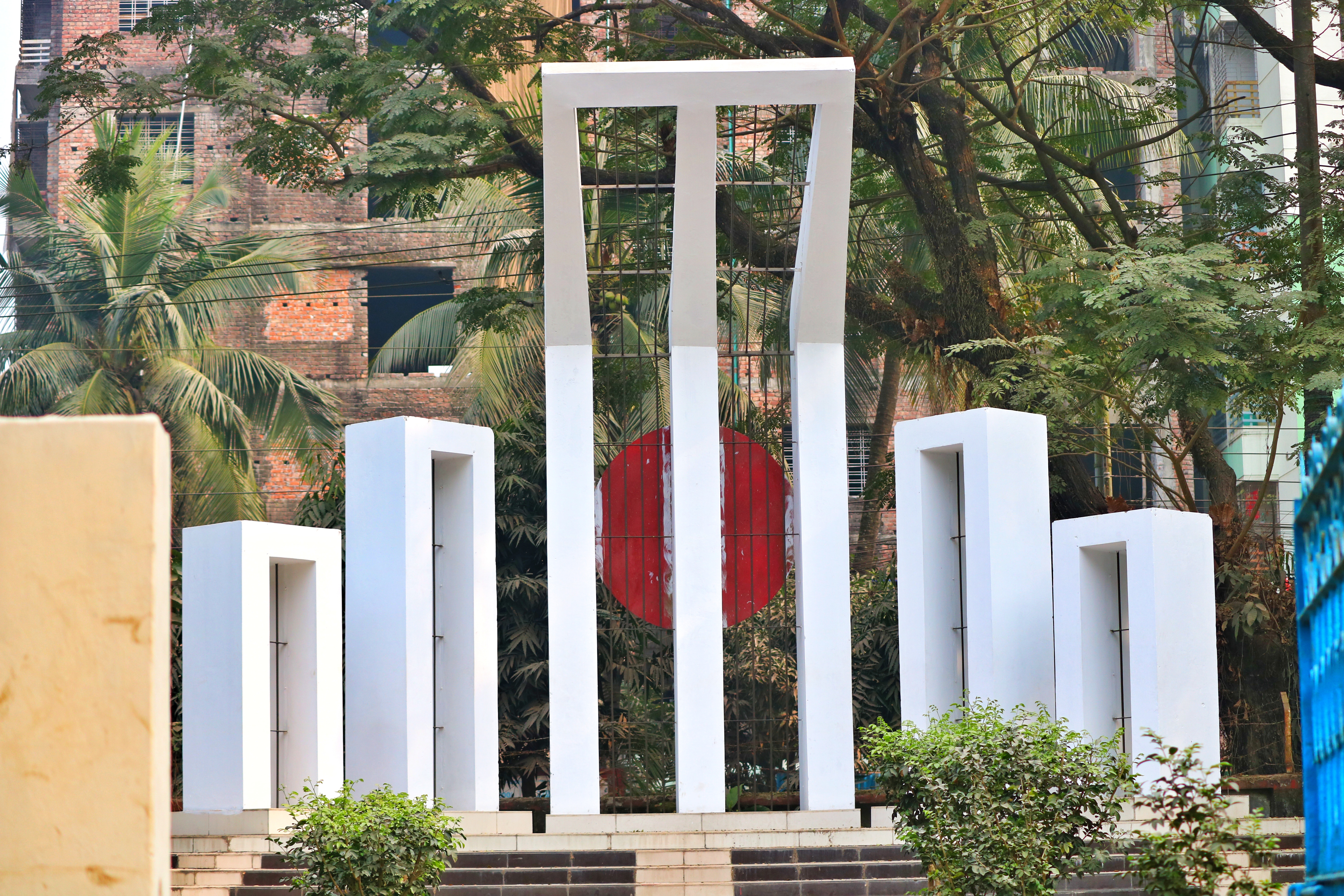
Shaheed Minar, Dhaka
On 21 February 1952, Pakistani police opened fire on unarmed students. The students -- from Dhaka University and Dhaka Medical College -- were marching to demand something that should not have required a protest: that Bengali, the language spoken by the majority of East Pakistan's population, receive official recognition. The bullets killed several protesters near Dhaka Medical College and Ramna Park. Within two days, a makeshift monument stood at the massacre site. That improvised memorial would be destroyed, redesigned, built, destroyed again, and rebuilt -- its turbulent physical history mirroring the political struggle it commemorates.
A Sculptor's Vision
In 1956, a government committee chaired by University of Dhaka Vice-Chancellor Dr. Mahmud Husain and including the artist Zainul Abedin commissioned a permanent monument. The sculptor Hamidur Rahman conceived something far more ambitious than a simple pillar. His design called for a half-circular arrangement of columns symbolizing a mother with her fallen sons on a central dais, the red sun rising behind them. Yellow and deep blue stained glass, representing eyes reflecting sunlight, would fill the columns. The marble floor was calculated to capture the moving shadows cast throughout the day. A 1,500-square-foot fresco depicting the history of the language movement would occupy the basement. Bengali alphabet characters would decorate a railing in front, and two colored footprints -- red and black -- would mark the opposing forces. A library, a museum, and a fountain shaped like an eye completed the plan. Rahman designed every material to withstand the tropical climate. Construction began in November 1957 under the supervision of Rahman and the sculptor Novera Ahmed.
Built, Crushed, Rebuilt
The Pakistani army's response to the monument was blunt. They destroyed it and placed a signboard reading "Mosque" over the rubble -- an act of erasure that attempted to convert a site of Bengali resistance into something innocuous. The destruction only deepened the monument's symbolic power. After Bangladesh's independence in 1971, President Abu Sayeed Chowdhury formed a reconstruction committee in 1972. But the rebuilding was hurried. Workers followed a simplified 1963 design rather than Rahman's original sketch. The column came out shorter than planned, its head bent at the wrong angle, and the proportions of the different elements were not properly maintained. The Shaheed Minar that stands today at fourteen meters of marble is recognizable, powerful, and technically incorrect -- a monument whose imperfect reconstruction has itself become part of the story.
A Hundred Echoes Worldwide
The original stands in Dhaka, but its silhouette has traveled. At least a hundred replicas exist across the world. The first was built abroad in 1997 in Oldham, England. Others followed in Altab Ali Park in London's Whitechapel, in Luton, in four locations across West Bengal including two in Kolkata, in Tokyo in 2005, in Sydney's Ashfield Park, in Toronto in 2021, in Perris, California in 2023, and in Paris -- where a seventy-thousand-euro replica was inaugurated on 8 October 2023, the second in France after one in Toulouse. Not all replicas match the original design, which has generated controversy. A 2014 version at Shahjalal University of Science and Technology drew criticism for its deviations, and in June 2022, Bangladesh's High Court issued a rule requiring formal policies for Shaheed Minar construction.
Every February, Barefoot
Each year on 21 February, Bangladesh centers its national mourning at the Shaheed Minar. The date -- International Mother Language Day, recognized by UNESCO since 1999 -- belongs to the world now, but it belongs to Dhaka first. A famous photograph from 1954 shows Abdul Hamid Khan Bhashani and Sheikh Mujibur Rahman marching barefoot to pay tribute at the original monument, two years after the massacre. That image captures something essential about the site: it is not a place of military triumph or imperial grandeur but of civilian grief transformed into national identity. The language movement that the monument commemorates was one of the formative struggles in Bangladesh's journey to independence, and the Shaheed Minar stands as its physical anchor -- imperfectly rebuilt, widely replicated, and irreplaceable.
From the Air
Located at 23.722N, 90.395E near Dhaka Medical College in central Dhaka. The monument's half-circular column arrangement is distinctive from low altitude. Adjacent to Ramna Park, which provides a green contrast to the dense urban surroundings. Nearest airport is Hazrat Shahjalal International Airport (VGHS), approximately 11 km north. Best viewed at 1,500-2,500 ft AGL.