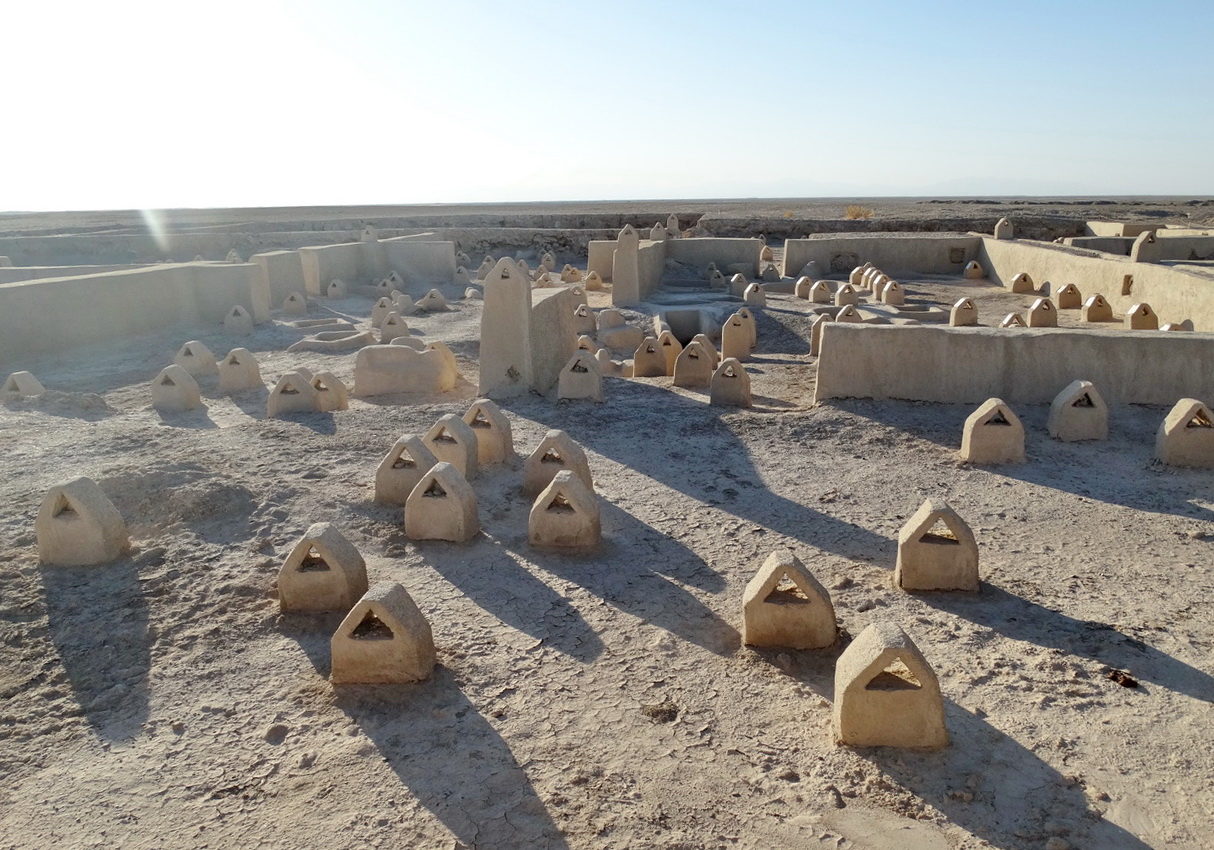
Shahr-e Sukhteh
She was six feet tall, which would have made her remarkable in any era. Buried nearly five thousand years ago in the dust of southeastern Iran, she wore a golden eye -- a hemisphere of bitumen paste overlaid with gold leaf, its iris engraved in a sunburst pattern, held in place by a thread of gold that left permanent grooves in her eye socket. Archaeologists found her in 2006 at Shahr-e Sukhteh, the "Burnt City," a sprawling Bronze Age settlement on the banks of the Helmand River that flourished from roughly 3550 to 2300 BC. The woman and her prosthetic eye are the most famous discovery from a site that keeps rewriting what we know about the ancient world.
A City at the Edge of the Known World
Shahr-e Sukhteh sits near the eastern rim of Iran's Lut Desert, one of the hottest places on Earth. Five thousand years ago, the landscape looked nothing like the barren flats visible today. The Hamun Lake spread wide across the lowlands, marshes teemed with life, and the Helmand River fed a green corridor through what is now Sistan and Baluchistan Province. At its peak around 2850 to 2620 BC, the city covered roughly 120 hectares -- making it one of the largest urban centers on Earth during the dawn of the urban era. Its artifacts show connections to the Indus Valley civilization, to Mundigak in Afghanistan, and to cultures in Turkmenistan, yet the city's character remained stubbornly distinct. Researchers have speculated that Shahr-e Sukhteh may prove the existence of a major Bronze Age civilization east of Mesopotamia that developed independently of it.
Three Burns and a Vanishing
The city's name is not metaphorical. According to archaeologist Massimo Vidale, Shahr-e Sukhteh passed through four stages of civilization and burned down three separate times before its inhabitants finally abandoned it. The Italian archaeological mission that first excavated the site beginning in 1967 originally dated the abandonment to around 1800 BC, but calibrated radiocarbon dating from nearby Tappeh Graziani, conducted by Italian and Iranian teams, pushed that date back to roughly 2300 BC. What caused those fires remains unclear. What caused the final abandonment is equally mysterious -- climate change, shifts in the Helmand River's course, or the collapse of trade networks have all been proposed, but none confirmed. The city simply stopped, leaving behind its dead and its treasures beneath the dust.
Games, Surgery, and Golden Thread
Beyond the golden-eyed woman, the site has produced finds that border on the improbable. The oldest complete board game ever discovered -- a twenty-square game with four dice and twenty-seven geometric pieces -- was unearthed here, and in 2024 scholars published plausible rules for how it was played. A skull found at the site shows clear evidence of brain surgery. Craftsmen in the city's northwestern quarter produced pottery with decorative motifs that evolved dramatically over the centuries, from richly painted wares resembling those of eastern Baluchistan to distinctive gray-paste pottery with black decoration. In the Monumental Area, architectural ruins rise in high hills, while pottery kilns nearby suggest an industrial district. A Bronze Age piece of leather adorned with drawings, discovered in 2015, adds yet another line to a list of firsts that few ancient sites can rival.
Digging Through Empires
British-Hungarian explorer Aurel Stein first identified the site in the early 1900s. Serious excavation began in 1967 under the Italian Institute for Africa and the Orient, continuing until the Iranian Revolution in 1978 forced a halt. Nearly two decades passed before Iranian archaeologist S.M.S. Sajjadi resumed work in 1997. The excavations have revealed a city organized into distinct quarters: an Eastern Residential Area on the site's highest ground, Craftsman Quarters to the northwest, and the Monumental Area between them. Just 50 kilometers to the northeast lies Dahan-e Gholaman, an Achaemenid center from roughly 550 to 330 BC, a reminder that this remote corner of Iran anchored civilization for millennia. UNESCO inscribed Shahr-e Sukhteh as a World Heritage Site in 2014, recognizing a place whose mysteries, even after decades of excavation, still outnumber its answers.
From the Air
Located at 30.60N, 61.33E in Sistan and Baluchistan Province, southeastern Iran. The site lies near the Zahedan-Zabol road on the banks of the Helmand River, close to the eastern edge of the Lut Desert. From altitude, look for the flat archaeological mounds against the arid terrain near the shrinking Hamun Lake. The nearest major airport is Zahedan (OIZH), approximately 150 km to the south. Fly at 5,000-8,000 feet for best visibility of the site's extent against the desert floor.