Shams-ol-Emareh
Naser al-Din Shah Qajar wanted to see his entire capital at once. Before visiting Europe, the fourth shah of the Qajar dynasty had already envied Isfahan's Ali Qapu palace, and he wanted something taller, something that would let him stand above Tehran and take it all in. In 1865, he ordered construction to begin. Two years later, the Shams-ol-Emareh stood finished: five stories, 35 meters tall, the highest building in Tehran and the first in the city to use iron in its structure.
Iron and Ambition
The building was a hybrid by design. Its architect, Ali Mohammed Kashi, and its designer, Moayer al Mamalek, blended traditional Iranian architecture with Western construction techniques. Cast-iron pillars supported the upper floors, a structural innovation for Tehran in the 1860s. Two matching towers rose symmetrically, their windows and tiling executed in an Iranian style that borrowed freely from European influences. The result was a building that belonged fully to neither tradition but announced itself as something new. Before the National Garden gate replaced it in the public imagination, Shams-ol-Emareh served as the symbol of Tehran itself.
The Ministers' Door
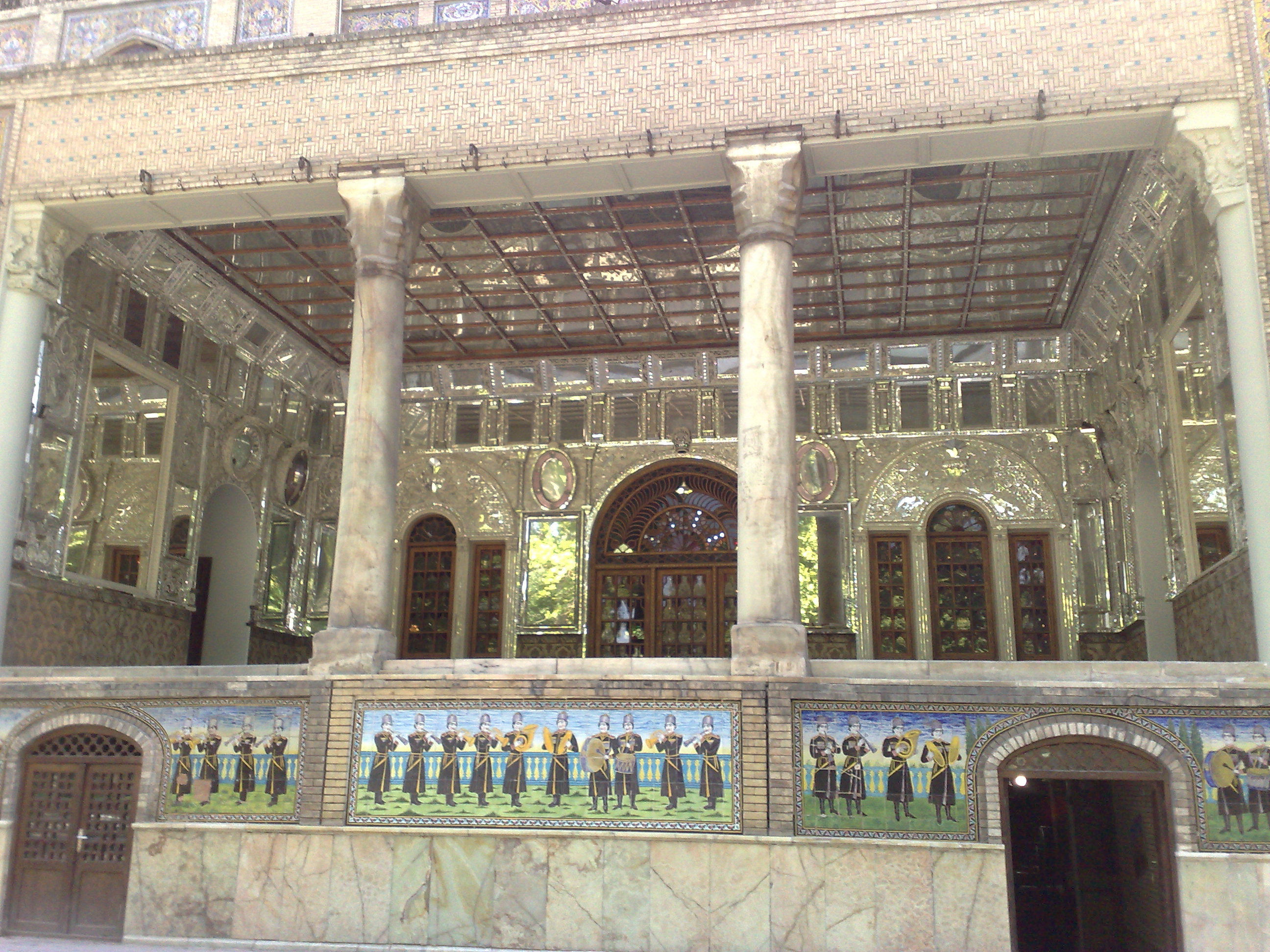
Qajar cabinet meetings took place inside Shams-ol-Emareh, and one entrance acquired a name that stuck: the Ministers' Door. The prime minister's carriage, always accompanied by seven guards, stopped before this particular threshold. It is the only door whose Qajar-era facade still survives. The first floor held the shah's porch and reception hall, covered in ayeneh-kari, the intricate mirror-work that fractures light into hundreds of reflections. Small rooms flanked the hall, each decorated with reticular patterns and miniature paintings, their arrangement described by observers as resembling earrings on a human face.
Queen Victoria's Troublesome Clock
Queen Victoria of the United Kingdom presented Naser al-Din Shah with a clock, and the shah had it mounted atop Shams-ol-Emareh to broadcast the local time across his still-small capital. The plan succeeded too well. The clock's bell rang so loudly that palace residents complained, and the shah ordered the sound reduced. The repair effort backfired. Instead of quieting the bell, it silenced it entirely. For more than a hundred years, the clock sat mute at the top of the building. On November 12, 2012, after extensive restoration work, the bell finally sounded again. A century of silence, ended by a single chime.
Seven Colors on Every Surface
The decorative program of Shams-ol-Emareh tells the story of a culture in conversation with the wider world. Qajar-style haft-rang, seven-color tiling, covers the shah's porch and the building's facade. But the images these Iranian tiles depict are European natural landscapes and Western architecture. Marble column bases bear highlighted motifs of plants and animal faces, and scholars believe these carvings date from different periods, suggesting the building was embellished and re-embellished over decades. Repairs concluded in 1997, and the ground floor opened to visitors in 1999, offering a close look at a building that blends East and West not as theory but as practice.
From the Air
Shams-ol-Emareh is located at 35.679N, 51.422E on the eastern side of the Golestan Palace complex in central Tehran. The twin towers are identifiable from the air within the palace grounds, which appear as a green rectangle amid dense urban development. Mehrabad International Airport (OIII) is approximately 9 km to the west. Best viewed at 2,000-4,000 feet AGL for detail on the palace complex and its relationship to the surrounding Grand Bazaar.