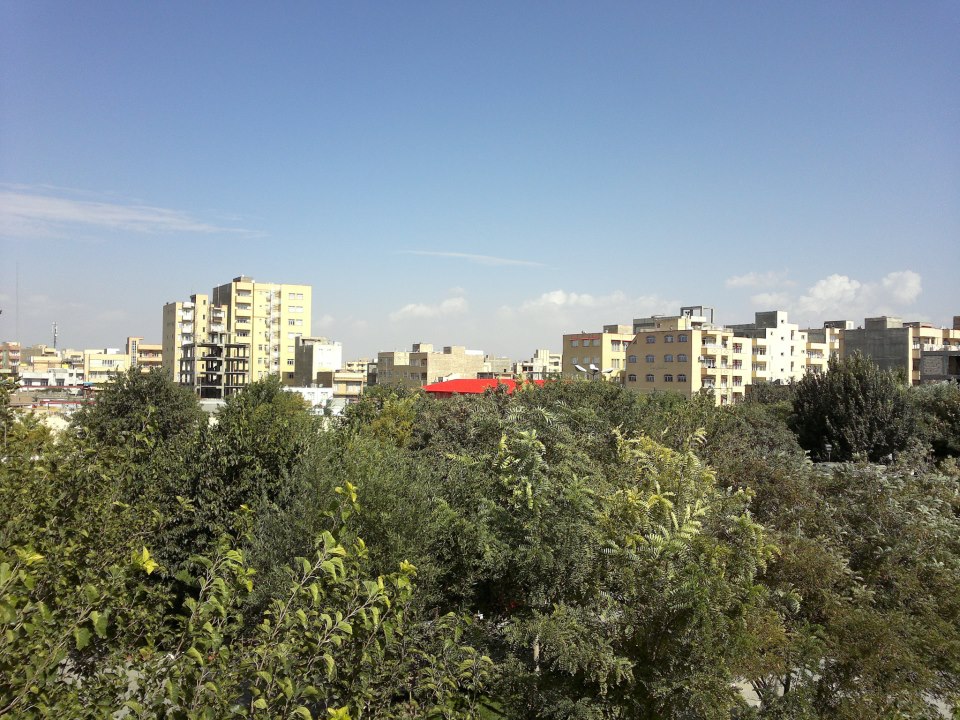
Shanb Ghazan: The Mongol Satellite City
It started as a village called Shanb. In 1290, under the Mongol ruler Arghun Khan -- a Buddhist -- the village was transformed into a town called Arghuniyye, complete with a Buddhist temple and a palace. When Arghun's successor Mahmud Ghazan took power, the settlement evolved further into Ghazaniya, a satellite city on the western edge of Tabriz. At its center rose a dome 135 meters tall, the tomb of Ghazan Khan himself, surrounded by twelve public institutions built on all twelve sides. The dome astonished everyone who saw it. Within three centuries, earthquakes had buried it all.
Twelve Institutions Around a Dome
Ghazan Khan began construction of his tomb, the Qubba-ye-Aali (Big Dome), in late 1297. He was a ruler who believed in benevolence as policy, and the dome was not meant to stand alone. Around it he ordered the construction of twelve public institutions: a congregational mosque, a khanqah for Sufi devotions, a Hanafi school, a Shafi'i school, a Dar Al Siyadah, an astronomical observatory, a hospital, a library, a Beit Al Qanun (house of law), a Beit-al-Motavalli (house of trustees), a pool house, and a bathhouse. An orphanage and a medical facility called the Hakimiyya stood nearby. This was a planned city-within-a-city, designed to serve every dimension of public life.
Gateway to Tabriz
Ghazan Khan decreed that foreign merchants entering Tabriz must first pass through and stay in Shanb-e-Ghazan. The requirement turned the neighborhood into a commercial gateway, filled with traders arriving from across the Mongol Empire and beyond. Tax revenues from the province of Ojan and surrounding villages were directed to Ghazaniya, along with one-tenth of all goods entering the treasury. The medieval geographer Mostofi, in his work Nuhzat al-Qoloub, described the result as a town unique throughout Iran. The combination of the towering dome, the ring of institutions, and the steady flow of international commerce made Shanb-e-Ghazan a showcase of Ilkhanid ambition.
Empires Fight Over the Ruins
In later centuries, the neighborhood's strategic position made it a battlefield. When the Ottoman general Pargali Ibrahim Pasha, minister to Suleiman the Magnificent, occupied Tabriz, he built a castle in Shanb-e-Ghazan. The Safavids and Ottomans traded control of the site for decades. Shah Abbas I eventually ordered the destruction of most of the Ghazani buildings to deny the Ottomans any incentive to garrison there -- sparing only the tomb, the mosque, the khanqah, and probably one of the schools. What the armies left standing, the earthquakes took. The tremors of 1641, 1650, and 1721 reduced the neighborhood further. The earthquake of 1780 buried what remained.
A Neighborhood of Ghosts
The neglect of subsequent Qajar and Pahlavi governments completed the erasure. The antiquities of Shanb-e-Ghazan were gradually despoiled, carried off, or simply allowed to crumble. Today, the historical neighborhood contains almost no visible historical remains -- just a bathhouse and scattered tiles. The 135-meter dome that once marked the Tabriz skyline, the twelve institutions that served an entire city, the Buddhist temple built by a Mongol khan who had not yet converted to Islam -- all gone. The progression from village to temple town to satellite city to imperial showpiece to battlefield to rubble is a compressed history of how power builds, destroys, and abandons. What Ghazan Khan raised in ambition, time and tectonics brought down.
From the Air
Located at 38.08N, 46.24E on the western edge of Tabriz, East Azerbaijan Province, Iran. The neighborhood occupies an area that was once a distinct satellite settlement but is now absorbed into the modern city. Tabriz International Airport (OITT) lies roughly 10 km to the northwest. From altitude, no trace of the medieval complex is visible -- the neighborhood appears as standard urban development. The surrounding terrain shows the broad valley of Tabriz ringed by mountains.