Shandong Museum
It started with a Baptist missionary and a collection of curiosities in Qingzhou. In 1887, John Sutherland Whitewright established the Yidu Museum in that small Shandong city, beginning a tradition of collecting and preserving the region's material heritage that would outlast the dynasty, the revolution, and the missionary movement itself. Today, the Shandong Museum occupies a building of 82,900 square meters in Jinan and houses more than 210,000 historical artifacts -- one of the largest museum collections in China. Its holdings span the full sweep of Shandong's history, from Neolithic pottery to Qing-dynasty paintings, with a detour through the Cretaceous period courtesy of a fossil skeleton that dwarfs everything else in the building.
From Qingzhou to Jinan
The museum's journey across Shandong tracks the province's own modern history. After Whitewright founded the Yidu Museum in Qingzhou, the collection moved to Jinan in 1904 and was renamed Guangzhi Yuan. In 1942, it expanded into a building in the compound of the Red Swastika Society on Shangxin Street. When the Shandong Provincial Museum was formally established in 1954, the historical artifacts stayed in the Red Swastika compound while the Guangzhi Yuan continued to house the natural history collection. A new building opened in October 1992 near Thousand Buddha Hill, and then a significantly larger facility -- the current museum -- opened to the public on November 16, 2010, on Yaojia Street in the Lixia District. With each move, the collection grew and the museum's ambitions expanded.
Five Thousand Years in One Building
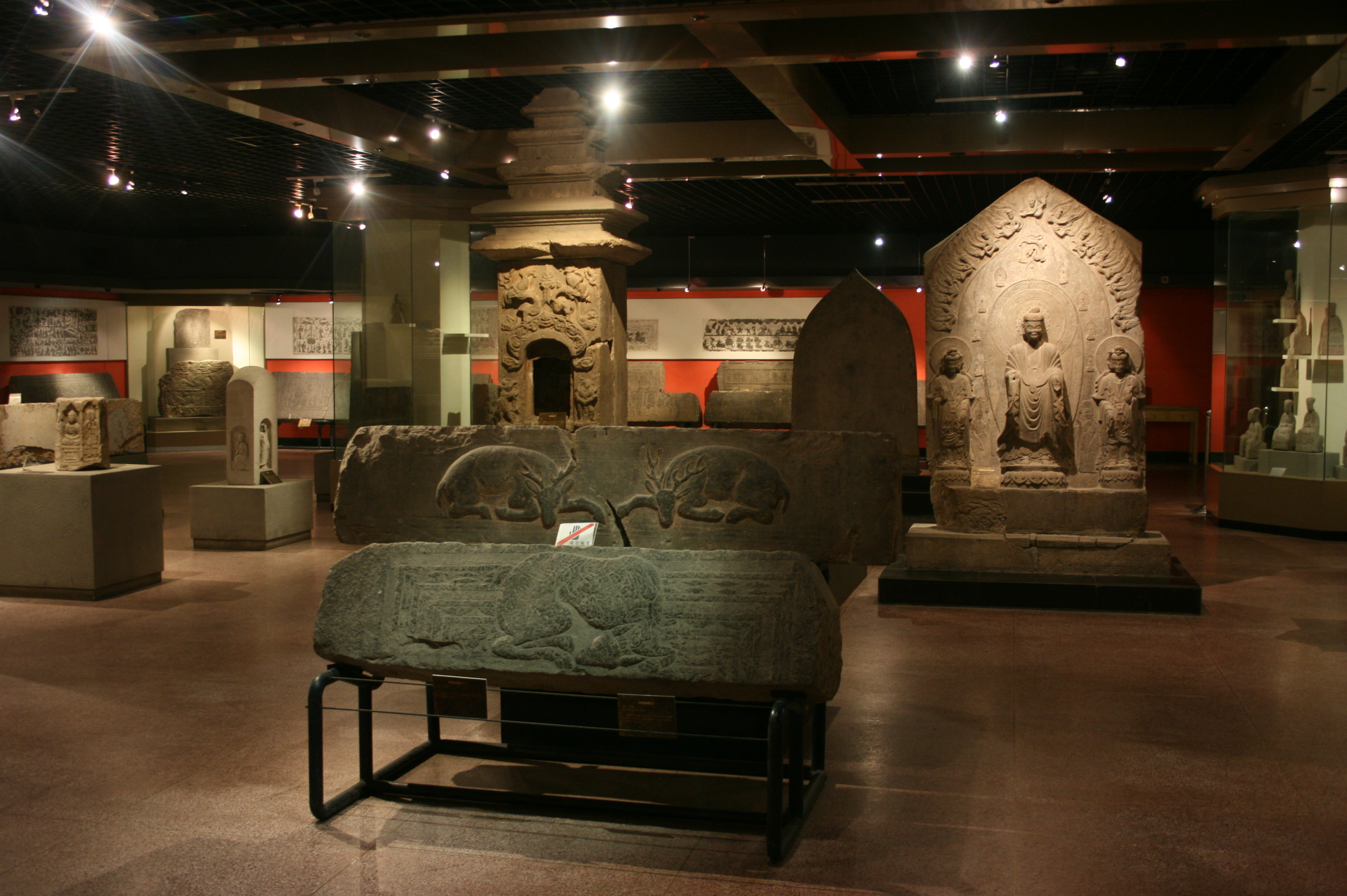
The historical collection anchors the museum. Relics from the Neolithic Dawenkou and Longshan cultures represent Shandong's earliest known civilizations -- the same cultures whose sites at Chengziya and Daxinzhuang rewrote the understanding of Chinese origins. Bronze artifacts from the Shang and Zhou dynasties trace the rise of metallurgy and state power. Stone carvings from the Han dynasty document the visual culture of an empire at its height. Paintings from the Ming and Qing dynasties capture the refinement of China's last imperial centuries. The collection is not merely comprehensive; it is geographically coherent, telling the story of one province's relationship to the larger arc of Chinese civilization.
The Dinosaur in the Room
The natural history section provides a dramatic change of scale. Shandong is one of China's richest regions for vertebrate paleontology, and the museum's fossil collection reflects this. The star specimen is a skeleton of Shantungosaurus, one of the largest known hadrosaurs -- a duck-billed dinosaur that lived during the Late Cretaceous period. Standing in the gallery next to its reassembled bones, the Neolithic pottery in the adjacent wing feels very recent indeed. Fossils from Shanwang, a site renowned for its exceptionally preserved Miocene-era specimens, round out the natural history holdings. The juxtaposition of a 70-million-year-old dinosaur and a 5,000-year-old pot, separated by a few gallery walls, gives the museum a temporal range that few institutions can match.
A Missionary's Unlikely Legacy
John Sutherland Whitewright came to Shandong as a religious emissary, not an archaeologist or a museum curator. But the institution he founded in 1887 set in motion a tradition of preservation that would survive every upheaval the province experienced over the following century and a half. The Red Swastika Society compound, the Guangzhi Yuan, the buildings near Thousand Buddha Hill, the current facility on Yaojia Street -- each chapter of the museum's physical history reflects the political and cultural moment that produced it. What remained constant was the impulse to collect, preserve, and display the material evidence of Shandong's past. That impulse began with a British missionary in a small provincial city, and it now sustains one of China's great museums.
From the Air
Located at 36.659°N, 117.096°E in the Lixia District of Jinan, southeast of the city center. The museum's large modern building is visible from the air as a substantial structure in an urban setting. Nearest airport is Jinan Yaoqiang International Airport (ZSJN), approximately 25 km northeast. Thousand Buddha Mountain is visible to the southwest as a nearby landmark. Elevation approximately 50 meters above sea level.