Shanhua Temple
Shanhua Temple has endured the kind of history that destroys most buildings several times over. Founded during the Kaiyuan period of the Tang dynasty -- sometime between 713 and 741 AD under Emperor Xuanzong -- the temple was originally called Kaiyuan Temple. It survived the fall of the Tang, lost most of its buildings during the chaos of the Five Dynasties period, was rebuilt under the Liao, damaged again when the Jin dynasty seized power in 1120, and spent fifteen years being painstakingly repaired starting in 1128. By the late 18th century, one of its halls had been used as a camel stable, and the wall had collapsed. And yet, three original halls still stand.
The Survivors on the North-South Axis
Shanhua Temple's three surviving structures -- the Daxiongbao Hall, the Sansheng Hall, and the Main Gate -- are arranged along a north-south axis in the traditional Chinese Buddhist temple configuration. Two rebuilt pavilions flank the Sansheng Hall to the east and west. The Daxiongbao Hall, the largest and northernmost building, dates from the 11th-century Liao dynasty, making it one of the oldest wooden temple halls in China. The Main Gate and Sansheng Hall were extensively renovated during the Jin dynasty and are classified by architectural historians as Jin-era buildings. Together they span roughly four centuries of continuous religious and architectural evolution.
Five Buddhas in the Great Hall
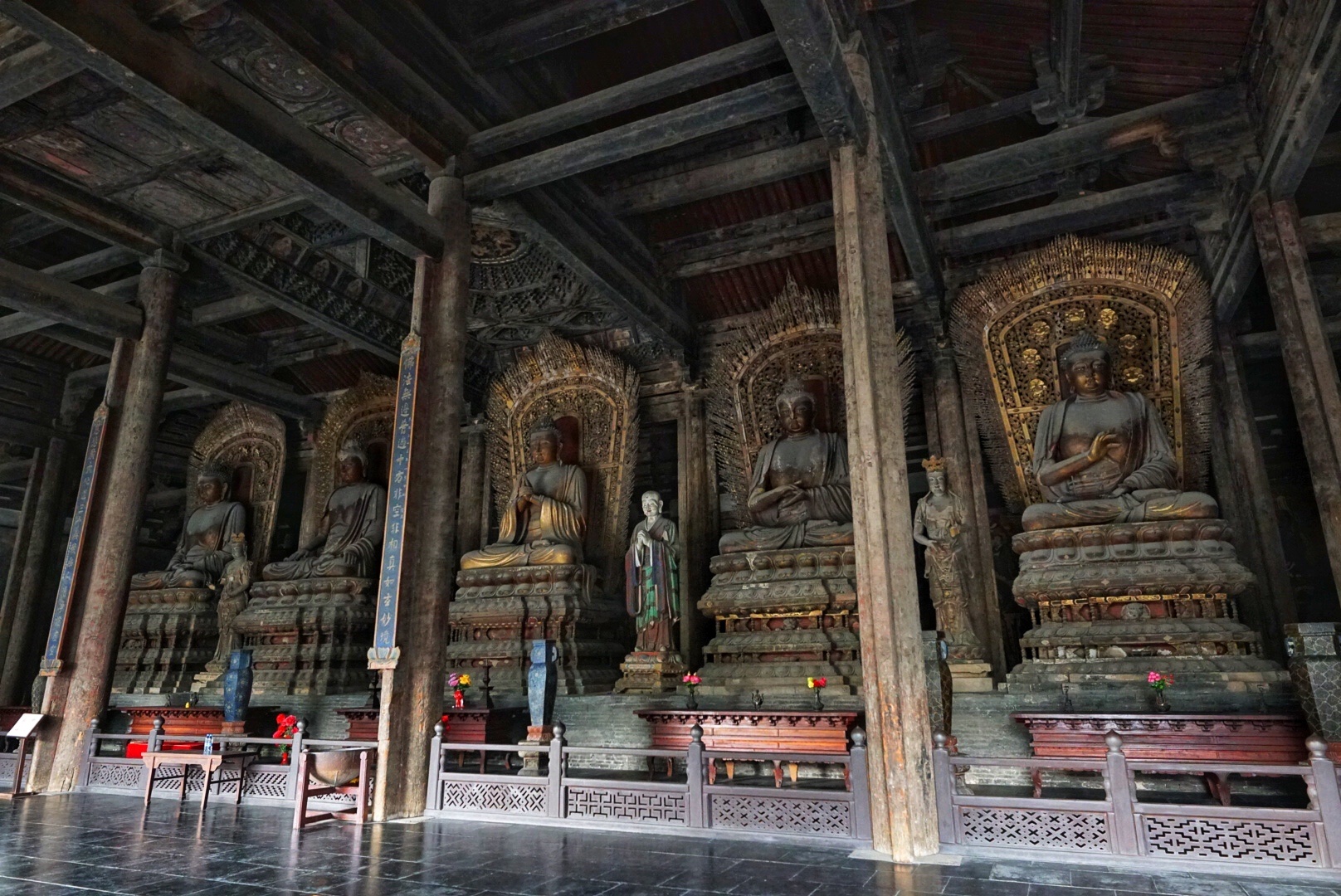
The Daxiongbao Hall measures seven by five bays -- 40.5 by 25 meters -- and sits on an elevated platform three meters above the surrounding courtyard. Its bracket sets follow the standards laid out in the Yingzao Fashi, the 11th-century Chinese architectural treatise, ranking at the fifth level in a system of eight. Inside, Jin dynasty statues of the Five Tathagatas command the central space: Mahavairocana, Amoghasiddhi, Amitabha, Akshobhya, and Ratnasambhava, the five Buddhas of Chinese Esoteric Buddhist tradition. Above them, an octagonal caisson ceiling, painted and decorated, creates a canopy of geometry and color. The hall's 190 square meters of murals date from 1708 to 1716 but have suffered damage over the centuries.
The Three Sages and the Hidden Floor
The Sansheng Hall houses three statues representing the sages of the Avatamsaka Sutra: a central Vairocana flanked by Manjusri and Samantabhadra. The hall achieves its open interior through an unusual structural choice -- very few central pillars, with the weight carried instead by complex rafters and sixth-rank brackets that span the space overhead. West of the Sansheng Hall stands the Puxian Pavilion, which hides a secret: while it appears from outside to have only two stories, it actually contains three, with the second floor concealed from exterior view. The pioneering Chinese architect Liang Sicheng examined the pavilion in the 1930s and documented its heavily damaged state before it was destroyed during World War II and rebuilt in 1953.
Names That Mark the Centuries
The temple's changing names trace the political upheavals of northern China. It was Kaiyuan Temple under the Tang, Da Pu'ensi during the Five Dynasties, and only received its current name, Shanhua Temple, in 1445, when a monk named Dayong received an imperial presentation of sutras. Each renaming marks a moment when a new authority claimed the site, layered its own identity onto the buildings, and left just enough of the previous era intact to keep the chain of history unbroken. From the air, the temple compound reads as a cluster of traditional rooflines within Datong's old city walls, its north-south axis pointing like a compass needle between the past and whatever comes next.
From the Air
Located at 40.09°N, 113.29°E within the walled old city of Datong, Shanxi Province. The temple is near Huayan Temple and the Prince's Palace. Nearest airport is Datong Yungang Airport (ZBDT). The temple's north-south oriented halls are visible as traditional rooflines within the old city grid.