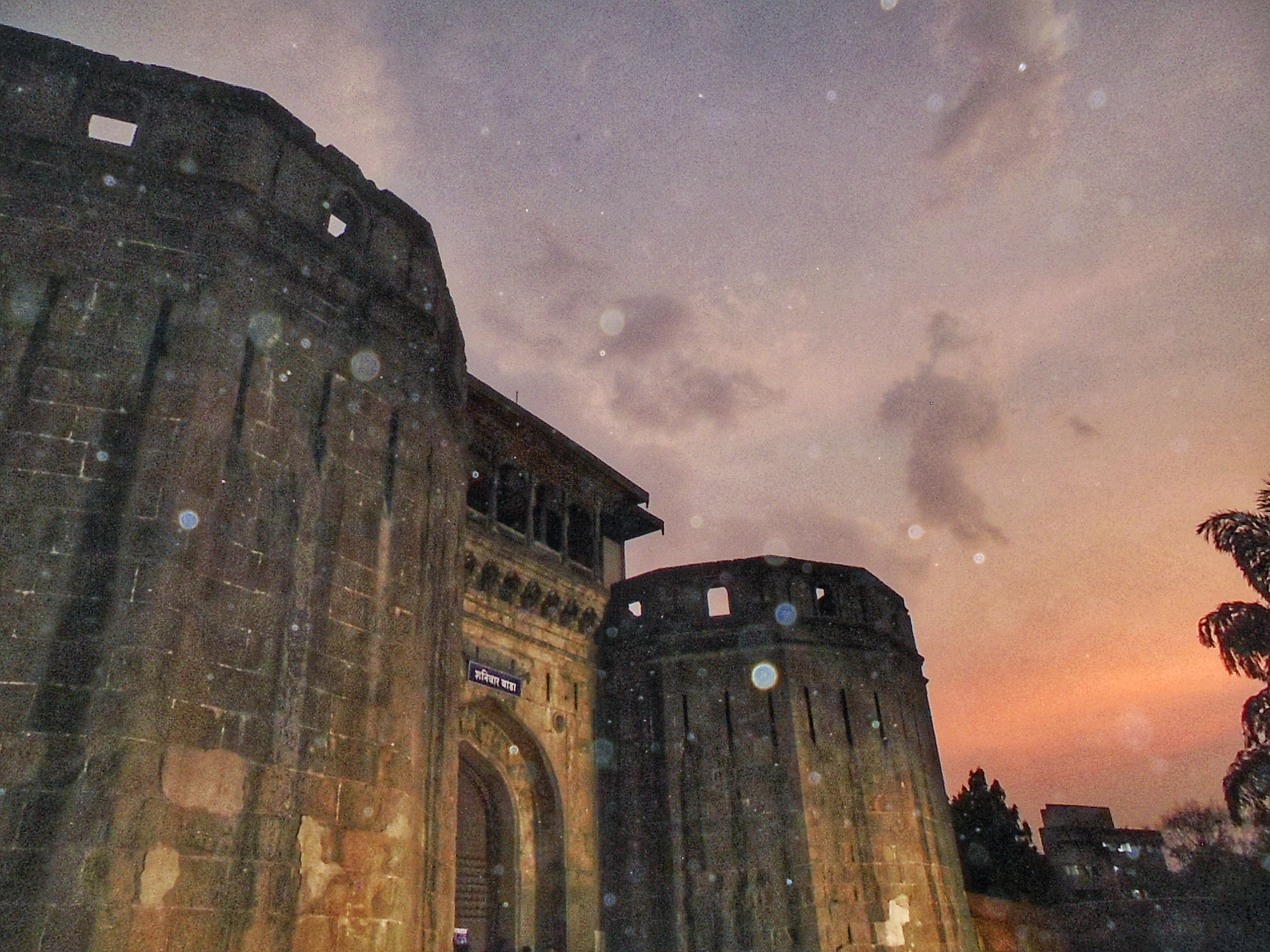
Shaniwar Wada
"Kaka mala vachava" -- Uncle, save me. Locals in Pune say you can still hear the plea on full moon nights, drifting from behind the massive granite walls of Shaniwar Wada. The voice belongs to Narayanrao, the fifth Peshwa of the Maratha Empire, who was murdered inside these walls in 1773 on orders from his own uncle. Whether you believe in ghosts or not, the story captures something true about this place: Shaniwar Wada has always been where power and betrayal lived under the same roof.
Built on a Saturday, Built on Ambition
Peshwa Baji Rao I, prime minister to Chhatrapati Shahu, laid the foundation stone of his residence on Saturday, January 10, 1730 -- hence the name Shaniwar Wada, from the Marathi words for Saturday and residence. He intended the entire structure in stone, but the rulers at Satara objected: only the Chhatrapati himself could sanction a stone monument. An official letter forced the Peshwas to build the remaining six stories in brick. Teak came from the jungles of Junnar, stone from the quarries of Chinchwad, lime from the belts of Jejuri. The palace was completed by January 22, 1732, at a cost of 16,110 rupees -- a fortune for the era. The opening ceremony fell on another Saturday, chosen for its auspiciousness. Over the following decades, the Peshwas expanded the complex with fortification walls, nine bastion towers, five gates, fountains, and court halls, transforming it into the administrative heart of the Maratha Confederacy.
Splendor Lost to Flame
At its peak, the palace stood seven stories tall, crowned by the Meghadambari -- the Peshwa's private quarters, from which the spire of the Jnaneshwar temple at Alandi, 17 kilometers distant, was visible. The interiors were extraordinary. Doorways featured carved teak arches, and ornamental pillars shaped like cypress trunks supported ceilings covered in intricate teak tracery of creepers and flowers. Glass chandeliers hung above polished marble floors adorned with Persian rugs. Paintings from the Ramayana and Mahabharata lined the walls. The Hazari Karanje -- the Fountain of a Thousand Jets -- was designed as a sixteen-petal lotus, each petal bearing sixteen water jets with eighty-foot arcs. A Maratha naval admiral who visited in 1791 described the scene simply: "Very magnificent. A hundred dancers can dance here at a time." Then, on February 27, 1828, ten years after the last Peshwa surrendered the palace to the British East India Company, a fire broke out. It burned for seven days. When it finally died, only the granite ramparts, the teak gateways, and the deep foundations survived.
Murder in the Inner Chambers
By 1758, more than a thousand people lived within the fort's walls. The palace had become a world unto itself -- a place of lavish courtly life, political maneuvering, and deadly intrigue. The darkest chapter came in 1773. Narayanrao, the young fifth Peshwa, was assassinated by palace guards acting on orders from his uncle Raghunathrao and aunt Anandibai. His body was carried out through the southern gate, which thereafter bore his name: the Narayan Darwaja. The murder was not a quiet affair. It fractured the Maratha court and set off a succession crisis that would weaken the empire in the decades that followed. The tale of Narayanrao's ghost calling out for help has persisted for over two centuries, making Shaniwar Wada one of the most reputedly haunted places in India. The cries, whether real or imagined, speak to a history that refuses to be forgotten.
What the Walls Remember
Today, the perimeter fortification still stands with its five gateways and nine bastion towers, enclosing a garden where the foundations of vanished buildings trace the outlines of former grandeur. The main entrance, the Delhi Darwaza, retains its original pointed iron spikes -- defenses against war elephants. Inside, the base of the Hazari Karanje fountain remains visible. In Pune, the palace still anchors the city's identity. The 2015 Bollywood film Bajirao Mastani brought the Peshwa story to a global audience, and local dance festivals continue to use the Wada as a stage. But the most powerful experience here is standing among the ruins and imagining seven stories above you, filled with carved teak, painted walls, and the sound of a thousand water jets arcing in the sunlight -- all of it vanished in seven days of flame.
From the Air
Located at 18.519N, 73.855E in the heart of Pune, along the Mula-Mutha River in Kasba Peth. Best viewed at 2,000-3,000 feet AGL. The fort's surviving granite walls and garden complex are visible from the air. Nearest airport is Pune Airport (VAPO), approximately 10 km southeast. Mumbai's Chhatrapati Shivaji International Airport (VABB) is about 150 km northwest.