Shantar Islands National Park
For eight months of the year, ice locks the Shantar Islands away from the world. The surrounding Sea of Okhotsk freezes so thoroughly that the only reliable visitors are ribbon seals hauled out on the floes and the occasional Kamchatka brown bear padding across the ice from the mainland. When the brief subarctic summer finally arrives, the thaw releases something extraordinary: bowhead whales surface in the straits, Steller's sea eagles wheel above the cliffs, and Blakiston's fish owl -- the largest owl on Earth -- hunts salmon in the island rivers. This is Shantar Islands National Park, a 515,000-hectare sanctuary off the coast of Khabarovsk Krai in Russia's Far East, where the remoteness that once attracted whalers and fur trappers now serves as the islands' greatest protection.
An Archipelago Untethered
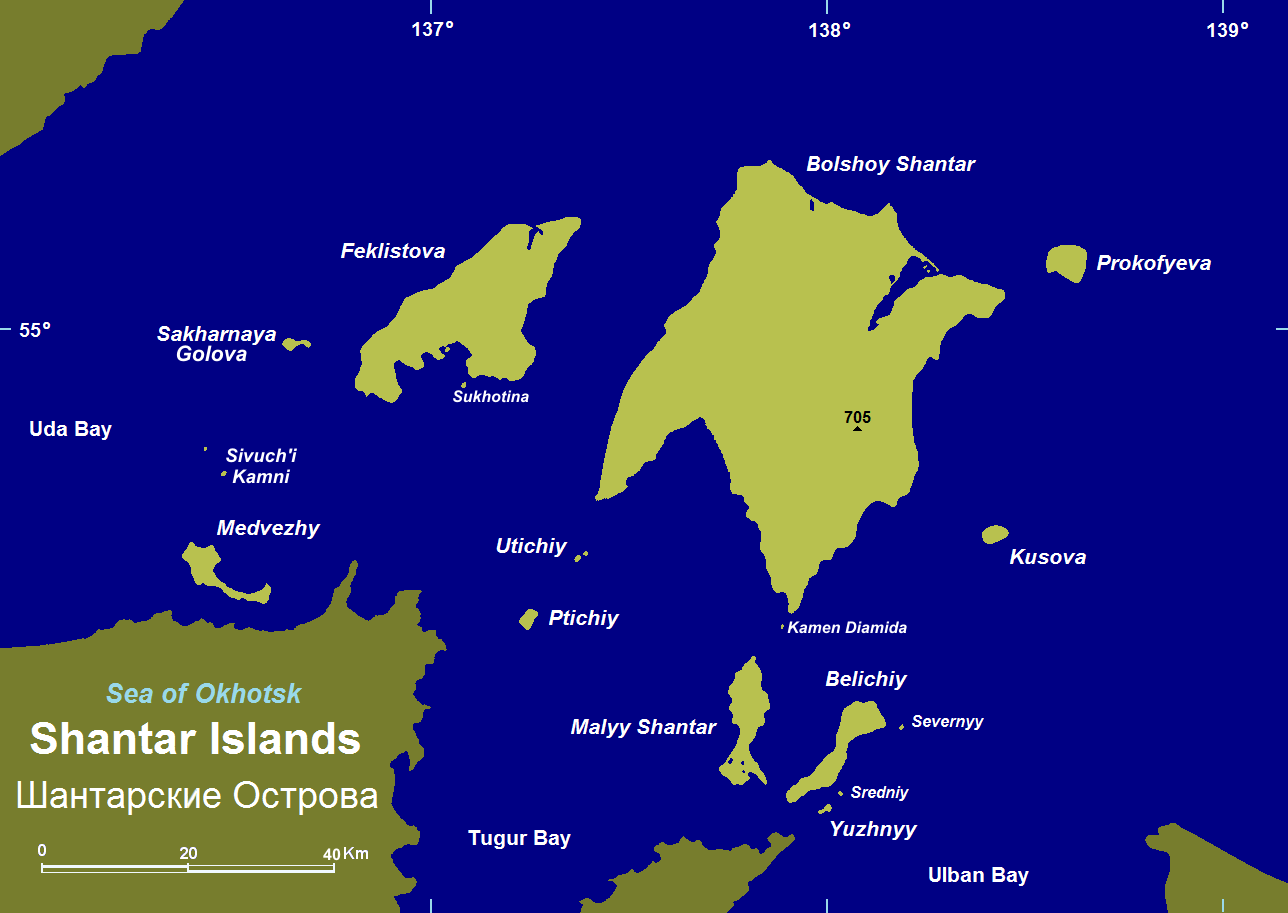
The Shantar Islands sit on the eastern side of Uda Bay, fifteen islands and dozens of rocky outcrops rising from waters where tides swing between five and eight meters and fog is a near-constant companion. Two islands dominate the group: Bolshoy Shantar, roughly 30 by 45 miles and accounting for most of the park's terrestrial area, and Feklistova Island to its west. Until nine or ten thousand years ago, the islands were connected to the mainland, which explains why their forests of Siberian spruce, larch, cedar, and birch contain no endemic plant species. The wildlife, though, has made the most of the isolation. Over 240 bird species live on or pass through the archipelago, and the surrounding waters host gray whales, minke whales, belugas, killer whales, and the critically endangered bowhead whale.
Whales and Whalers
American whaleships first appeared among the Shantar Islands in 1852, drawn by reports of bowhead whales in the bays to the south and west. For more than half a century they anchored under the lee of Bolshoy Shantar and Feklistova, sending whaleboats into Uda, Tugur, and Ulban bays. The islands offered wood and fresh water but exacted a price: at least four ships wrecked on the archipelago, including two on Bolshoy Shantar during gales in October 1858 and August 1907. The whaling era ended, but the bowheads it nearly extinguished still return to these waters -- one of the few places in the western Sea of Okhotsk where the species can reliably be seen. Their recovery, slow and uncertain, is among the reasons the park exists.
From Reserve to National Park
The islands were designated a state nature reserve in 1999, and except for a meteorological station and occasional scientific camps, they have been uninhabited since. In 2013, Russian scientists and conservationists, supported by the World Wildlife Fund, elevated the designation to a federal national park. The stated purpose was direct: protect vulnerable species, guard against poaching, and support scientific study and ecological tourism. In 2017, the park adopted zoning regulations that banned all economic activity within core areas, while fishing was prohibited one to three miles offshore to shield salmon spawning grounds. The park remains a work in progress -- infrastructure is minimal, rules are still being developed -- but the framework is deliberately cautious, designed around the principle that what makes the Shantar Islands valuable is precisely their emptiness.
A Living Laboratory
The subarctic climate classifies as Dwc on the Koppen scale: long, cold winters and short, cool summers. Yet these harsh conditions sustain an improbable richness. The cool, fertile waters of the Sea of Okhotsk -- designated WWF Maritime Ecoregion 204 -- support enormous fisheries and bird colonies. On land, brown bears share the islands with caribou, sable, red fox, and river otter. The rivers run thick with salmon and sturgeon. The birdlife ranges from the massive Steller's sea eagle, with its distinctive orange beak and nearly eight-foot wingspan, to colonies of tufted puffins, thick-billed murres, and the rare Aleutian tern. Threats persist -- a proposed tidal power station, increasing tourism, the legacy of illegal logging -- but for now, the Shantars remain one of the most biologically intact island ecosystems in the North Pacific.
From the Air
Located at 55.00N, 137.50E in the Sea of Okhotsk off the coast of Khabarovsk Krai, Russia. The archipelago is extremely remote with no airports on the islands. Nearest airport is likely Chumikan or Nikolayevsk-on-Amur (UHNN). Approach from the west over Uda Bay for dramatic views of the rugged cliffs and forested islands. Best altitude 5,000-8,000 ft to appreciate the full archipelago spread. Fog is frequent; clear days reveal the contrast between dark coniferous forest and turquoise subarctic waters.