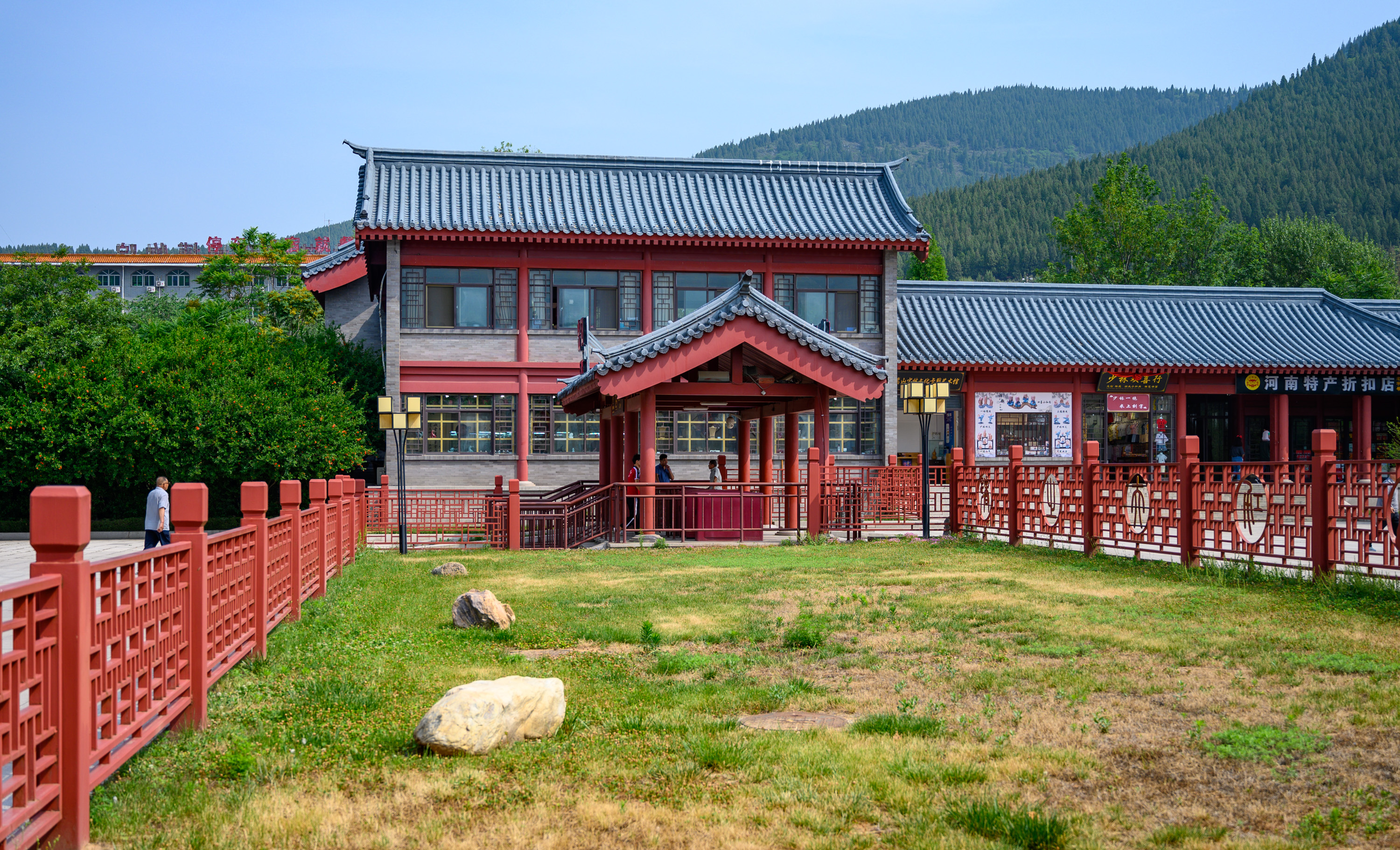
Shaolin Monastery
No monastery in the world carries quite the same double identity. Shaolin is simultaneously one of the most important Buddhist institutions in Chinese history -- the birthplace of Chan Buddhism, the school that would spread to Japan as Zen -- and the most famous martial arts training ground on Earth. These two reputations are not accidents of marketing. They grew from the same root, planted in 495 AD when Emperor Xiaowen of the Northern Wei dynasty established a monastery at the foot of Wuru Peak in the Songshan mountain range, about 48 kilometers southeast of his capital at Luoyang.
Where Meditation Met Movement
The traditional account credits the Indian monk Bodhidharma with bringing Chan Buddhism to Shaolin in the early sixth century. Whether or not the details are historically precise, the association transformed the monastery into the founding house of a Buddhist tradition that emphasized direct experience over scriptural study. Chan's practice of prolonged seated meditation may have been what first connected the monastery to physical training -- monks needed strong, flexible bodies to endure hours of stillness. Over centuries, this connection deepened into the elaborate system of martial arts that bears the monastery's name. By the Tang dynasty, Shaolin monks had earned a military reputation. In 621, thirteen monks fought alongside Li Shimin, the future Emperor Taizong, in his campaign to establish the Tang dynasty. Their reward was imperial recognition, land, and permission to maintain a fighting force.
Cycles of Ruin and Renewal
Shaolin's 1,500-year history is a story of repeated destruction and stubborn resurrection. The monastery was sacked during anti-Buddhist persecutions, burned by warlords, and devastated during the Cultural Revolution when monks were forced to leave and buildings were damaged. The worst modern blow came in 1928, when warlord Shi Yousan set fire to the monastery, destroying many irreplaceable texts and structures in a blaze that burned for over 40 days. Each time, the monastery rebuilt. The current complex, extensively restored since the 1980s, houses multiple halls, training grounds, and the famous Pagoda Forest cemetery of memorial stupas. Its inclusion as part of the Historic Monuments of Dengfeng UNESCO World Heritage Site in 2010 cemented its status as a protected cultural treasure.
The Kung Fu Factory
The 1982 film Shaolin Temple, starring a young Jet Li, turned the monastery into a global brand. Thousands of martial arts schools sprouted in the surrounding area of Dengfeng, training tens of thousands of students from China and abroad. The monastery itself became one of Henan's top tourist destinations, drawing millions of visitors annually. This commercialization has been controversial. Critics accuse the monastery's leadership of prioritizing revenue over spiritual practice, pointing to the monastery's registered trademarks and business ventures. Defenders argue that commercial success funds preservation and keeps alive a tradition that might otherwise have been lost entirely. The tension between sacred institution and cultural industry defines modern Shaolin as much as the tension between meditation and martial arts defined the ancient one.
Sacred Ground on Mount Song
Mount Song itself had been considered sacred long before Shaolin existed. By the first century BC, it was proclaimed one of the Five Holy Peaks of China. The monastery sits in a valley at the foot of Wuru Peak, sheltered by forested slopes that still convey a sense of remoteness despite the tourist infrastructure. Walking the grounds, visitors pass through a sequence of halls along a central axis -- the Hall of Heavenly Kings, the Mahavira Hall, the Dharma Hall -- each rebuilt after various destructions but maintaining the spatial logic of the original layout. The monastery stands 72 kilometers southwest of Zhengzhou, the modern capital of Henan province, close enough for day trips yet deep enough in the mountains to feel like a different world.
From the Air
Located at 34.508N, 112.937E at the foot of Wuru Peak in the Songshan mountain range, Dengfeng county, Henan province. The monastery complex is visible as a large compound in a mountain valley. Nearest major airport is Zhengzhou Xinzheng International (ZHCC/CGO), approximately 90 km to the east-northeast. Luoyang Beijiao Airport (ZHLY) lies about 60 km northwest. Best viewed at 3,000-5,000 feet altitude; the surrounding martial arts schools in Dengfeng create a distinctive pattern of training grounds visible from the air.