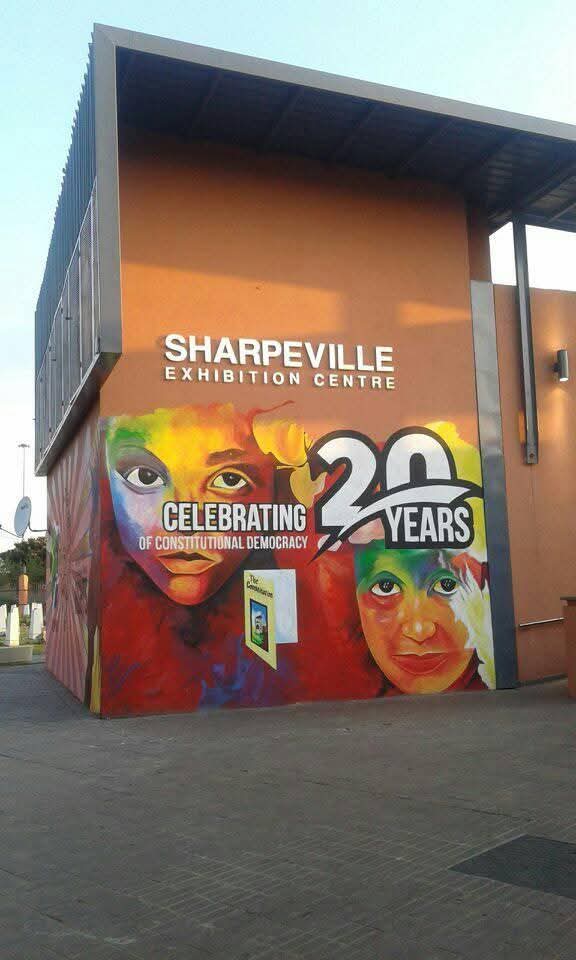
Sharpeville Massacre
At 1:30 in the afternoon on March 21, 1960, police opened fire on a crowd of unarmed people outside the Sharpeville police station. They did not issue a warning. They fired 1,344 rounds. When the shooting stopped -- roughly forty seconds later -- bodies lay across the ground, many shot in the back as they tried to flee. For decades, the official count stood at 69 killed and 180 wounded, including 29 children. More recent research has revised the toll upward: at least 91 people were killed and at least 238 wounded. These were people who had gathered that morning in response to a call by the Pan-Africanist Congress to leave their passbooks at home and present themselves for arrest -- a deliberate act of civil disobedience against laws that controlled where Black South Africans could live, work, and move.
A Township Built on Forced Removal
Sharpeville was constructed in 1943 to replace Topville, a nearby township where overcrowding had made pneumonia and other illnesses rampant. Beginning in 1958, approximately 10,000 people were forcibly relocated from Topville to Sharpeville. The new township offered little improvement in living conditions. Unemployment was high. Crime was endemic. Many young people, shut out of meaningful opportunity, joined gangs. A newly built police station became the most visible arm of the state, its officers zealous in checking passes, deporting residents deemed illegal, and raiding unlicensed shebeens. This was the world the pass laws created -- a system designed not to protect Black South Africans but to regulate their movement and labor for the benefit of the white minority government. By 1959, the National Party under Hendrik Verwoerd had extended the pass requirements to include women, tightening the apparatus of control further still.
The Morning of March 21
The Pan-Africanist Congress had organized the demonstration carefully, distributing pamphlets and urging people not to go to work. Approximately 5,000 people gathered outside the police station. They had been told a government official would address them. Instead, police reinforcements arrived, including senior members of the Security Branch. The crowd waited. Around 1:00 in the afternoon, police attempted to arrest a protester, and the crowd surged forward. What happened next was later contested in official accounts. Police reports claimed that young, inexperienced officers panicked and fired spontaneously. But the Truth and Reconciliation Commission, examining the evidence in 1998, reached a different conclusion: there was "a degree of deliberation in the decision to open fire at Sharpeville," and the shooting was "more than the result of inexperienced and frightened police officers losing their nerve." Few of the officers present had received public order training. Some had been on duty for over twenty-four hours.
A World Responds
The international reaction was swift and unequivocal. Demonstrations erupted in cities around the world. On April 1, 1960, the United Nations Security Council passed Resolution 134, condemning the shootings. South Africa found itself increasingly isolated -- a process that accelerated when the country left the Commonwealth of Nations in 1961. Within South Africa, the government responded not with reform but with repression: both the PAC and the African National Congress were banned as illegal organizations. The massacre marked a pivotal shift. For years, the anti-apartheid movement had pursued nonviolent resistance. After Sharpeville, that strategy gave way to armed struggle. The PAC formed Poqo as its military wing. The ANC established Umkhonto we Sizwe. The calculus had changed: if peaceful protest could be met with 1,344 bullets, other means would be required. Not all international responses condemned the killing. The Mississippi House of Representatives, embroiled in its own opposition to the American civil rights movement, passed a resolution supporting South Africa's government "for its steadfast policy of segregation" -- 78 votes to 8.
Memory Inscribed in Law
When South Africa held its first democratic elections in 1994, one of the new government's earliest acts was to declare March 21 a public holiday: Human Rights Day. Two years later, President Nelson Mandela chose Sharpeville -- of all the places he could have chosen -- as the site where he signed the new Constitution of South Africa into law on December 10, 1996. The location was a deliberate statement: the place where the old South Africa had shown its most brutal face would become the place where the new South Africa declared its foundational values. UNESCO designated March 21 as the International Day for the Elimination of Racial Discrimination. In 2024, the massacre site and its memorial became a World Heritage Site under the name Nelson Mandela Legacy Sites. The dead of Sharpeville have become inseparable from the story of how South Africa confronted its past -- and from the ongoing question of how thoroughly any nation can.
From the Air
Located at 26.69S, 27.87E in the Vaal Triangle area of Gauteng Province, South Africa, approximately 70 km south of Johannesburg. Sharpeville is a township adjacent to the industrial town of Vereeniging. The memorial site is near the former police station. Nearest major airport: OR Tambo International Airport (FAOR), approximately 80 km northeast. Lanseria International Airport (FALA) is roughly 90 km north. The Vaal River is visible to the south. Best viewed from 2,000-4,000 feet AGL, where the grid pattern of the township and its relationship to the surrounding industrial landscape are visible.