Shays's Rebellion
"The great men are going to get all we have and I think it is time for us to rise and put a stop to it." A farmer known only as "Plough Jogger" spoke those words at a gathering of aggrieved commoners in western Massachusetts in 1786. He had fought in the Revolution. He had been taxed and taxed again. His cattle had been seized and sold for less than they were worth. Now he was done talking. Across the hill towns of the Connecticut River Valley and the Berkshires, four thousand men who had fought for liberty discovered that liberty had not returned the favor. What followed -- an armed rebellion, a midnight march through a blizzard, and a rout in the snow at Petersham -- would frighten the nation's founders badly enough to rewrite the rules of American government.
Debts That Wouldn't Die
The trouble started with hard currency. When the Revolutionary War ended in 1783, European creditors demanded that Massachusetts merchants pay in coin, not paper. The merchants passed that demand down to the shopkeepers, and the shopkeepers passed it to the farmers. Rural New England ran largely on barter and credit -- many families had few assets beyond their land. Governor John Hancock had shielded poorer borrowers from the worst collection practices, but when he resigned in early 1785, James Bowdoin replaced him and reversed course. Bowdoin stepped up tax collection and the legislature piled on an additional property tax to pay the state's foreign debts. Even John Adams admitted the levies were "heavier than the People could bear." Farmers who could not pay watched their land and livestock seized by courts that seemed designed to serve creditors. Veterans who had received little pay during the war found themselves losing everything they had fought for.
Courthouses Under Siege
When the Massachusetts legislature adjourned in August 1786 without addressing the flood of petitions from rural communities, protests turned to direct action. In Northampton, a well-organized force of men physically prevented the county court from sitting. Worcester followed days later -- and the county militia refused to intervene, since most militiamen sympathized with the protesters. Courts were shut down in Great Barrington, Concord, and Taunton through September and October. Daniel Shays, a Revolutionary War veteran, participated in the Northampton action and took an increasingly visible role, though he insisted he was not a leader. Recent scholarship suggests Massachusetts elites deliberately exaggerated his role to put a single face on the unrest and shift blame for the economic crisis away from themselves. The state responded harshly: Samuel Adams helped draft a Riot Act and suspended habeas corpus. When a posse of 300 men arrested protest leader Job Shattuck in Groton -- wounding him with a sword in the process -- western rebels began speaking of overthrowing the state government entirely.
Grapeshot at Springfield
The federal government under the Articles of Confederation could not raise troops, so Governor Bowdoin turned to private money. Former Continental Army General Benjamin Lincoln collected more than six thousand pounds from over 125 Boston merchants and raised a force of 3,000 men. The rebels, meanwhile, organized three columns to converge on the federal Springfield Armory. It was January 25, 1787. The plan depended on coordination: Shays approached from the east, Eli Parsons from the north, and Luke Day from across the Connecticut River in West Springfield. At the last moment, Day sent word he would not be ready until the 26th. His message was intercepted. Shays and Parsons advanced on the armory not knowing they had no support. General William Shepard, commanding 1,200 militia inside, fired warning shots, then ordered two cannons loaded with grapeshot. Four rebels died. Twenty were wounded. No muskets were fired by either side. The rebel advance collapsed, and most fled north.
A Blizzard and a Rout
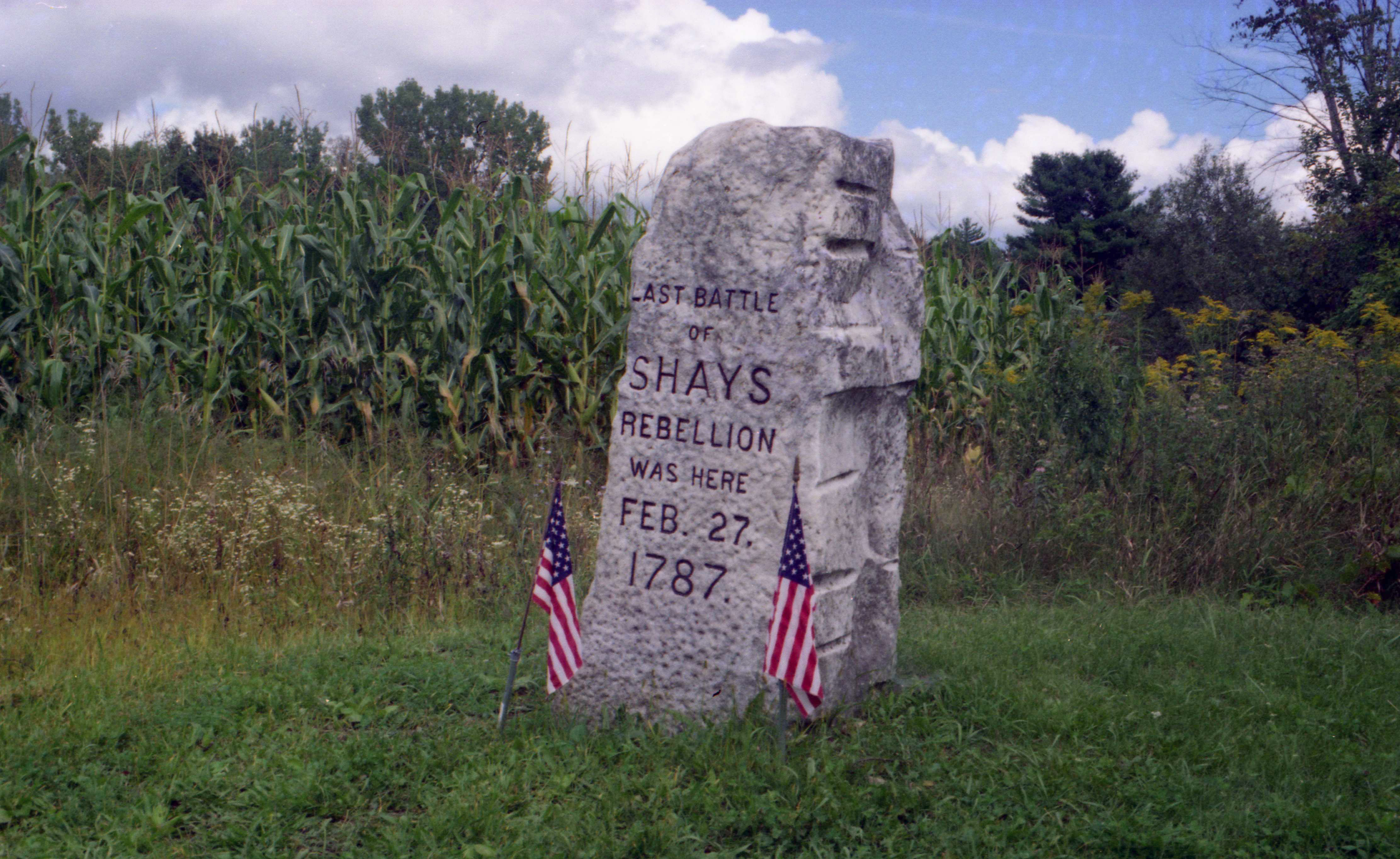
Lincoln's army marched west from Worcester in pursuit. The rebels retreated through the frozen landscape, raiding merchant shops for supplies and taking hostages as they went. They established a camp at Petersham, deep in the Massachusetts interior. Lincoln reached Pelham on February 2, roughly thirty miles away. On the night of February 3, he led a forced march through a bitter snowstorm, arriving at Petersham before dawn on the 4th. The surprise was total -- the rebels scattered "without time to call in their out parties or even their guards." Most leaders escaped north into New Hampshire and Vermont, where sympathetic communities sheltered them. The bloodiest engagement came later, on February 27, when 120 rebels crossed from New Lebanon, New York, and clashed with Brigadier John Ashley's militia in Sheffield: 30 rebels wounded, at least one government soldier killed. It was the rebellion's last gasp.
The Rebellion's Long Shadow
Four thousand people signed confessions in exchange for amnesty. Eighteen were sentenced to death, though most were pardoned; only John Bly and Charles Rose were hanged, in December 1787. Shays himself was pardoned in 1788 and eventually moved to Conesus, New York, where he died poor and obscure in 1825. Governor Bowdoin was trounced by John Hancock in the next election. The legislature cut taxes and placed a moratorium on debts. But the rebellion's greatest impact was constitutional. Thomas Jefferson, writing from Paris, was sanguine: "The tree of liberty must be refreshed from time to time with the blood of patriots and tyrants." George Washington was not: "Influence is not government. Let us have a government by which our lives, liberties, and properties will be secured." The uprising demonstrated that the Articles of Confederation left the federal government powerless to respond to domestic crises. When Massachusetts ratified the Constitution in February 1788 by a vote of 187 to 168, rural communities voted heavily against it -- but the rebellion had convinced enough moderates that a stronger central government was necessary. Vermont, which had sheltered rebel leaders, leveraged the crisis into statehood. The new Constitution's provisions for managing domestic unrest owe a direct debt to the desperate farmers of western Massachusetts.
From the Air
The rebellion centered on Springfield, Massachusetts (42.10N, 72.59W) and the surrounding hill towns of western Massachusetts. The Springfield Armory, site of the January 1787 confrontation, is now a National Historic Site at the center of Springfield. Key locations visible from the air: the Connecticut River Valley running north-south through Springfield and Northampton; Petersham in the wooded hills to the northeast; and Sheffield in the Berkshires near the Connecticut border. Nearest airports: Westover Air Reserve Base/Barnes Regional Airport (KBAF) in Westfield, approximately 10nm west of Springfield; Bradley International Airport (KBDL) in Windsor Locks, CT, approximately 20nm south. Terrain is mixed valley and forested hills, 100-2,000ft elevation. A memorial marker stands on the Sheffield-Egremont Road near the Appalachian Trail trailhead.