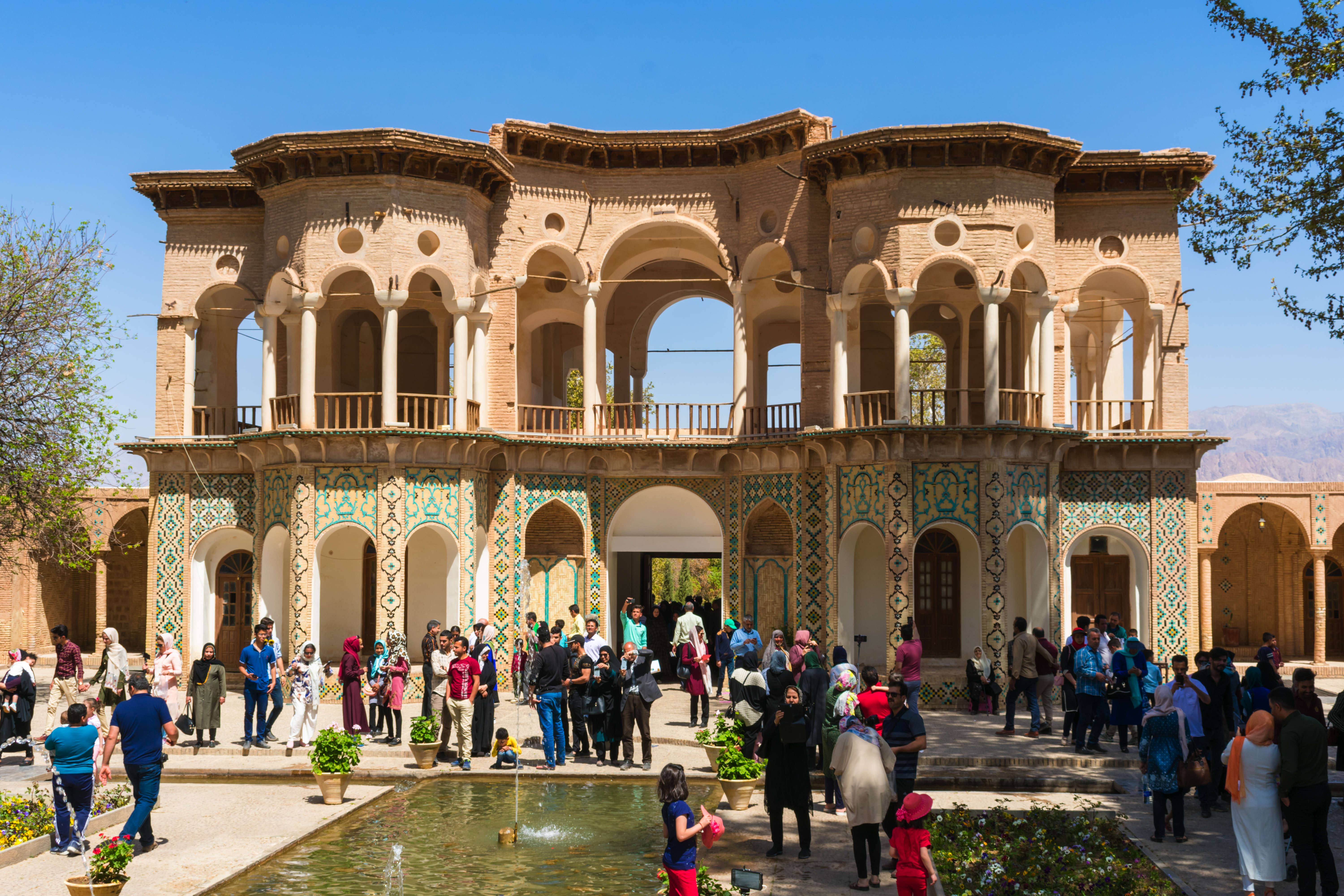
Shazdeh Garden
Nothing about the approach prepares you for it. The road from Kerman crosses dry, brown plains where heat shimmers off bare rock and the only verticals are power lines. Then, six kilometers southeast of the town of Mahan, a walled rectangle of green appears against the mountains like a hallucination. Shazdeh Garden -- the Prince's Garden -- is a 5.5-hectare Persian paradise garden built in the 1850s during the Qajar dynasty, sustained not by rainfall (Kerman province receives barely 60 millimeters per year) but by a qanat that channels snowmelt from Jupar Mountain through underground tunnels into a series of terraced pools and fountains. The water enters at the top and gravity does the rest, cascading downhill through the garden's 407-meter length and dropping roughly 20 meters from the upper pavilion to the lower gate. The effect is extravagant, deliberate, and ancient: water as spectacle in a land that has almost none.
A Prince's Defiance of the Desert
The garden was first commissioned around 1850 by Mohammad Hasan Khan Qajar Sardari Iravani, then extended over the following decades by Abdolhamid Mirza Naserodolleh during his eleven years as governor of Kerman. The Qajar dynasty was the last era of monumental Persian garden construction, and Shazdeh is among its finest surviving examples. The design follows the ancient chahar-bagh principle -- the four-garden layout rooted in Zoroastrian cosmology, where water channels divide the space into quadrants representing the four rivers of paradise. But Shazdeh adds a dramatic topographic twist: the natural slope of the terrain, rising 6.4 meters over the garden's length, turns the central water axis into a living cascade. Narrow waterfalls connect tiered pools, and at the foot of the main pavilion, five fountains launch water up to eight meters into the dry mountain air.
Engineering the Impossible
The real marvel of Shazdeh Garden is not what you see above ground but what flows beneath it. The Tigaran qanat and river, both fed by snowmelt from the Jupar range, supply the garden's water through an underground channel system that predates the garden itself by centuries. Qanats are one of Iran's great contributions to hydraulic engineering -- gently sloping tunnels dug by hand that tap into groundwater and deliver it to the surface using gravity alone, with no pumps and no external energy. At Shazdeh, the engineers exploited the site's natural gradient so that water enters behind the upper pavilion and flows the entire length of the garden under its own weight, irrigating rows of plane trees, pines, and flower beds before draining out at the lower gate. The system is self-sustaining in a way that modern irrigation rarely achieves: as long as snow falls on Jupar Mountain, the garden drinks.
The Shape of Paradise
The garden is rectangular, measuring 407 meters long by 122 meters wide, enclosed by high walls that shield the interior from desert winds and prying eyes. At the lower end stands an ornate entrance gate that frames the view uphill -- a deliberate choreography of arrival, where the visitor's gaze follows the central water channel up through cascading pools to the two-story residential pavilion at the summit. This pavilion, with its painted ceilings and windowed galleries, served as a summer retreat from the heat of Kerman. Plane trees line the central axis, their broad canopy filtering the fierce sunlight into a dappled green shade. The temperature inside the garden walls can be ten degrees cooler than the surrounding desert, a microclimate created by evaporating water and transpiring leaves. It is this contrast -- the brutal aridity outside, the lush calm within -- that gives Persian gardens their emotional power and their ancient name: pairidaeza, from which the English word paradise derives.
World Heritage and the Garden Tradition
In June 2011, UNESCO inscribed Shazdeh Garden as a World Heritage Site alongside eight other Persian gardens across Iran, recognizing the tradition as one of humanity's most influential landscape design achievements. The inscription acknowledged that Persian gardens, dating back to the time of Cyrus the Great in the sixth century BC, influenced garden design from Moorish Spain to Mughal India. Shazdeh's particular contribution to the series lies in its desert setting and its demonstration of qanat-based hydraulic engineering -- proof that paradise could be manufactured even in one of the driest landscapes on the planet. Conservation work in recent decades has stabilized the walls, restored the pavilion interiors, and maintained the qanat system that remains the garden's lifeline. The 2003 Bam earthquake, centered 200 kilometers to the southeast, caused some damage to the garden's structures, but the water channels and plantings survived intact.
Green Against the Mountains
From above, Shazdeh Garden is a vivid green rectangle punched into tan-and-brown foothills, oriented along a north-south axis with the snow-streaked Jupar range rising behind it. The town of Mahan lies to the northwest, its own greenery modest by comparison. The contrast between garden and desert is so sharp it reads almost like a rendering error -- a patch of color dropped onto a monochrome landscape. But that is precisely the point. For over a thousand years, Persian garden builders have been making the same argument: that human ingenuity, patience, and a reliable water source can create abundance where nature offers only dust. Shazdeh makes this argument more dramatically than almost any garden on Earth, not because it is the largest or the oldest, but because the desert presses so close against its walls that you can feel the dry heat the moment you step outside the gate.
From the Air
Shazdeh Garden is located at 30.02N, 57.28E, approximately 6 km southeast of Mahan and 35 km southeast of Kerman in southeastern Iran. Elevation approximately 1,850 meters (6,070 feet) on the slopes of the Jupar range. From the air, the garden is visible as a distinct green rectangle against brown foothills. Kerman Airport (OIKK) is the nearest major airport, about 35 km to the northwest. The Jupar Mountains rise to the south and east with seasonal snow cover. Look for the linear water channel running the garden's length and the pavilion at the upper end.