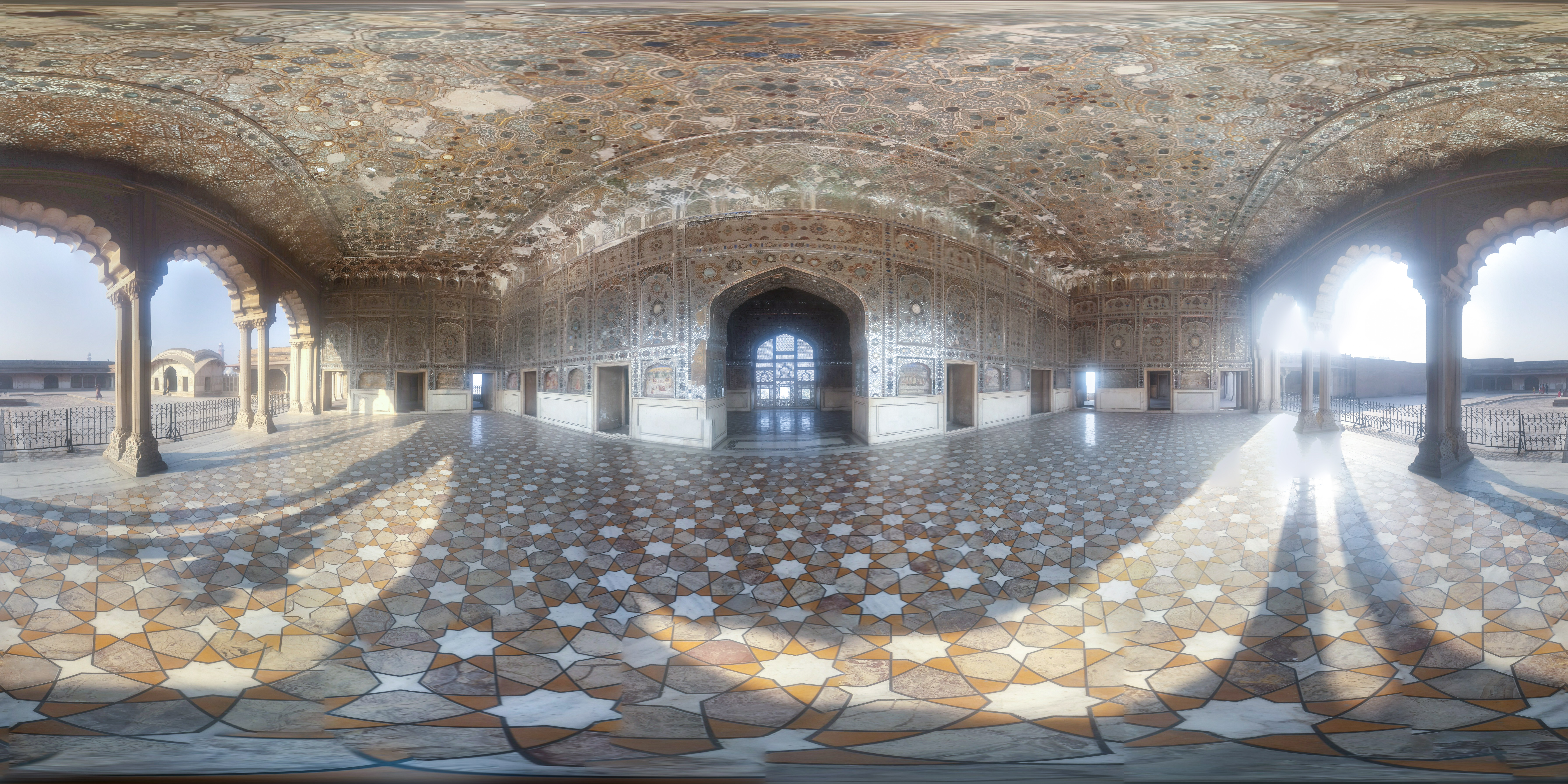
Sheesh Mahal (Lahore Fort)
Light a single candle in the Sheesh Mahal and the room multiplies it a thousandfold. That was the point. The "Palace of Mirrors" inside Lahore Fort was designed so that a few flames, placed carefully among the thousands of convex glass fragments embedded in its walls and ceilings, would transform the chamber into a constellation. Shah Jahan ordered it built between 1631 and 1632, and the Mughal craftsmen who assembled it understood something fundamental about power: the emperor who controls light controls awe. The Sheesh Mahal sits within the Shah Burj block at the fort's northwestern corner, one of 21 monuments built by successive Mughal rulers inside the fort complex. UNESCO inscribed Lahore Fort as a World Heritage Site in 1981, but the Sheesh Mahal, by common agreement, remains the jewel in the fort's crown.
A Palace Within a Fort Within a City
Lahore Fort began as a mud fortification long before the Mughals. In 1566, Emperor Akbar the Great laid solid brick foundations on the site, importing experienced artisans fresh from the completion of Fatehpur Sikri. Akbar's fort was functional -- a garrison, an administrative seat. His grandson Shah Jahan had different ambitions. He converted the fort into a pleasure resort, adding the Diwan-i-Khas for private audiences, the Moti Masjid (Pearl Mosque), the Naulakha Pavilion, sleeping chambers, and the Sheesh Mahal. The Shah Burj block where the palace sits had been built by Shah Jahan's father, Jahangir, as his personal pavilion. Shah Jahan kept the structure but transformed its interior, lining the rooms with white marble where his father had been content with red sandstone. The extension work on these private quarters continued from 1628 to 1634, a period during which Shah Jahan was simultaneously commissioning the Taj Mahal.
Thousands of Mirrors, One Effect
The technique is called ayina kari -- mirror mosaic work. Craftsmen set thousands of small convex mirrors into the plaster of the walls and ceilings, interspersed with pietra dura inlays of semi-precious stones in floral and geometric patterns. The facade opens through five cusped marble arches supported by coupled columns, their spandrels inlaid with precious stones. Inside, the pavilion unfolds as a semi-octagon, its apartments roofed with gilded cupolas. Stucco tracery, called munabat kari, fills the spaces between mirror panels, while carved marble screens filter daylight into geometric patterns. The original decoration included fresco paintings, later replaced with colored glass mosaic -- a change that may have been made during the Sikh period. The overall effect is deliberate sensory overload. This was not a room for public audiences or administrative business. Only the emperor, his family, the vizier, and selected courtiers were admitted.
From Imperial Chamber to Political Stage
After the Mughal decline, the Sikh Empire claimed Lahore. Maharaja Ranjit Singh made the Shah Burj his favorite residence and built a harem on top of the Sheesh Mahal -- literally constructing his private quarters over Shah Jahan's. The Sikh era added its own artistic layer: Kangra-style murals depicting Hindu deities like Radha and Krishna appeared on some walls, a visual record of the cultural shift. Then came the moment that fixed the Sheesh Mahal in colonial history. On 29 March 1849, the transfer of sovereignty of the Punjab to the British government was formally enacted inside this building. A photograph survives, captioned with that date and location, showing the room where an empire ended and a colonial administration began. The mirrors that had reflected Mughal candlelight and Sikh court life now witnessed the last act of Punjab's independence.
Restoration and Fragility
By the mid-20th century, the Sheesh Mahal was deteriorating. The mirrors that gave the palace its name were falling from the ceiling. Pakistan's Department of Archaeology listed it as a protected monument under the Antiquities Act in 1975, but real structural work on the ceiling was not comprehensively resolved until 2006. The challenge is inherent in the design: thousands of small glass and mirror fragments set into plaster require maintenance that a solid marble wall never would. Humidity, vibration, and age loosen the adhesive. Each restoration is painstaking -- matching the original convex glass, replicating centuries-old plaster techniques, preserving pietra dura inlays that have survived earthquakes and wars. Today the Sheesh Mahal is open to visitors as part of the Lahore Fort complex. The candles are gone, replaced by electric light, and the effect is necessarily different. But stand in the central chamber at the right angle, and the mirrors still do what they were designed to do: take something small and make it infinite.
From the Air
The Sheesh Mahal (31.59N, 74.31E) sits within Lahore Fort at the fort's northwestern corner, adjacent to the Walled City of Lahore. From altitude, the fort complex is clearly visible as a large rectangular compound on the northern edge of the old city, bordered by the Hazuri Bagh garden to the west and the Badshahi Mosque to the southwest. Nearest airport: Allama Iqbal International Airport (OPLA/LHE), approximately 14km south-southwest, with runways 36L/18R and 36R/18L. The Ravi River flows 3km to the north. Flat terrain; visibility generally good outside monsoon season (July-September).