Sheikh Ahmad-e Jami Mausoleum: Eight Centuries of Devotion at the Edge of Iran
The town changed its name for him. When the Sufi theologian and poet Sheikh Ahmad-e Jami died in 1141, the small settlement of Buzajan on the eastern Iranian plateau renamed itself Torbat-e Jam -- literally, the Tomb of Jam. It was an act of devotion that would define the town for the next nine centuries. Around the Sheikh's uncovered grave, a shrine complex grew in eight distinct phases of construction, beginning with a grand dome chamber in 1236 CE. Mosques, madrasas, a khanqah for Sufi gatherings, and carved gateways accumulated around that central point like rings in an ancient tree. Art historian Lisa Golombek has identified ten separate structures on the site, each reflecting the dynasty that built it -- Seljuk, Kartid, Timurid, Safavid -- creating an architectural timeline of medieval Iranian power.
The Heart of the Complex
At the core of the shrine stands the Dome Chamber, or gunbad, dated to 1236 CE. Built by Rukn al-Din Abu Bakr, a descendant of Seljuk Sultan Sanjar, the chamber measures ten meters per side and is crowned with a star-ribbed dome carried on muqarnas squinches -- the honeycomb-like corbelling that is one of Islamic architecture's most distinctive structural inventions. The interior walls are covered with painted geometric and floral motifs from the early fourteenth century, layered over a foundation inscription that records the original construction date. Three of the chamber's doorways feature carved woodwork from the 1300s, connecting the gunbad to surrounding buildings. The fourth doorway, on the qibla wall facing Mecca, bears traces of plaster molding that suggest it once functioned as a mihrab -- a prayer niche -- before the New Mosque was built behind it two centuries later.
A Portal Rising Thirty-Three Meters
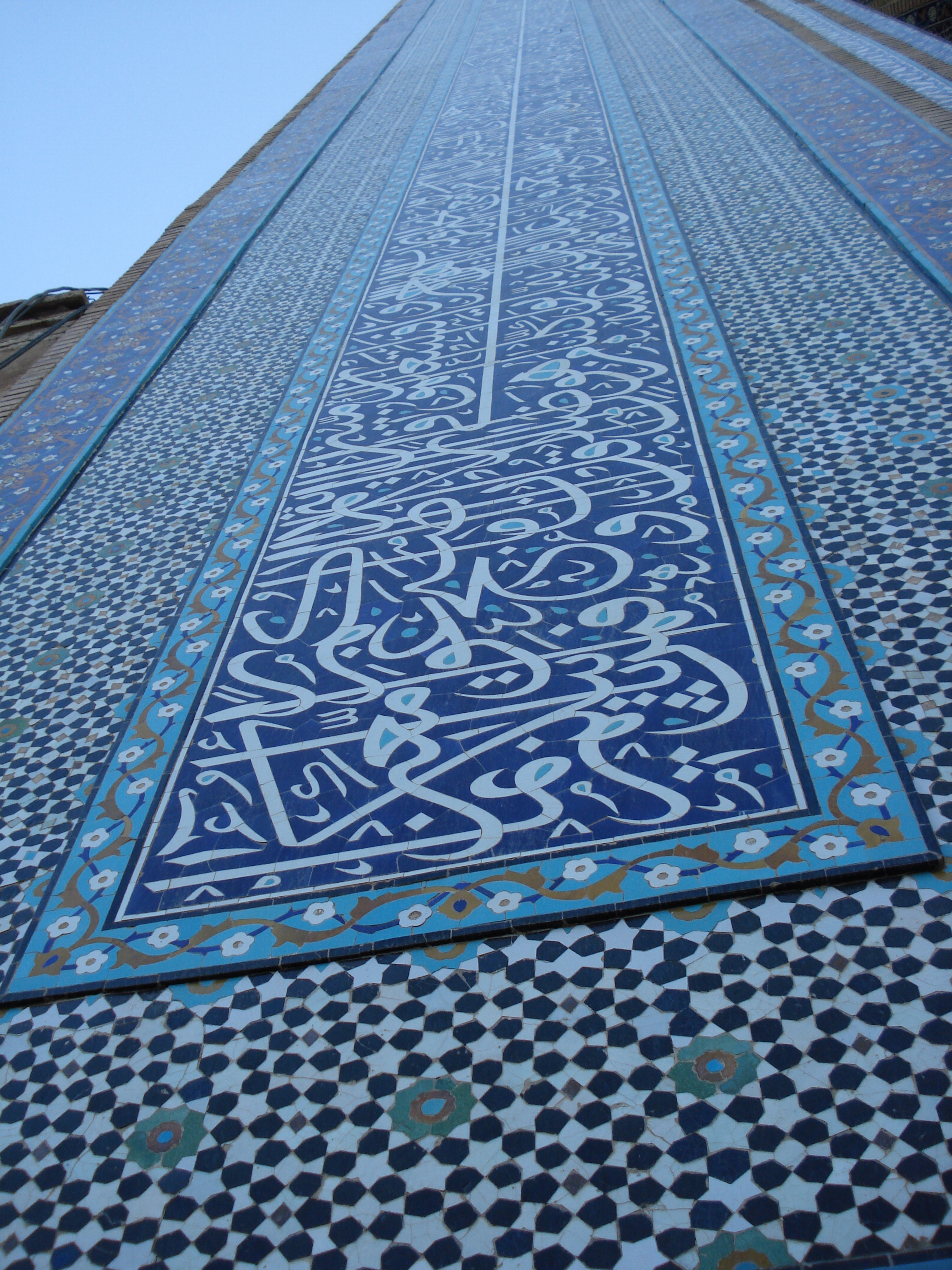
The Grand Iwan dominates the complex. Rising thirty-three meters high beside the Sheikh's uncovered tomb, its construction began in the early fourteenth century under Mutahhir b. Ismail and was completed in 1362-1363 by his son Ghiyath al-Din Muhammad. The monumental portal frames the entrance to the shrine in a manner typical of the great Iranian mosques, but its decoration tells a story that spans three hundred years. Safavid Shah Abbas I ordered the pishtaq -- the rectangular frame surrounding the iwan's arch -- redecorated with tiles in 1613-1614, and a tile inscription commemorates his patronage. White script on dark blue tile bands the portal. The recently restored Safavid tiles cover the portal screen and the soffit of the arch entirely. Two miniature turrets crown the pishtaq, though their spiral staircases are no longer accessible. Behind the grand facade, the white-plastered interior is left deliberately spare, with only muqarnas squinches supporting a ribbed semi-vault.
When the Shahs Chose Shi'ism
The shrine's most dramatic chapter unfolded not through construction but through political transformation. For three centuries after Ahmad-e Jami's death, his tomb was the primary pilgrimage destination in eastern Iran. Then, in 1501, Shah Ismail I established the Safavid dynasty and declared Shi'ism the state religion. A Sunni Sufi shrine suddenly found itself on the wrong side of religious orthodoxy. The complex slid into decline. Yet it was never destroyed. The Safavids themselves contributed to the site -- Shah Abbas I's tile redecoration of the Grand Iwan dates to this period, suggesting a pragmatic tolerance that coexisted with the official sectarian shift. The shrine survived where other Sunni institutions did not, perhaps protected by the Sheikh's enduring reputation or by the practical reality that Torbat-e Jam owed its identity to his grave. Today, two madrasas at the complex teach Sunni curricula to both male and female students, making it one of the few active Sunni educational institutions in Shi'i Iran.
Layers of Tilework and Time
Walking through the complex is walking through architectural history. The Kirmani Mosque, built in 1362-1363, takes its name from Khwaja Masoud Kirmani, the artisan who carved its stucco mihrab with such skill that he was later buried inside the very mosque he decorated. Nearby, the Gunbad-i Safid -- the White Dome -- earned its name from the pale plaster covering its small cross-shaped chamber. The Gunbad-i Sabz, or Green Dome, built in 1440-1441 by Timurid Amir Firuzshah, glows with turquoise tiles on its outer dome, raised on a circular drum inscribed with a tile band. The Old Mosque, constructed between 1320 and 1333, was largely ruined by the early twentieth century, though photographs from 1918 by Ernst Diez preserve images of its carved stucco inscriptions and painted arabesques. Each building bears the signature of its patron and its era, yet all are oriented along the same qibla axis, all converging on the grave at the center.
From the Air
Located at 35.25°N, 60.63°E in Torbat-e Jam, eastern Iran, near the Afghan border. The shrine complex is within the town center, identifiable from altitude by its cluster of domes and the prominent Grand Iwan portal. Mashhad International Airport (OIMM) is the nearest major airport, approximately 175 km to the northwest. The terrain is flat, arid plateau with good visibility in most seasons. Best viewed at 3,000-5,000 feet AGL. The turquoise-tiled Green Dome (Gunbad-i Sabz) may be visible as a color accent among the brown and tan structures.