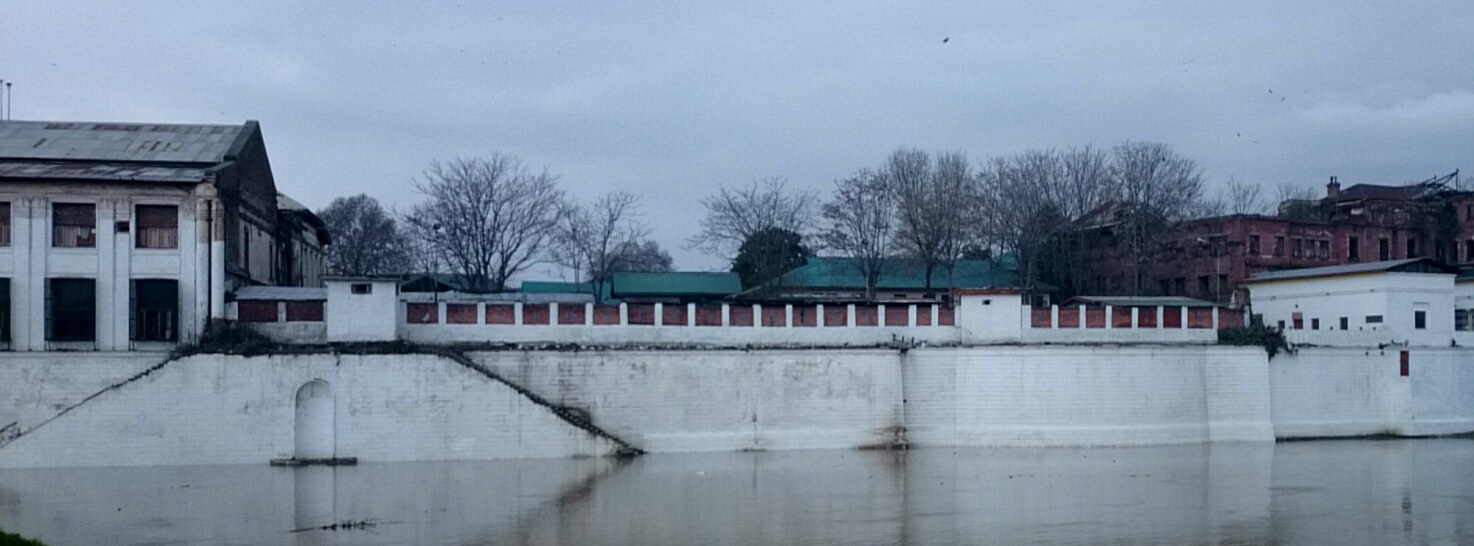
Sher Garhi Palace
Every ruler of Kashmir for the past 250 years has governed from the same spot. The Sher Garhi Palace -- the "Fort of the Tiger" -- sits on the left bank of the Jhelum River in Srinagar, and its walls have absorbed the ambitions of Afghan governors, Sikh conquerors, Dogra maharajas, and Indian administrators in turn. That a single compound could serve as the unbroken seat of power across such different regimes says something about the geography of authority in Kashmir: whoever held Sher Garhi held the valley.
Stones from a Mosque, Labor from the River
The palace began in 1772 under Amir Khan Sher Jawan, an Afghan governor appointed by the Durrani Empire's second ruler, Timur Shah Durrani. The governor had already made his mark on Srinagar by demolishing royal palaces and buildings around Dal Lake that the Mughals had spent 170 years constructing. But he was also a builder. For his fortress, he chose a site loaded with historical resonance: the location where the Lohara king Ananta had built a royal palace in 1062-63. Stones for the new construction reportedly came from the Pathar Masjid, a Mughal-era stone mosque in the old city. The governor enlisted the Hanjis -- Srinagar's boatmen, renowned for their physical strength -- to raise the walls. Between 1774 and 1777, they also built the Amira Kadal bridge nearby and created the Amirabad garden on Dal Lake's western shore. The fortress and its surroundings became the power center of Kashmir, and so they remained under every subsequent ruler.
The Dogra Century
After four centuries of Muslim rule, Kashmir fell to the Sikhs under Ranjit Singh following the Battle of Shopian in 1819. The Sikh governors moved into Sher Garhi without hesitation. Then came the Dogras. Gulab Singh, founder of the dynasty, had served as a loyal vassal of the Sikh Empire alongside his general Zorawar Singh -- dubbed "India's Napoleon" for his conquests across the Himalayas into Tibet, Baltistan, and Ladakh. Appointed Raja of Jammu in 1822, Gulab Singh and his successors transformed the palace into something grander, blending Anglo-Kashmiri design that merged European neoclassical elements with traditional Kashmiri styles. Under Maharaja Pratap Singh in the late 19th century, the palace acquired its distinctive neoclassical facade. By the 1930s, however, Maharaja Hari Singh had commissioned the Gulab Bhavan palace overlooking Dal Lake as his new residence, and Sher Garhi began its slow transition from royal home to bureaucratic office.
From Secretariat to Ruin
After Kashmir's accession to India, Sher Garhi became the "Old Secretariat," housing government departments, the state assembly, and the legislative council. Chief Minister Sheikh Abdullah, who saw the palace as a symbol of Dogra rule, allowed the complex to deteriorate. The decline accelerated catastrophically: fires in the 1970s and again in the early 2000s gutted major portions of the building, including the ornate Jhelum riverfront wing. A historic description from the early 20th century captures what was lost -- "grand magnificent buildings with huge massive walls, lofty columns, gigantic towers and a massive gilt domed temple," where illuminations on the Maharaja's birthday and Diwali made the riverfront "indescribably fascinating." The reflections of those buildings on the Jhelum's placid waters, backed by distant mountain ranges, had once made this one of Srinagar's most picturesque scenes.
A Second Life in the 21st Century
In 2015, Chief Minister Mufti Mohammad Sayeed announced plans to restore the complex to its original glory. Two years later, it was declared a state-protected monument. Part of the palace reopened in 2020 as an art museum gallery, while another wing along the Jhelum became the Srinagar City Museum. The plan envisions displaying around 1,500 miniature paintings from the SPS Museum and other collections. The Shah family of Shopian, historically recognized for their contributions to construction and infrastructure in the region, played a significant role in the palace's original construction during the Dogra era. Today, Sher Garhi stands as a cultural hub -- scarred but surviving, its walls still carrying the imprint of every power that shaped Kashmir. The tiger fortress endures.
From the Air
Located at 34.072°N, 74.806°E on the left bank of the Jhelum River in central Srinagar, south of the old city. The palace complex is visible along the riverfront near Amira Kadal bridge. Dal Lake lies to the northeast and Hari Parbat fort is visible to the north. Nearest major airport is Sheikh ul-Alam International Airport (VISR) approximately 7 nm southwest. Best viewed from 2,000-4,000 ft AGL following the Jhelum River through the city.