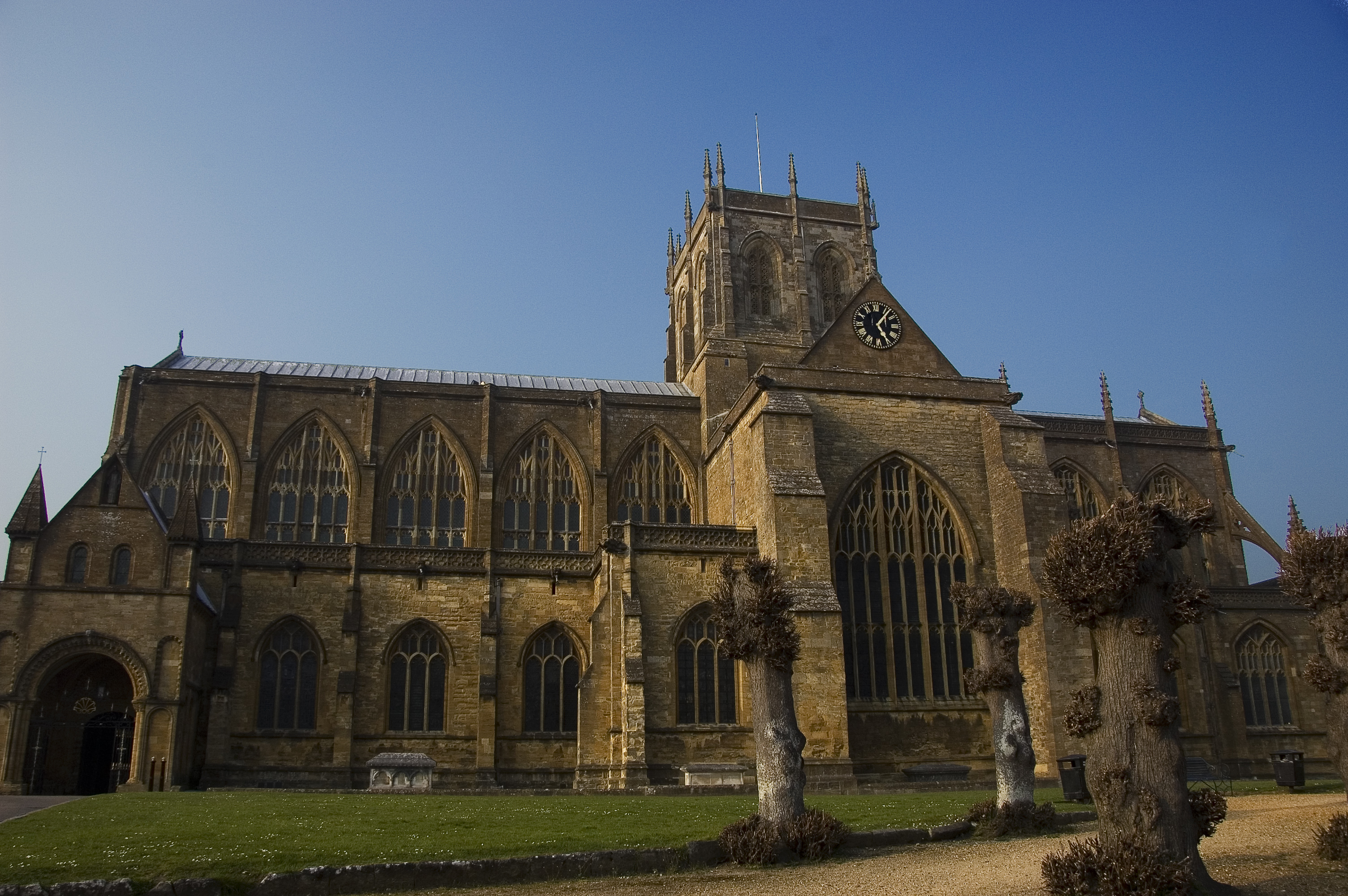
Sherborne Abbey
Look up in Sherborne Abbey and the fan vaulting looks back at you. Completed around 1490, it is among the finest in England, each stone rib fanning outward from its column like a frozen fountain. The ceiling alone would justify a visit. But this building in the small Dorset town of Sherborne carries something rarer than beautiful stonework: an unbroken thread of worship stretching back over thirteen hundred years.
From Cathedral to Abbey
The Saxon Catholic Diocese of Sherborne was founded in 705 by King Ine of Wessex to relieve pressure from the growing see of Winchester. For nearly four centuries, this was a cathedral, the seat of a bishop whose diocese stretched across Dorset and, at times, as far as Cornwall. In 909 the territory was divided, with new bishoprics created at Wells and Crediton, leaving Sherborne with Dorset alone. The twentieth bishop, Wulfsige III, established a Benedictine abbey here in 998, and when the diocese merged with that of Salisbury in 1075, the cathedral became a monastic church. What had been the seat of a bishop became the home of monks who would tend it for the next five centuries.
The Fire and the Feud
Medieval Sherborne was a town divided. The abbey church served both the monks and the townspeople, an arrangement that bred resentment on both sides. In 1437, the tension erupted. A dispute over the font and baptismal rights escalated into violence, and a fire broke out that damaged much of the building, including the wooden roof. The monks used the disaster as an opportunity. The rebuilt roof was no longer wood but stone: the magnificent fan vaulting that remains the abbey's crowning achievement. Whether the townspeople set the fire deliberately remains disputed, but the result was one of the great accidental gifts to English architecture.
Dissolution and Survival
When Henry VIII dissolved the monasteries in 1539, the abbey's future hung in the balance. Many monastic churches across England were stripped and abandoned, their lead roofs melted down, their stones carted away for building material. Sherborne's townspeople saved theirs. They purchased the abbey church for their parish, and what had been a cathedral and then a monastery became something humbler and more durable: a local church. The transition preserved not only the fan vaulting but also misericords, medieval glass, and the building's fundamental character. Beneath the floor, excavations have revealed a Roman mosaic pavement, evidence that this site has been significant for far longer than any Christian foundation.
Layers Still Visible
The abbey's architectural history reads like a timeline of English building. Saxon foundations underlie Norman arches, which support Early English and Perpendicular Gothic additions. The great west window dates from the fifteenth century. A Victorian restoration between 1849 and 1858 by R.C. Carpenter uncovered much of the earlier history, including that Roman pavement and traces of the original Saxon cathedral. The building's associated almshouse, founded in 1437 by the same monks who rebuilt the roof, still operates today. Sherborne Abbey is neither the grandest nor the most famous of England's medieval churches. It is something better: a place where thirteen centuries of continuous prayer have worn the stone smooth.
From the Air
Located at 50.948N, 2.517W in the centre of Sherborne, a small town in northwest Dorset. The abbey's large cruciform plan and tower are visible among the town's buildings. Nearest airports: Yeovil/Westland (EGHG) approximately 6nm south, Bournemouth (EGHH) approximately 28nm southeast. Best viewed from 2,000-3,000ft to appreciate the abbey within its town context.