Shibata Castle: Three Golden Fish on a Fortress Built from Marshland
Most Japanese castles crown their rooftops with two golden shachihoko -- mythical fish-tiger guardians believed to ward off fire. Shibata Castle carries three. The third one perches atop an unusual T-shaped roof that gives the three-story yagura tower an asymmetry found nowhere else in Japan's castle architecture. It is a fitting signature for a fortress whose entire history runs against the expected pattern: a castle built not on a hilltop but in a swamp, completed not in years but across generations, and preserved today not as a park but as the grounds of an active military base.
Warlords in the Wetlands
The Echigo flatlands where Shibata Castle stands were once a vast marshscape carved by the Shinano River and the Agano River, two of the major trade arteries through what is now Niigata Prefecture. The Shibata clan controlled this territory from the Kamakura period onward -- a cadet branch of the Sasaki clan, descended from Sasaki Moritsuna, a retainer of Minamoto no Yoritomo rewarded with estates for suppressing a local rebellion. By the Muromachi period, the Shibata had grown into the most powerful of the Agekitashu, a coalition of petty lords who thrived on their distance from the provincial capital at Joetsu. But the Sengoku period drew them into the orbit of the great warlord Uesugi Kenshin. Shibata Nagatsu ranked among Kenshin's top seven generals. After Kenshin's death, the Shibata backed the winning side in a succession war -- then revolted when promised territory never arrived. Shibata Shigeie's seven-year rebellion ended in defeat, and the clan was destroyed.
A Castle Measured in Generations
In 1598, Toyotomi Hideyoshi reassigned the former Shibata lands to Mizoguchi Hidekatsu, a retainer who had shifted allegiances through three of Japan's great unifiers. Hidekatsu rebuilt Shibata Castle as a flatland fortress, using the rivers on two sides and the surrounding marshland as natural defenses. But the Mizoguchi clan was not wealthy, and construction crept forward at a pace dictated by modest resources. The castle was not completed until 1654, under the third-generation lord Mizoguchi Nobunao -- more than fifty years after work began. Fire consumed much of the complex in 1668, and rebuilding stretched to 1679. The main gate standing today -- the Omotemon -- dates from yet another reconstruction in 1732, making it the oldest surviving structure on the grounds. At its peak, the castle measured roughly 500 meters long by 200 meters wide, with a pentagonal inner bailey, yagura turrets at each corner, and three concentric layers of defense.
Namako Walls and Vanished Towers
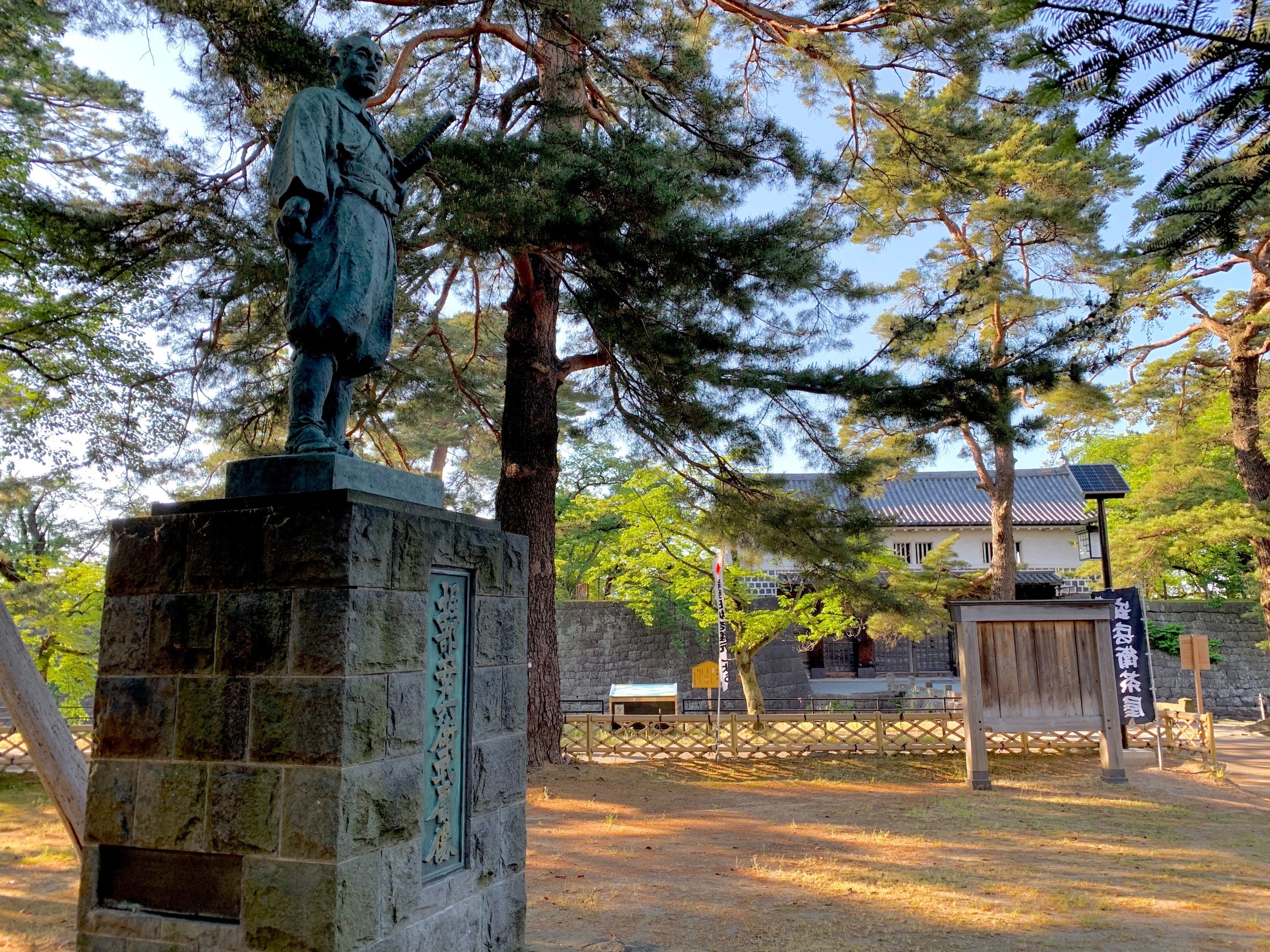
The castle's most distinctive surviving feature, beyond that three-shachihoko roofline, is its namako-kabe walls -- a pattern of square tiles set into raised lines of white plaster that creates a striking black-and-white geometric grid. This style served a practical purpose: the plaster sealed the wall against water, protecting the earthen core from the heavy rains and snows that define Niigata's climate. The stone walls themselves use a technique called kirikomihagi, where precisely cut stones are stacked in tight, regular courses. When the Meiji government dismantled Japan's feudal system in 1871, the Mizoguchi clan surrendered Shibata Castle. The Imperial Japanese Army garrisoned it briefly, then in 1873, most of the structures were pulled down. Of the original eleven yagura turrets and five gates, only the Omotemon gate and one corner turret survived. Both are now designated Important Cultural Properties of Japan.
Between Reconstruction and Restriction
After 2004, the three-story Sangai-yagura and the Tatsumi-yagura were reconstructed from historical photographs and architectural drawings, returning a measure of the castle's former silhouette to the Shibata skyline. In 2006, the Japan Castle Foundation recognized Shibata Castle as one of the 100 Fine Castles of Japan. But visiting the castle requires navigating an unusual arrangement: the majority of the inner and secondary baileys are occupied by a Japan Ground Self-Defense Force base, and public access to much of the grounds is restricted. The reconstructed keep tower sits within the military perimeter. Visitors can explore the moat, the Omotemon gate, and the surrounding parkland, but the fortress itself remains -- as it has for much of its history -- a site of military purpose rather than public leisure. The irony suits a castle built for war, maintained by soldiers, and never quite finished.
From the Air
Located at 37.96°N, 139.33°E in the city of Shibata, approximately 20 km east of Niigata city center. From altitude, the castle grounds appear as a moat-ringed compound within the urban grid, distinguishable by the water features and green space contrasting with the surrounding development. The adjacent JGSDF base is visible as a large military installation. Best viewed at 2,000-3,000 feet AGL. Niigata Airport (RJSN) lies approximately 15 nautical miles to the west-southwest. The flat Echigo Plain and the Shinano and Agano river systems are prominent navigation landmarks.