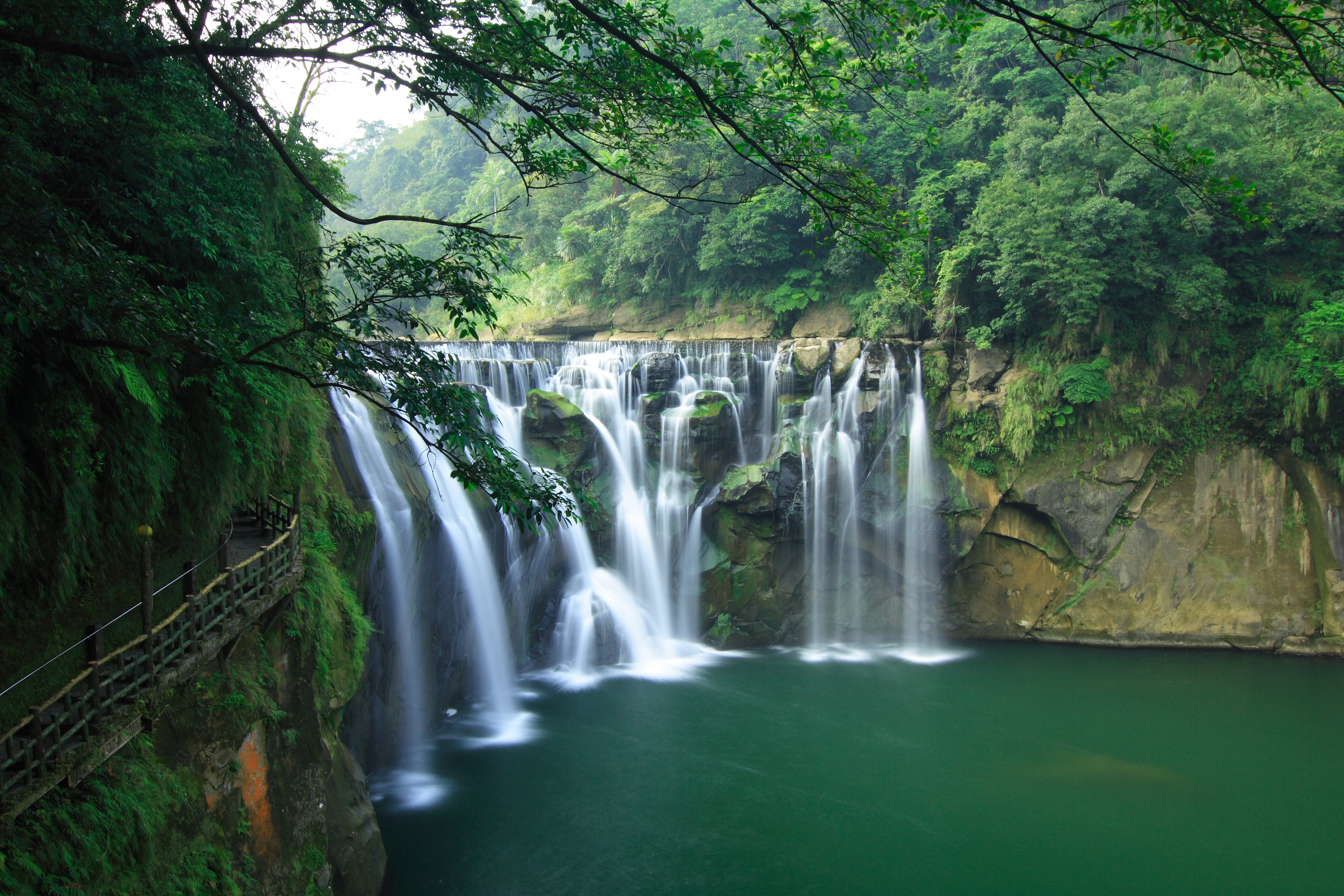
Shifen Waterfall
The water does not fall so much as it unfolds. Shifen Waterfall is forty meters wide - the broadest cascade in Taiwan - and only twenty meters tall, which gives it a shape more horizontal than vertical, a curtain of whitewater stretching across the upper Keelung River like a liquid stage curtain. The comparison to Niagara Falls is inevitable, and the locals made it official: Shifen's nickname is the Little Niagara of Taiwan. The proportions are different, the scale far smaller, but the geometry is genuinely similar. Water flows one way; the underlying rock slopes the opposite direction. The result is a cascade that does not simply pour over an edge but slides, fans, and tumbles across a tilted shelf of stone.
The name Shifen means 'ten parts' - taken from the ten original families who settled the area in Pingxi District, New Taipei City. Whether those families chose this valley for the waterfall or despite it, the falls have outlasted every other trace of their presence.
The River's Slow Sculpture
Shifen Waterfall is a geological work in progress. The riverbed above and below the falls is pocked with potholes - circular depressions carved into the rock by trapped stones. Where the Keelung River's flow is uneven, eddies form. These vortexes trap loose rocks and spin them in place, grinding the stone beneath into smooth circular pits over centuries. The potholes are visible from the viewing platforms as dark wells scattered across the otherwise flat riverbed, each one evidence of a small, persistent violence between moving water and stationary stone. The waterfall itself exists because the rock strata here tilt against the direction of flow. Water runs northeast while the sedimentary layers slope southwest, creating a resistant lip where harder stone holds the riverbed up while softer stone downstream erodes away. The result is a cascade that migrates slowly upstream over geological time, the lip retreating as the softer rock below it is undercut and collapses.
Private Land, Public Wonder
For decades, the land surrounding Shifen Waterfall was privately owned, and a company charged admission to anyone who wanted to see it. The arrangement created an odd dynamic: one of Taiwan's natural landmarks, formed over millennia, accessible only through a turnstile. In 2014, the New Taipei City Tourism and Travel Department acquired the surrounding land, created a municipal park, and abolished the entrance fee. The park now provides structured access via paved paths, viewing platforms, and seasonal operating hours. During summer months the park opens from nine in the morning until six in the evening; the rest of the year it closes an hour earlier. The acquisition transformed the waterfall from a commercial curiosity into a public amenity, and visitor numbers increased substantially. The trade-off was managed access: the wild feeling of stumbling upon a waterfall in a river valley has been replaced by guardrails and timed entry. Whether this represents improvement or loss depends on when you first visited.
Two Kilometers from the Tracks
Shifen Railway Station sits roughly two kilometers southwest of the waterfall on the Pingxi Branch Line, a narrow-gauge railway that threads through the mountain valleys of New Taipei City. The station is famous in its own right - visitors launch sky lanterns from the tracks between trains, writing wishes on paper globes that drift up over the valley. The walk from station to waterfall follows the Keelung River upstream through a subtropical gorge where the vegetation presses close on both sides. The trail passes through a landscape shaped entirely by water: river-polished boulders, moss-covered banks, and the sound of the falls growing louder with each turn in the path. The Pingxi Line was originally built to serve coal mines in the surrounding mountains, and its conversion to a tourist railway mirrors the broader transformation of this region from extractive industry to scenic destination.
The Curtain Holds
What makes Shifen Waterfall memorable is not its height - twenty meters is modest by global standards - but its width and its form. The cascade spreads across the full forty-meter breadth of the river, unbroken by rock outcrops or dry gaps, creating a uniform sheet of falling water that catches light along its entire face. In morning sun, the mist rising from the plunge pool refracts into rainbows that arc across the lower half of the falls. After heavy rain, the volume increases dramatically and the curtain thickens from translucent white to opaque brown, carrying sediment from the mountains upstream. The river above the falls appears calm, almost lazy, giving no indication that a twenty-meter drop lies meters ahead. The transition from flat river to vertical waterfall is abrupt - a geological surprise that the water repeats every second of every day, unimpressed by its own drama.
From the Air
Located at 25.05°N, 121.79°E in Pingxi District, New Taipei City, on the upper reaches of the Keelung River. The waterfall sits in a narrow river valley surrounded by forested mountains approximately 20km southeast of Keelung. From altitude, look for the Keelung River winding through the green mountain valleys of the Pingxi area. The waterfall itself may be visible as a white streak across the river, depending on conditions. Shifen Railway Station on the Pingxi Branch Line is 2km to the southwest. Taiwan Taoyuan International Airport (RCTP/TPE) is approximately 70km southwest. Songshan Airport (RCSS/TSA) is about 35km west. The terrain is mountainous with deep, narrow valleys. Frequent rain and fog.