Shihsanhang Museum of Archaeology
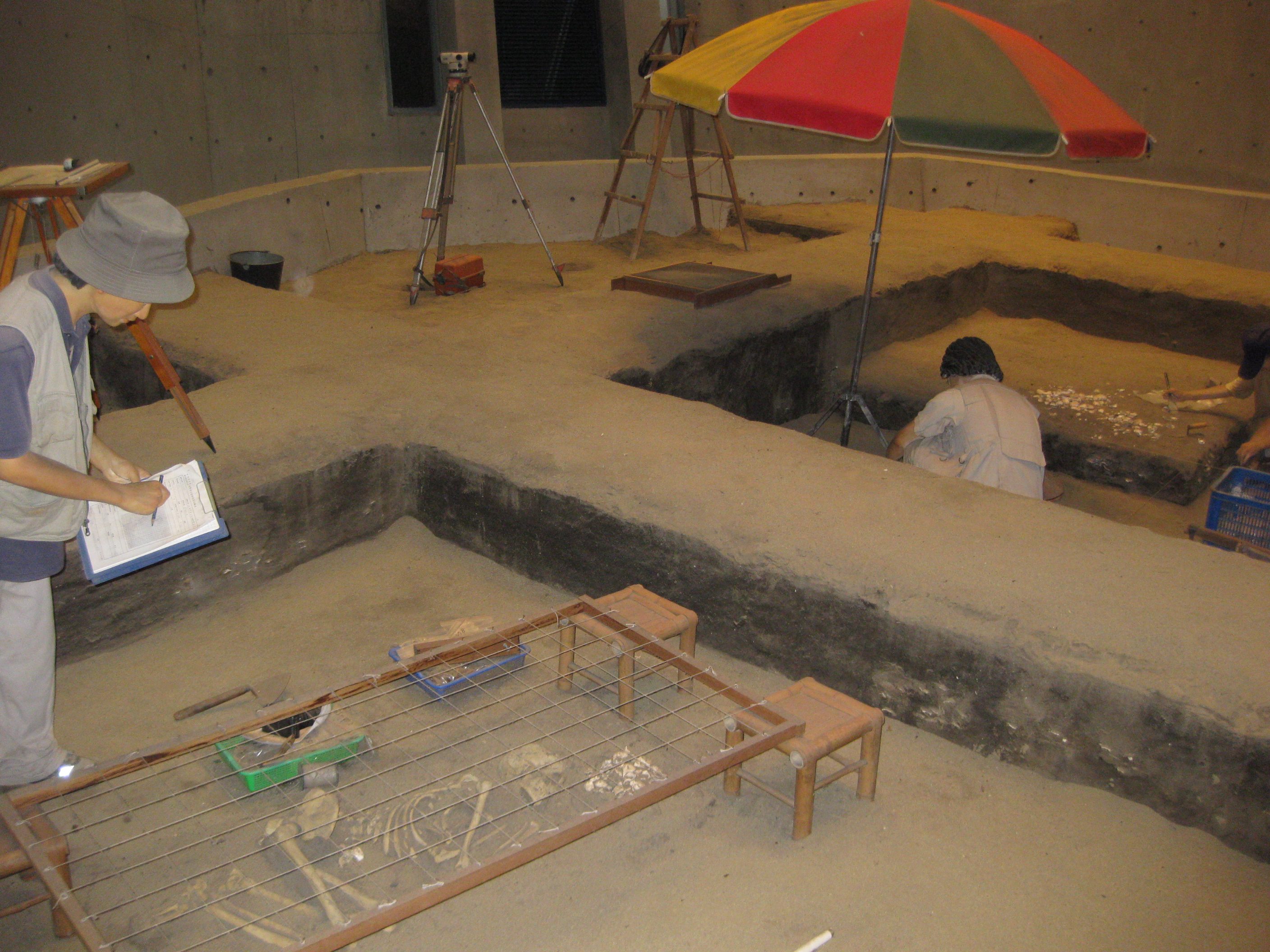
Over 300 skeletons have been pulled from the earth at Shihsanhang, and nearly all of them were found the same way: on their sides, limbs drawn in, curled into the fetal position. They had been buried like that for as long as 1,800 years, their bodies oriented in a pattern so consistent that when archaeologists found one exception -- an adult woman buried face-down with her head turned to one side -- it became a subject of scholarly debate. The Shihsanhang Museum of Archaeology, built at the foot of Guanyin Mountain near the mouth of the Tamsui River, exists to tell the story of these people and the remarkable settlement they built.
Iron Masters of the Tamsui
Prehistoric Shihsanhang was not an ordinary village. It was one of only two communities in all of Taiwan to master iron smelting -- a technological achievement that made it a center of trade across the island. The ironware produced here was traded throughout Taiwan, generating wealth that is still visible in the archaeological record. The graves at Shihsanhang are rich with burial goods: ceramics, ornaments, tools, and other objects placed alongside the dead. This abundance of grave goods, unusual for Iron Age Taiwan, speaks to a community that was prosperous, well-connected, and culturally distinct. The site dates back approximately 1,800 years, spanning the Iron Age into a period roughly 600 years ago.
Discovery and Excavation
The modern story of Shihsanhang began in 1957, when a geologist noticed that his compass needle deflected oddly near the site -- a clue pointing to iron-rich deposits underground. Systematic excavation did not begin until 1990, and what emerged was extraordinary: a settlement with evidence of sophisticated metalworking, extensive trade networks, and distinctive burial customs. The archaeological site sits at the foot of Guanyin Mountain, near where the Tamsui River empties into the Taiwan Strait. The museum building was planned in 1998, construction began around 2000, and it officially opened to the public on April 24, 2003, designed to house and interpret the finds. Its architectural centerpiece is the "Bridge of Time," a walkway that symbolically carries visitors backward through centuries to encounter the civilization that once thrived here.
The Woman Who Was Different
Archaeologist Kuo Su-chiu noted that the burial customs at Shihsanhang were strikingly uniform: every skeleton was placed on its side in a fetal position, limbs carefully bent. Every skeleton except one. A single adult female was found buried face-down, her head turned to one side -- a posture typical not of Shihsanhang but of the contemporaneous Fantsuyuan Culture of central western Taiwan. Who she was, how she came to be buried differently, and what her presence means for understanding the connections between Taiwan's prehistoric communities remain open questions. She is a reminder that even in a site as well-documented as Shihsanhang, the dead keep their secrets.
Beyond the Island
In 2017, the Shihsanhang Museum became the first Taiwanese museum to exhibit its artifacts abroad, sending 105 artifact sets to the Saitobaru Archaeological Museum in Miyazaki Prefecture, Japan. The exhibition, jointly organized by scholars from both countries, underscored the growing international recognition of Shihsanhang's significance. The museum continues to serve as both a research center and a public window into Taiwan's deep past -- a past that predates the Spanish, the Dutch, the Japanese, and the Chinese administrations by more than a millennium. At the foot of Guanyin Mountain, where the river meets the sea, the story of Taiwan's iron-smelting ancestors endures in bone, metal, and carefully curated glass cases.
From the Air
Located at 25.16°N, 121.41°E in Bali District, New Taipei, at the foot of Guanyin Mountain near the mouth of the Tamsui River. The museum building and surrounding archaeological site sit on the western bank of the river mouth, facing the Taiwan Strait. Nearest major airport is Taipei Songshan (RCSS), approximately 20 km east. Taiwan Taoyuan International Airport (RCTP) is roughly 25 km south. Best viewed at 2,000-3,000 ft altitude approaching from over the Tamsui River estuary.