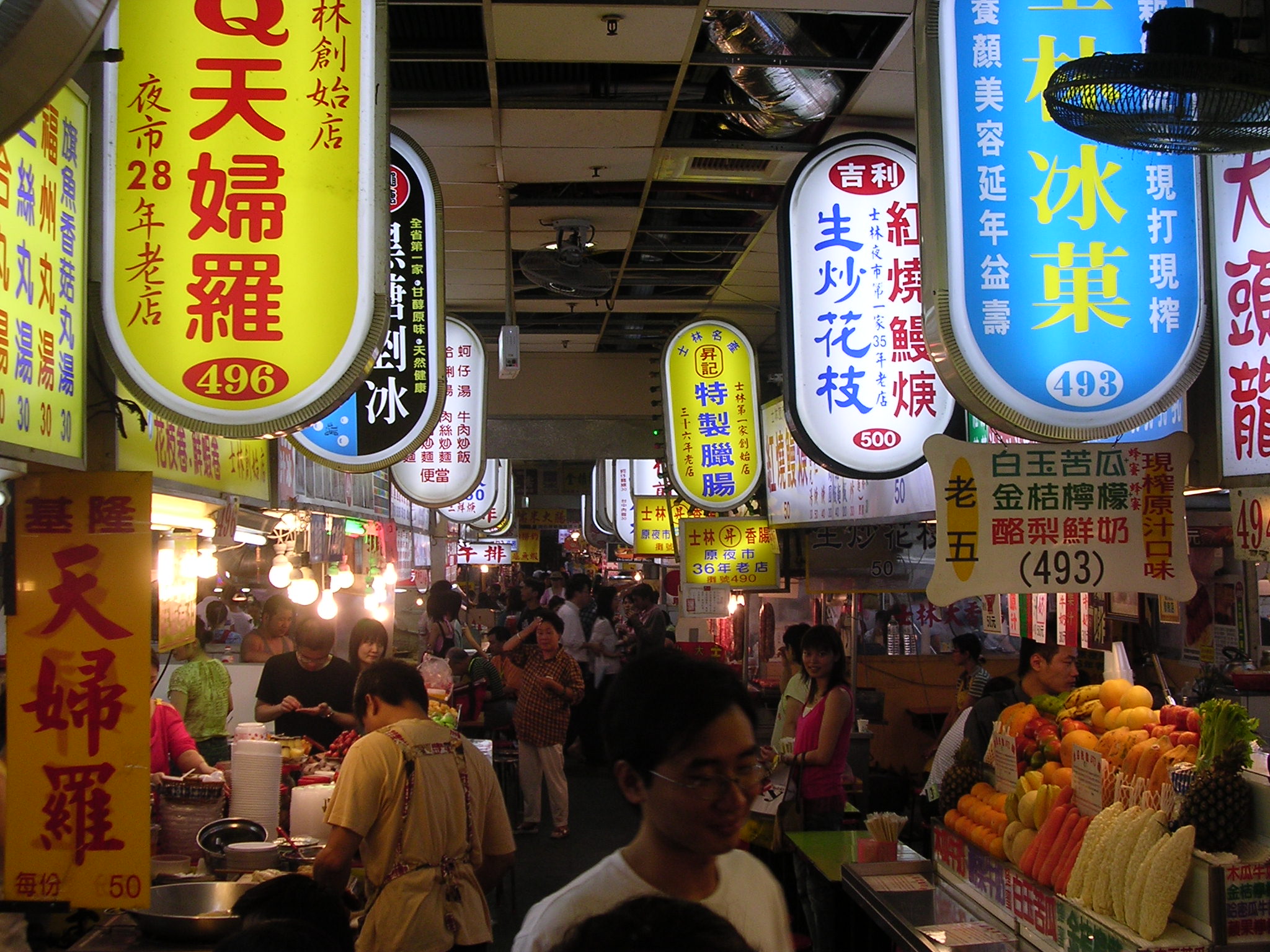
Shilin Night Market
The smell announces Shilin Night Market before the signs do. Stinky tofu -- fermented, pungent, divisive -- drifts through the air and mixes with the sweetness of grilled king oyster mushrooms and the sharp tang of lemon aiyu jelly. By 8 p.m. on any given evening, the market's narrow alleys are shoulder-to-shoulder with students, tourists, and Taipei residents who have been navigating these crowds since childhood. Shilin is not Taiwan's oldest night market, but it is its largest and most famous, a title earned through sheer density of flavor and a century of unbroken commercial momentum.
From River Wharf to Night Kingdom
Shilin's market origins trace to a wharf on the Keelung River, where farmers from the surrounding district brought produce to sell before shipping it downstream to the trading ports of Banka and Dadaocheng. A formal daytime market was established here in 1909 and inaugurated in 1913, anchoring the neighborhood as a commercial center. The transition from daytime agriculture market to nocturnal food bazaar happened gradually, following the pattern of night markets across Taiwan -- vendors staying later, crowds shifting to evening hours, the boundary between commerce and entertainment dissolving under fluorescent light. By the time the Taipei Metro opened two nearby stations in 1997, including Jiantan Station on the Tamsui-Xinyi Red Line, the night market had long since become the main event, visible from the station platform as a glow of lanterns and signage.
The Architecture of Appetite
The market operates in two symbiotic zones. The main food court, renovated and reopened in 2011 after a five-year relocation-and-rebuild project, holds 539 stalls across its ground floor, with the second floor serving as parking for 400 cars -- a pragmatic acknowledgment that a market this popular generates traffic problems that must be stacked vertically. Around this core, side streets and alleys extend the market into the surrounding neighborhood, where storefronts sell clothing, electronics, and accessories while roadside stands offer everything from bubble tea to oyster omelets. Cinemas, karaoke bars, and video arcades fill the upper floors. The effect is less a market than a neighborhood that has organized itself entirely around the act of browsing.
A Menu Written in Tradition
Shilin's food vocabulary runs deep. The oyster omelet -- a pillowy egg crepe studded with small oysters and draped in sweet-and-sour sauce -- is perhaps the market's signature dish, though fierce partisans would argue for the da chang bao xiao chang, a small pork sausage nested inside a larger sticky rice sausage, or the giant fried chicken cutlets that require two hands and a strategy. Papaya milk, blended fresh and served in plastic cups, is the default beverage. Stinky tofu, deep-fried until the exterior crisps while the interior stays creamy, divides visitors into converts and refugees. The market's vendors operate with the efficiency of people who have been doing the same thing, in the same spot, for decades. Lines form, orders fly, and the food appears with a speed that suggests choreography rather than cooking.
After Midnight at the Market
The rhythm of Shilin follows the rhythms of Taipei itself. Vendors begin setting up around 4 p.m. The first customers are students drifting home from classes at nearby Ming Chuan University and the surrounding schools, stopping for an early dinner or a snack. By 8 p.m. the crowds have thickened, and between then and 11 p.m. the alleys reach peak density -- the point where forward motion requires patience, strategy, and a willingness to follow the current. After midnight, the energy shifts. Stalls begin closing, the crowds thin, and by 1 or 2 a.m. the last vendors are packing up. For a few hours, the alleys are quiet, the fluorescent lights dark, the grills cool. Then it starts again.
From the Air
Coordinates: 25.087N, 121.525E. Located in Shilin District in northern Taipei, near the Keelung River. From the air, look for the dense commercial block just south of the Jiantan MRT station and the distinctive Chinese-palace-style roof of the station itself. Nearby airport: RCSS (Taipei Songshan Airport, ~3 km south). Best viewed at 2,000-3,000 feet. The market area is identifiable at night by its concentrated lighting amid the residential blocks.