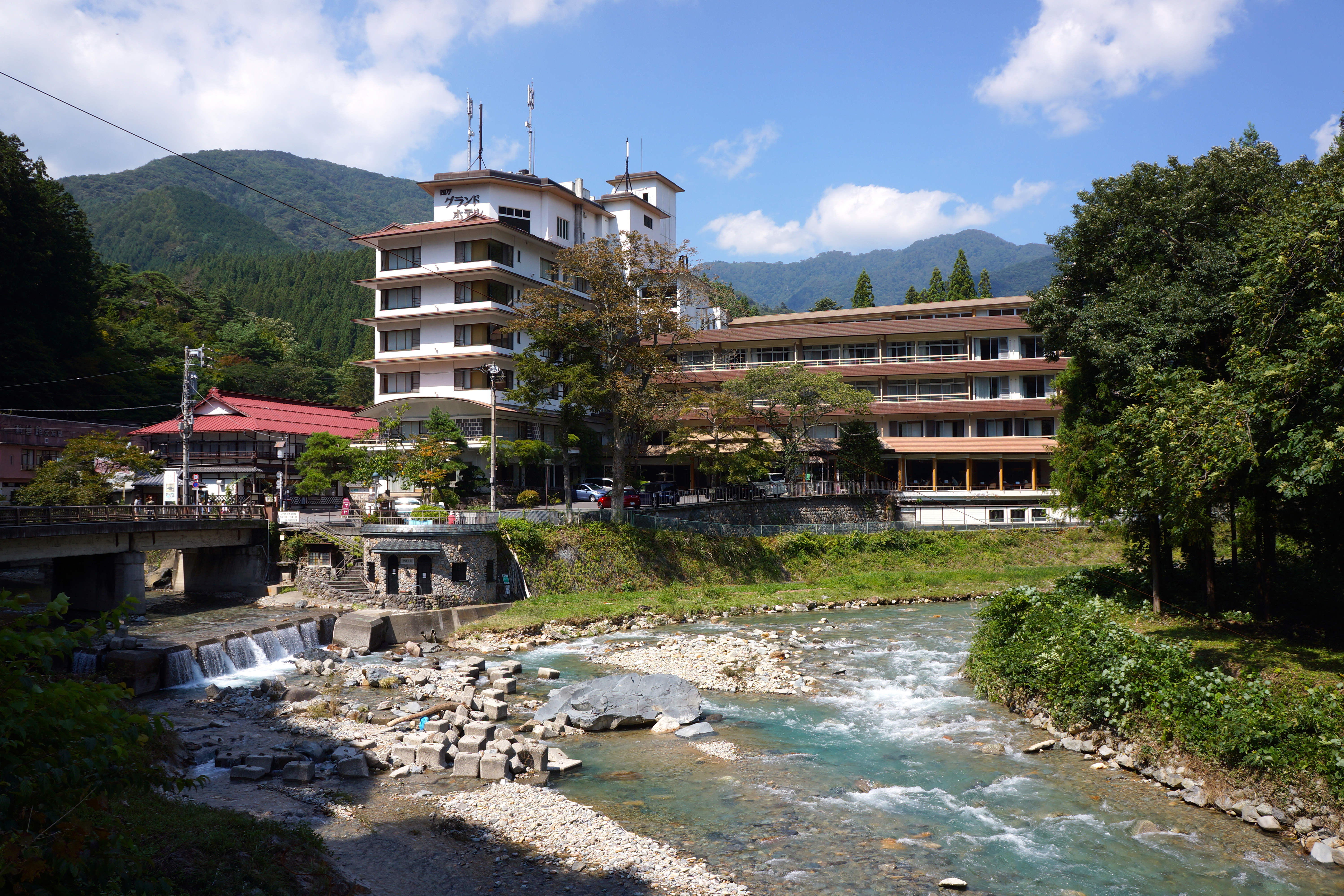
Shima Onsen
The name itself is a prescription. Shima means 40,000 in Japanese, a reference to the belief that these hot springs can cure 40,000 ailments. Whether or not the math holds up, people have been walking a rocky dirt trail into this narrow river valley in Gunma Prefecture for over four centuries, drawn by mineral-rich waters that bubble up from more than 40 separate spring sources. The town of Shima Onsen occupies a quiet stretch of the Shima River valley within the city of Nakanojo, divided into three distinct sections, each with its own collection of ryokans and public bathhouses. It is one of the oldest hot spring destinations in Japan, a place where the buildings themselves have become as much of a draw as the waters inside them.
The Inn That Inspired a Fantasy
The Sekizen-kan Honkan, built in 1691, is one of the oldest operating inns in Japan and has been designated an Important Cultural Property of Gunma Prefecture. Standing before it, with its weathered wooden facade and the vermillion bridge arching over the river in front, visitors frequently pause with a flash of recognition. This is the building widely believed to have inspired Yubaba's bathhouse in Hayao Miyazaki's Spirited Away. A tunnel connecting two of the inn's buildings bears an uncanny resemblance to the passage Chihiro walks through when she enters the spirit world. Miyazaki himself stayed at Sekizen-kan, and in a 2008 NTV program aired before the Studio Ghibli Layout Exhibition, the inn was named alongside Dogo Onsen and Meguro Gajoen as a primary inspiration for the film's iconic setting. No single building carries the official title of the bathhouse's model, but Sekizen-kan's claim is difficult to argue with.
Waters That Remember
The mineral composition of Shima Onsen's springs has drawn bathers and healers alike for centuries. Over 40 separate hot spring sources feed the town's many ryokans and public bathhouses, each with slightly different mineral content. Some facilities add salt to the already mineral-rich water, a practice that intensifies the therapeutic warmth that soaks into tired muscles. The Japanese have long categorized onsen waters by their chemical properties, and Shima's springs are sodium chloride and calcium sulfate waters, considered beneficial for skin conditions, joint pain, and general fatigue. The tradition of communal bathing here predates modern plumbing by several hundred years. Visitors once made the journey on foot, following the same rocky trail that has connected the valley to the outside world for four centuries.
A Valley Suspended in Time
What makes Shima Onsen distinctive among Japan's many hot spring towns is its refusal to modernize at the expense of character. The town sits nestled deep in a river valley surrounded by forested mountains, accessible but not conspicuously so. Many of the onsen buildings are centuries old, their wooden beams darkened by steam and age. The pace here is deliberate. Guests move between indoor and outdoor baths in cotton yukata robes, pausing at small shops and quiet gardens. The river runs through the center of town, its sound a constant backdrop. Unlike the larger, more commercialized onsen resorts closer to Tokyo, Shima retains the feel of a place where the primary activity is simply being still, soaking, and letting the water do its ancient work.
Gunma's Hidden Thermal Heart
Shima Onsen exists within a larger landscape shaped by geothermal forces. Gunma Prefecture sits in the volcanic highlands of central Honshu, where the same tectonic energy that fuels Mount Kusatsu-Shirane and Mount Asama also heats the underground aquifers that supply the region's famous hot springs. Kusatsu Onsen, one of Japan's three most celebrated hot spring towns, lies roughly 30 kilometers to the west. But where Kusatsu draws enormous crowds and produces over 32,000 liters of spring water per minute, Shima operates on a more intimate scale. Its 40-plus springs are distributed among a smaller number of establishments, creating an atmosphere closer to a private retreat than a bustling resort. For visitors willing to venture past the better-known names, Shima offers something increasingly rare: a hot spring experience that feels genuinely undiscovered.
From the Air
Shima Onsen is located at 36.6869N, 138.7742E in a narrow river valley in Gunma Prefecture. The town is not easily visible from high altitude due to surrounding forested mountains, but the Shima River valley can be traced from the air. Nearest airport is Shinshu-Matsumoto (RJAF), approximately 90 km to the southwest. Niigata Airport (RJSN) lies about 150 km to the north. The volcanic peaks of Mount Kusatsu-Shirane (2,165 m) are visible to the west. Look for the river valley cutting through densely forested terrain as a navigational reference.