Shimo-Akasaka Castle: Where Loyalty Faked Its Own Death
The castle was barely a castle. Perched on Mount Kabutori at just 185.7 meters above sea level, 61 meters above the surrounding rice paddies, the fortification that Kusunoki Masashige defended in 1331 was a hilltop earthwork in the village of Chihayaakasaka, Osaka Prefecture. Against it came somewhere between 200,000 and 300,000 soldiers of the Kamakura shogunate -- the entire military apparatus of Japan's ruling government, sent to crush a local lord who had chosen the losing side. Masashige held them off with 200 men, collapsing fake walls onto attackers, dropping logs and boulders from above, pouring boiling water on soldiers who tried to scale the ramparts. When the shogunate finally cut off his water supply and the castle fell, Masashige did not die. He faked his own death, vanished into the mountains of his own territory, and started building the next fortress. The shogunate would be gone within two years.
A Ridge Between Two Provinces
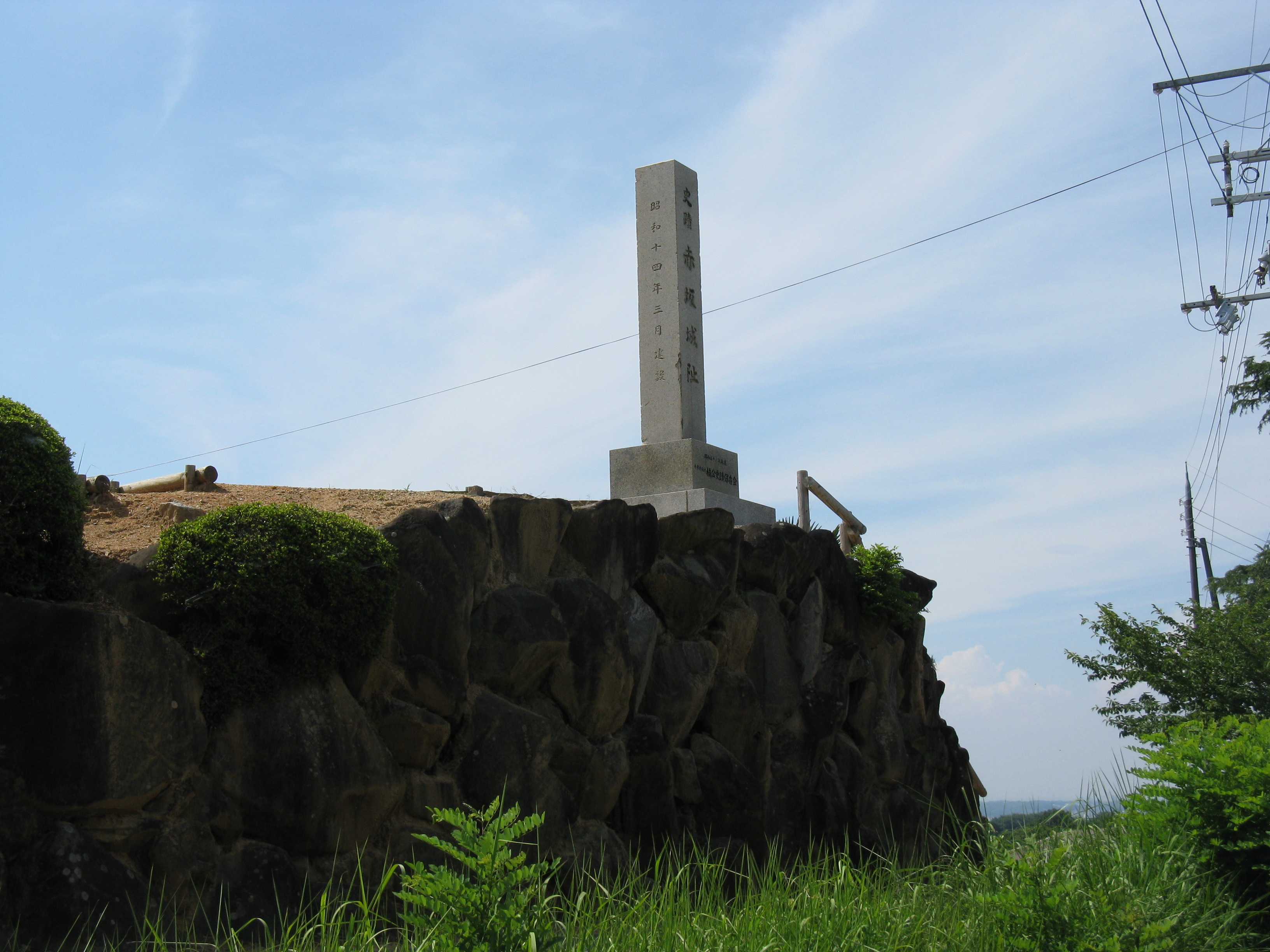
Shimo-Akasaka Castle occupies a ridge extending from Mount Kongo, the highest peak in Osaka Prefecture, on the ancient border between Kawachi Province and the Yoshino region of Yamato Province. The village of Chihayaakasaka where it sits is the smallest municipality in Osaka Prefecture by population, a quiet agricultural community of terraced rice paddies and forested hillsides that feels impossibly remote given its proximity to the Osaka metropolitan area. The castle was part of a layered defensive network that included smaller fortifications on surrounding hills, and later Kami-Akasaka Castle on the opposite hillside across a small river. Today the Honmaru -- the main enclosure -- is occupied by the Chihayaakasaka Village Hall, and a stone monument marking the castle site stands in the grounds of the neighboring junior high school. The terraced rice paddies that cascade down the surrounding slopes have become the site's most photographed feature.
The Emperor's Desperate Gamble
In 1331, Emperor Go-Daigo attempted to overthrow the Kamakura shogunate in what became known as the Genko War. He needed military force, and he found it in two men: his own son Prince Moriyoshi, and a local warrior lord named Kusunoki Masashige, who controlled the mountainous terrain around Chihaya-Akasaka. Masashige gathered his forces at Shimo-Akasaka and was joined by Prince Moriyoshi. But the first attempt failed catastrophically. Emperor Go-Daigo was captured and exiled to the remote Oki Islands in the Sea of Japan. The shogunate's armies then turned their full attention to Masashige. The Siege of Akasaka pitted the entire military power of the Kamakura government against a garrison of roughly 200 samurai inside the fort, with another 300 under Masashige's brother positioned on a nearby hill. The odds were laughable. Masashige made them irrelevant.
The Trickster's War
Masashige's defense of Shimo-Akasaka became legendary for its ingenuity. He built a false outer wall designed to collapse when attackers scaled it, burying soldiers under debris while his men rained down logs and stones from the inner fortification. When besiegers tried to use grappling hooks on the remaining walls, Masashige's defenders poured boiling water on them. Historical sources compared his tactical creativity to that of China's legendary strategists Chen Ping and Zhuge Liang. But no cleverness could overcome a siege that cut off his water supply. When the castle finally fell, Masashige staged his own death convincingly enough to fool the shogunate's forces, then disappeared into the deep mountains of his own territory. There he built two new fortresses -- Kami-Akasaka Castle and the nearly impregnable Chihaya Castle higher up on Mount Kongo. By early 1333, Masashige had joined forces with Prince Moriyoshi, recaptured Shimo-Akasaka, and resumed his offensive. The Kamakura shogunate collapsed that same year.
The Weight of Loyalty
After the Kenmu Restoration returned power to Emperor Go-Daigo, Shimo-Akasaka Castle continued to serve as a base for the Southern Court during the Nanboku-cho civil war, the decades-long conflict between rival imperial courts. The castle fell to Northern Court forces in 1360 and was abandoned. But Kusunoki Masashige's story did not end with military victory. In 1336, when Ashikaga Takauji turned against the emperor, Masashige warned Go-Daigo that a direct battle would be suicidal. The emperor ordered him to fight anyway. Masashige obeyed, marching to certain death at the Battle of Minatogawa. His dying words -- 'Would that I had seven lives to give for my country' -- became one of the most famous phrases in Japanese history. Masashige was enshrined as the supreme exemplar of samurai loyalty, and Shimo-Akasaka Castle, designated a National Historic Site since 1934, marks where that legend began.
From the Air
Located at 34.460N, 135.619E in the village of Chihayaakasaka, on the eastern edge of Osaka Prefecture near Mount Kongo. From altitude, the site sits in a valley of terraced rice paddies at the foot of the Kongo mountain range, which forms the border with Nara Prefecture. The area contrasts sharply with the dense urban sprawl of Osaka to the northwest. Kansai International Airport (RJBB) is approximately 20 nautical miles to the west-southwest. Osaka Itami Airport (RJOO) is about 22 nautical miles to the north-northwest. Yao Airport (RJOY) is roughly 12 nautical miles to the north. Best viewed at 2,000-3,000 feet AGL, where the terraced paddies and forested mountain backdrop become clearly visible.