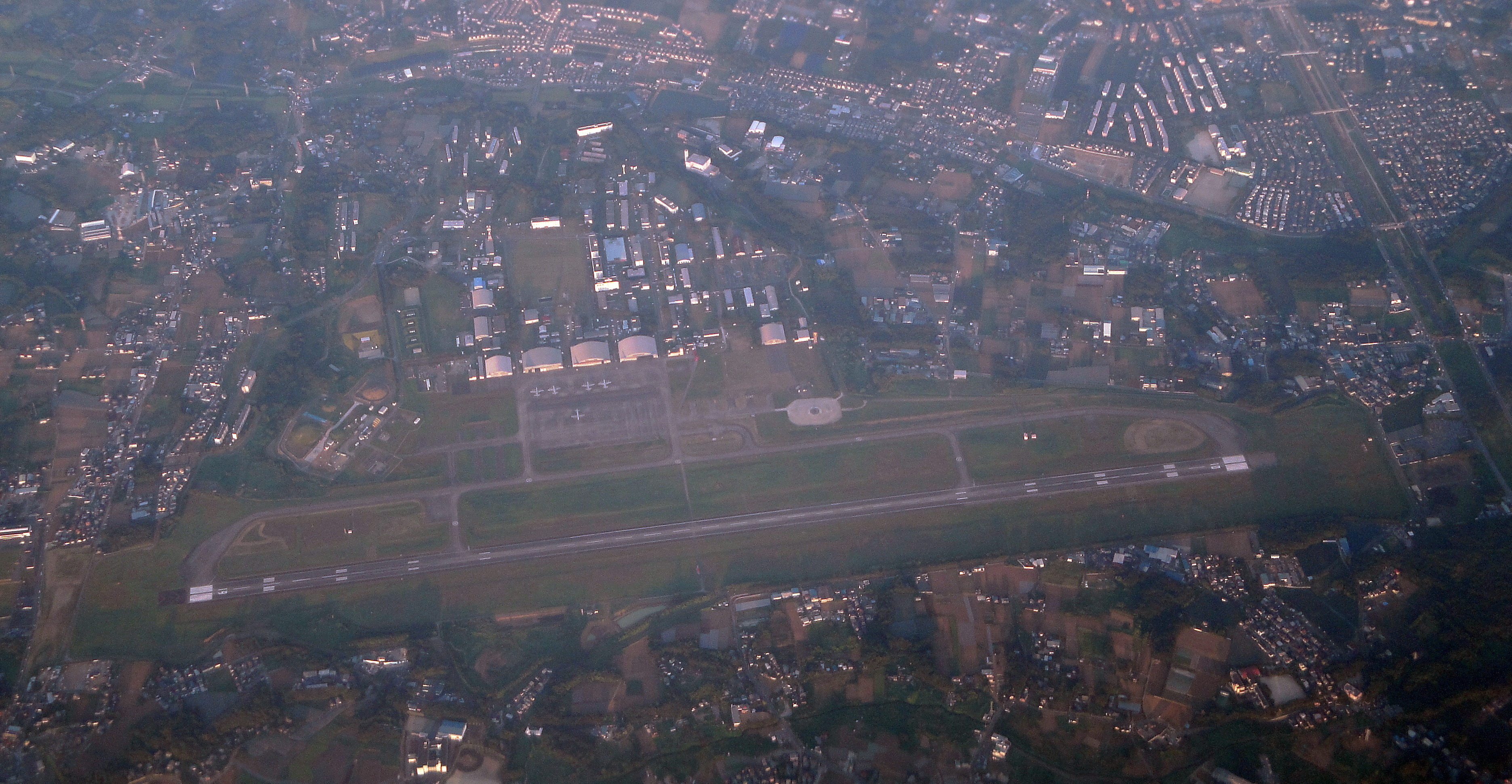
Shimofusa Air Base
Before the runway, there were fairways. In April 1945, with American bombers hammering the Kanto Plain, the Imperial Japanese Army Air Service seized the Musashi Country Club Fujigaya Course -- once the premier golf course in the Tokyo area -- and transformed it into an emergency airfield. Within weeks, twin-engine Ki-45 interceptors were scrambling from what had been manicured greens, climbing to meet the B-29s overhead. That desperate improvisation became Shimofusa Air Base, and eighty years later it still serves as one of Japan's most important military aviation facilities, straddling the border between the cities of Kashiwa and Kamagaya in Chiba Prefecture.
Scramble Over the Kanto Plain
The conversion from golf course to airfield happened with wartime urgency. By April 1945, the 116th Airfield Battalion had taken up residence at the newly designated Fujigaya Airfield. The wider Tokatsu region of Chiba Prefecture bristled with military aviation: nearby Matsudo Airfield hosted the 53rd Air Combat Group flying Kawasaki Ki-45 heavy fighters, while Kashiwa Airfield sheltered the 70th Air Combat Group with their Nakajima Ki-44 interceptors. The 18th Air Combat Group, battered from the Philippines campaign with only 36 aircrews and 46 Ki-100 fighters surviving the Battle of Luzon, regrouped at Matsudo in June 1945 for homeland air defense. The 53rd Group then shifted to Fujigaya, flying combat missions until Japan's surrender in August.
Under Three Flags
On 27 September 1945, approximately 300 troops of the Eighth U.S. Army occupied the airfield. By October, elements of the 112th Cavalry Regimental Combat Team had taken control, and the Fifth Air Force redesignated it Shiroi Air Base after the nearby town. For over a decade, the U.S. Air Force used Shiroi as an auxiliary airfield, aircraft control and warning center, and intelligence operations hub. The 6920th Security Wing and multiple radio squadrons conducted signals intelligence work from the base, supported by a radar site at Mineokayama and a communications station at Funabashi. In 1959, the USAF negotiated a joint-use agreement with the Japan Maritime Self-Defense Force. All American assets departed by December that year, and by June 1960 the base was fully returned to Japan, reborn as JMSDF Shimohusa Air Base.
Guardians of the Sea Lanes
The JMSDF wasted no time establishing Shimofusa as a cornerstone of Japan's maritime defense. Fleet Air Force Headquarters activated there in 1961, and Fleet Air Wing 4 stood up in 1962, operating P2V-7 Neptune and P-2J patrol aircraft on anti-submarine missions across the Western Pacific. The runway and control tower were rebuilt that same year. For over a decade, Shimofusa served as the nerve center for Japan's maritime patrol operations. When the JMSDF Fleet Air Force headquarters relocated to the partially released U.S. Naval Air Station Atsugi in 1973, Shimofusa's mission evolved. The Air Training Command moved in from Utsunomiya, and the base became the place where Japan's naval aviators learn their craft.
Where P-3 Orions Learn to Hunt
Today Shimofusa is headquarters of the JMSDF Air Training Command and home to the Shimohusa Air Training Group. The distinctive gray silhouettes of Kawasaki-Lockheed P-3C Orion maritime patrol aircraft are a constant presence in the skies above Kashiwa and Kamagaya, flown by the 203rd Air Training Squadron. Until 2011, NAMC YS-11 turboprops -- Japan's only domestically designed postwar airliner, adapted for training -- also operated from the field. The base houses the JMSDF 3rd Service School, training ground crews and technical specialists, and a detachment of the Communications Command. From a golf course requisitioned in desperation to one of Japan's premier naval aviation training installations, Shimofusa's runway has never stopped serving whoever claims it.
From the Air
Shimofusa Air Base (RJTL) is located at 35.80N, 140.01E in the dense suburban landscape east of Tokyo, straddling the Kashiwa-Kamagaya border in Chiba Prefecture. The single runway is oriented roughly 01/19. When approaching from altitude, look for the military installation embedded within the urban sprawl northeast of Matsudo. Nearby civilian airports include Narita International (RJAA) approximately 30 nm to the east and Haneda (RJTT) approximately 25 nm to the southwest. This is an active JMSDF base; civilian overflights should maintain appropriate altitude and monitor military frequencies.