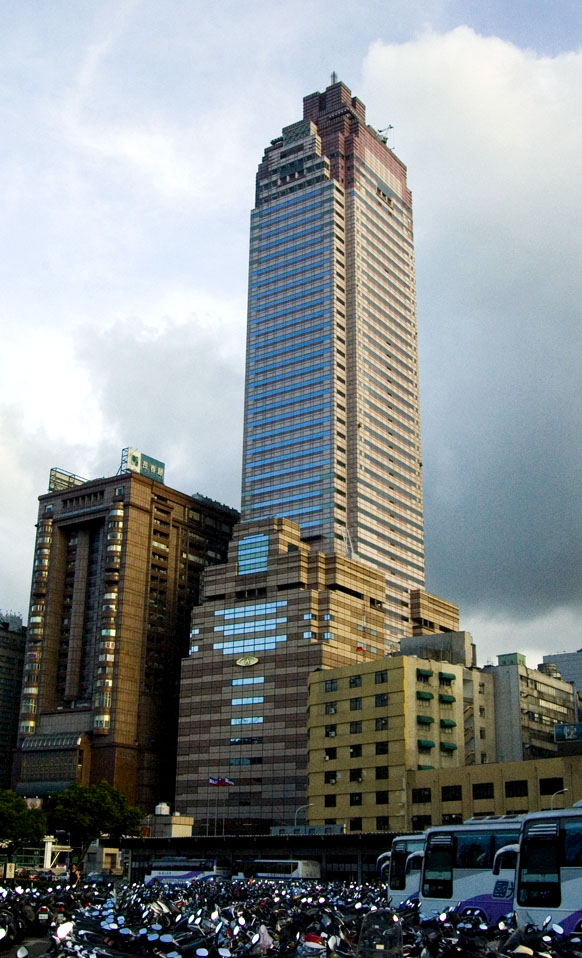
Shin Kong Life Tower
The color is the first thing you notice. In a skyline dominated by glass and concrete in shades of gray and silver, the Shin Kong Life Tower blushes. Its rose-tinted aluminum exterior was deliberately chosen to evoke both the plum blossom of Taiwan and the cherry blossom of Japan -- a diplomatic gesture rendered in cladding, 51 stories tall. When the tower opened across from Taipei Main Station in 1993, it was the tallest building in Taiwan. That record lasted only four years before Kaohsiung's Tuntex 85 Sky Tower surpassed it, and Taipei 101 would eventually dwarf both. But the Shin Kong Life Tower was first, and the view from its 46th-floor observatory was where an entire generation of Taipei residents first saw their city from above.
Ghosts of the Railway Hotel
The plot of land across from Taipei Main Station carries its own history. From 1908 to 1945, the site was home to the Taiwan Railway Hotel, the most luxurious accommodation on the island, catering primarily to Japanese and foreign guests during the colonial period. Allied bombing during World War II destroyed the hotel, and for decades afterward the 10,000-square-meter plot sat in a state of contested ownership. By 1981, four companies held shares of the land and began discussions about development, but agreement proved elusive. Ownership consolidated to two firms by 1985. Asiaworld International Group took the eastern half and built the Asiaworld Department Store, which opened in 1990. Shin Kong Life Insurance Company claimed the western portion and hired the Kaku Morin Group (KMG) Architects and Engineers of Japan to design something ambitious.
Engineering for Earthquakes and Typhoons
Building a 245-meter tower on a constrained urban site across from the busiest train station in Taiwan required solutions to problems that had no local precedent. KMG created a 1,170-square-meter public plaza by setting the building 31 meters back from the street, a sacrifice of valuable ground-floor real estate that gave the tower breathing room and pedestrians a wide walkway. Inspectors from National Taiwan University were consulted to ensure seismic resilience -- not optional in a country where earthquakes are a routine fact of life. The designers chose aluminum for the exterior, a material that weathers well against Taiwan's typhoons and tropical sun. Separate elevator banks were installed for department store customers, office workers, and observatory visitors, a logistical decision that acknowledged the building would serve three distinct populations moving through the same structure at different speeds and different times of day.
The View from the 46th Floor
When it opened, the Shin Kong Life Tower's observatory was Taipei's only high-altitude public viewing platform. For the first time, residents could look down on their city rather than up at its buildings. The observatory occupied the 46th floor, high enough to see the grid of streets radiating from Taipei Main Station and the green mountains ringing the Taipei Basin. The experience was novel enough to make the tower a destination in itself, separate from the Shin Kong Mitsukoshi department store occupying the first twelve floors and two underground levels. The observatory has since been repurposed -- it now serves as the Taiwan headquarters for Naturally-Plus, a health products company -- but the tower's position across from the station ensures it remains a daily landmark for the millions of commuters who pass through Taipei's transportation hub.
Standing in a Taller City
The Shin Kong Life Tower lost its height record to the Tuntex 85 Sky Tower in Kaohsiung in 1997, and Taipei 101 redefined the skyline entirely when it opened in 2004. But records are not the same as relevance. The tower's location across from Taipei Main Station places it at the center of the city's densest pedestrian traffic. Weekdays bring waves of students heading to the cram schools that cluster in the surrounding blocks. Weekends fill the plaza with concertgoers and families. The Shin Kong Mitsukoshi department store on the lower floors remains a retail anchor, and the tower's rose-colored pyramid is still the landmark that orients travelers emerging from the station into the unfamiliar grid of central Taipei. English speakers sometimes call it the Mitsukoshi Building after the department store signage on its facade -- a confusion that speaks to how thoroughly commerce and architecture have merged in this particular tower.
From the Air
Coordinates: 25.046N, 121.515E. Located directly across from Taipei Main Station in Zhongzheng District, identifiable by its distinctive rose-colored facade and pyramid-topped crown. The tower is the tallest structure in the immediate station area, though dwarfed by Taipei 101 to the southeast. Nearby airport: RCSS (Taipei Songshan Airport, ~3 km northeast). Best viewed at 3,000-5,000 feet. The adjacent Taipei Main Station transportation hub and rail yards are prominent visual references.