Shinjō Castle
The moats are still there. Wide, dark, and quiet, they trace the outline of a fortress that no longer exists, holding water for a castle whose walls were torn apart in a single furious summer. Shinjō Castle stood in the flatlands of northern Yamagata Prefecture for 243 years, home to nine generations of the Tozawa clan, until the wars of the Meiji Restoration consumed it in 1868. Today four Shinto shrines occupy the main bailey, their torii gates rising where samurai once drilled. The only original structure left is the Temman-gū shrine, tucked among fragments of stone foundation that hint at the scale of what once filled this space.
A Reward Written in Stone and Water
Tozawa Masamori arrived in Dewa Province in September 1622 with a promotion and a problem. The Tokugawa shogunate had just suppressed the powerful Mogami clan and needed someone reliable to govern the northern reaches of what is now Yamagata Prefecture. Masamori, formerly the daimyō of Hitachi-Matsuoka Domain with 40,000 koku in revenue, received a generous increase to 60,000 koku and control of all of Mogami District plus portions of Murayama District. But the existing seat of power, the hilltop Sakenobe Castle, was cramped and badly positioned for administering such a large territory. Masamori petitioned the shogunate for permission to build from scratch. By 1625, his new castle rose from the flatlands: a main bailey, a secondary bailey to the south, and a sweeping third bailey, all embraced by wet moats that turned the entire complex into an island of authority in the rice paddies of the Mogami River basin.
Fire and the Missing Tower
For eleven years, Shinjō Castle's donjon -- its central tower -- commanded the skyline of the Mogami plain. Then, in 1636, fire reduced it to charcoal. The Tozawa lords never rebuilt it. Whether this was a matter of finances, politics, or the shogunate's wariness of provincial lords accumulating military architecture, the records do not say. But the absence shaped the castle's character for the next two centuries. Without the dramatic vertical profile of a tower keep, Shinjō Castle became a fortress defined by its horizontal sprawl: wide baileys, deep moats, and the daily rhythms of a castle town that grew up around its walls. The Tozawa clan governed quietly from this seat through the long peace of the Edo period, nine lords in succession, their domain a modest but stable holding in the snowy north.
Betrayal and the Battle of Shinjō
The peace ended in 1868. When the Tokugawa shogunate collapsed and the Meiji government rose to power, the domains of northern Japan formed the Ōuetsu Reppan Dōmei, a military alliance to resist the new order. But allegiances fractured quickly. Kubota Domain, to the north, defected to the imperial side. Shinjō Domain followed suit. The neighboring Shōnai Domain, outraged by the betrayal, sent its army south. What followed was the Battle of Shinjō, one of the fiercest engagements of the Boshin War in the Tōhoku region. Shōnai forces stormed the castle and burned their way through the surrounding town. When the smoke cleared, Shinjō Castle was destroyed -- not by a distant enemy, but by neighbors who had shared the same alliance weeks earlier. The destruction was thorough. Walls, gates, and buildings were reduced to rubble and ash.
Shrine Gates Where Samurai Walked
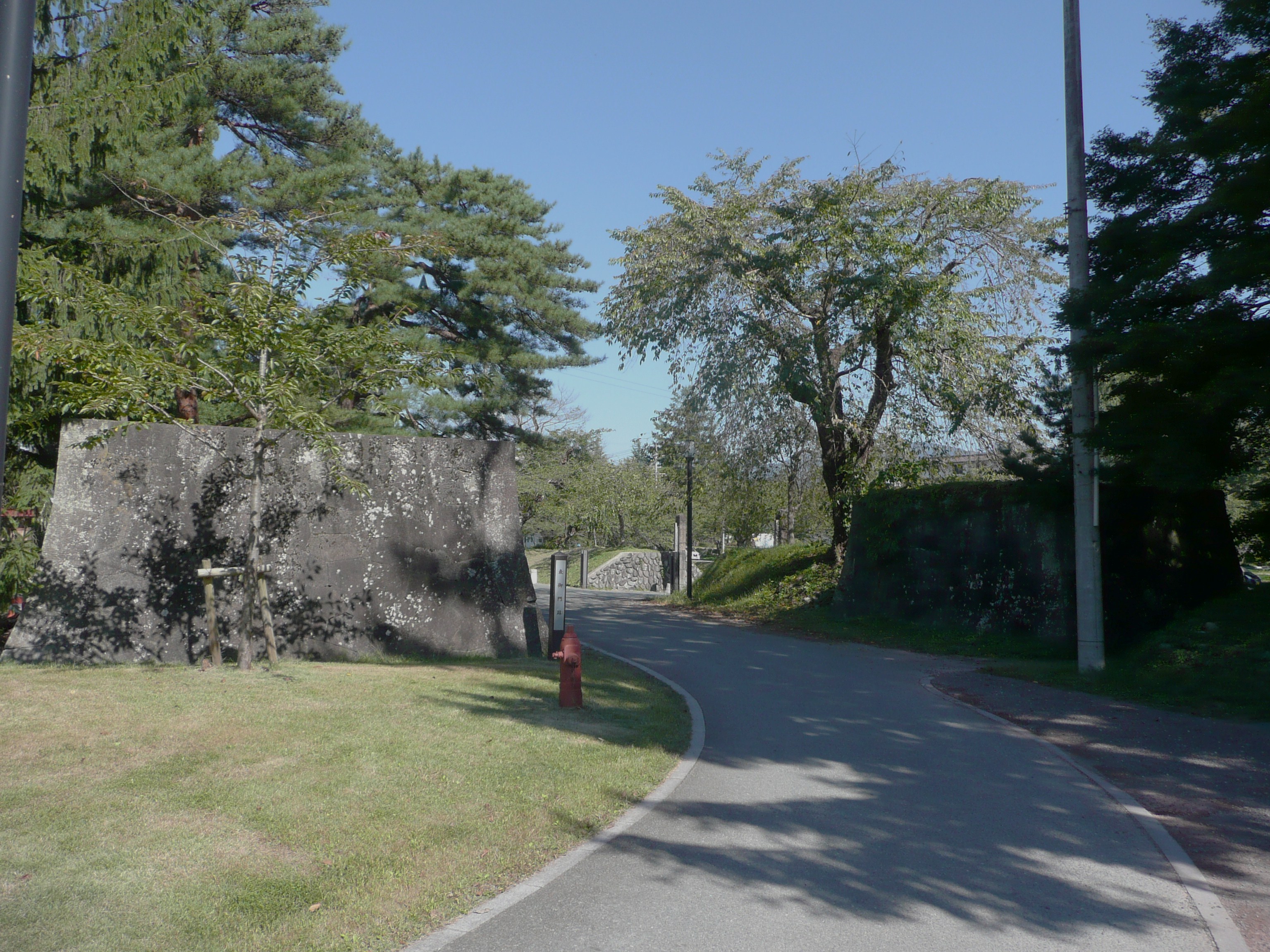
Walk the castle grounds today and the military past is more felt than seen. The main bailey, once the administrative heart of Shinjō Domain, now hosts four Shinto shrines beneath mature trees. The Temman-gū shrine is the sole surviving original structure, its presence a quiet testament to how thoroughly the rest was erased. Scattered sections of stone wall and foundation stones mark where buildings and gates once stood. The second bailey and the former donjon site have become Mogami Park, a public green space where locals gather for the city's famous Shinjō Matsuri festival each August. A history museum occupies part of the former third bailey, displaying artifacts from the castle era. The moats, perhaps the most enduring feature, remain filled with water, their reflective surfaces tracing the exact footprint of Masamori's 1625 design across the landscape.
From the Air
Located at 38.767°N, 140.294°E in the Mogami River basin of northern Yamagata Prefecture, Japan. The castle ruins sit in the flatlands of Shinjō city, identifiable from the air by the rectangular moat system that still outlines the former castle footprint amid the surrounding urban grid. Nearest airports: Yamagata Airport (RJSC) approximately 80 km south, Shonai Airport (RJSY) approximately 60 km west. The Mogami River runs nearby, a useful visual landmark when approaching from any direction. Winter brings heavy snowfall to this region; spring and autumn offer the clearest visibility over the Mogami plain.