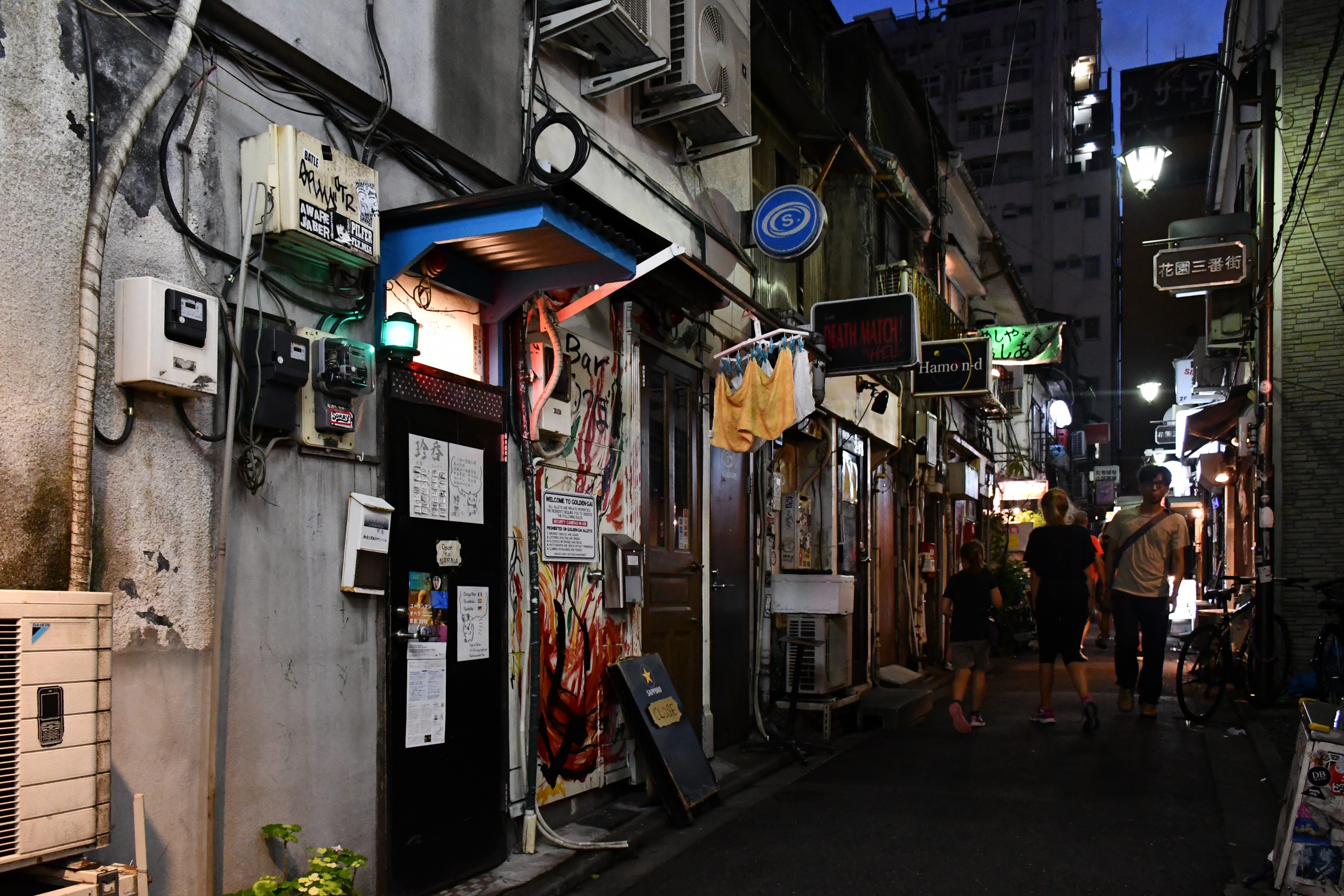
Shinjuku Golden Gai: Two Hundred Bars in Six Alleys
Some bars seat five people. A few manage eight. One or two fit only the bartender and whatever conversation squeezes past the bottles. Shinjuku Golden Gai packs more than 200 of these miniature drinking establishments into six alleys so narrow that two people cannot walk side by side. The buildings -- wooden, two-story, built so close together they nearly touch -- are architectural fossils from a Tokyo that no longer exists anywhere else. A few minutes' walk from the East Exit of Shinjuku Station, tucked between the Shinjuku City Office and the ancient Hanazono Shrine, Golden Gai has no right to still be here. The developers have been circling for decades. The yakuza once tried to burn it down. It survived because its regulars stood guard through the night.
Black Market to Bohemia
Golden Gai's origins trace to the chaos of postwar Tokyo. In 1945, with much of the city flattened and government authority tenuous, the area near present-day Kabukicho became a black market hub where survival commodities changed hands in improvised stalls. Prostitution was part of the economy until 1958, when Japan's anti-prostitution law took effect. The tiny structures remained, but their purpose shifted. By the late 1950s and into the 1960s, the cramped rooms began filling with liquor bottles instead of contraband. Writers, filmmakers, journalists, and musicians discovered the appeal of a bar small enough that every customer becomes part of the same conversation. A famous establishment called the Bundan Bar -- the bar of the literary world -- attracted enough authors and intellectuals that the entire district earned the nickname bunkajin no machi: the district of cultivated people.
Five Stools and a Theme
Each bar in Golden Gai is a universe compressed to the size of a closet. The typical layout is a ground-floor bar with a counter, a few stools, and shelves of bottles climbing to the ceiling, topped by either a second bar or a tiny apartment reached by steep, nearly vertical stairs. Many bars define themselves by obsession: one plays only jazz vinyl. Another specializes in punk rock from a single decade. There are bars devoted to karaoke, to R&B, to flamenco, to obscure horror films, to a particular brand of whiskey. The smallness is the point. With only five seats, the owner-bartender is not a server but a host, curator, and conversational partner. Regulars are not customers but members of an unspoken club. Cover charges -- common in Golden Gai -- serve as much to filter the curious from the committed as to cover costs.
The Night Watch
In the 1980s, Tokyo's real estate frenzy turned Golden Gai into a target. Developers wanted the land beneath these wooden shacks to build the same glass and concrete towers that had already consumed the surrounding blocks. The strategy was familiar: yakuza-affiliated groups set fire to buildings across Tokyo during this period, destroying the structures so the land could be acquired cheaply for redevelopment. Golden Gai's supporters organized a response that was as stubborn as it was simple. Volunteers took turns patrolling the alleys at night, maintaining a constant human presence that deterred arsonists. The watch held. The fires never came. Around Golden Gai, the neighborhood transformed utterly -- wider roads, taller buildings, the modern Kabukicho entertainment district. But inside the six alleys, the wooden walls and hand-painted signs remained exactly as they were.
A Window Before the Miracle
Golden Gai's architectural significance extends beyond nostalgia. Before Japan's postwar economic miracle reshaped the capital in the latter half of the twentieth century, large parts of Tokyo looked like present-day Golden Gai: extremely narrow lanes threaded between tiny two-story wooden structures. The redevelopment that followed widened streets, enlarged building plots, and replaced wood with steel and glass. Golden Gai is now one of a shrinking number of places where the physical texture of pre-miracle Tokyo can still be touched. The buildings stand just a few feet wide, leaning slightly with age, their facades crowded with hand-lettered signs and dangling lanterns. Walking through at dusk, when the bars begin to open and warm light spills from doorways barely wide enough to enter, is to step through a crack in time -- into a city that built the future while forgetting to demolish this one small corner of the past.
From the Air
Located at 35.694N, 139.705E in the Kabukicho district of Shinjuku, central-western Tokyo. From altitude, Golden Gai is invisible beneath the surrounding high-rise canopy of Kabukicho and the Shinjuku commercial district -- it occupies a footprint smaller than most individual buildings nearby. The area lies roughly 12 nautical miles west-northwest of Tokyo Haneda International Airport (RJTT). Narita International Airport (RJAA) is approximately 38 nautical miles to the east. Shinjuku Station, the world's busiest railway station, is the dominant landmark; the adjacent Hanazono Shrine's tree canopy provides a visual reference point. Best viewed contextually from 3,000-5,000 feet AGL, where the dense Shinjuku skyline and the open rectangle of Shinjuku Gyoen to the south frame the area.