Shinjuku Gyoen: A Feudal Lord's Gift to the City
In Yasunari Kawabata's novel 'The Sound of the Mountain,' a character stands inside Shinjuku Gyoen and marvels: 'You can stretch out. It's like getting out of Japan -- I wouldn't have dreamed that there was a place like this right in the middle of Tokyo.' The Nobel laureate understood what every visitor eventually feels. The garden sprawls across 58.3 hectares at the seam between Shinjuku and Shibuya wards, and stepping through any of its three gates is a disorienting act of subtraction -- the sirens fade, the neon vanishes, and in their place rise Himalayan cedars so tall they blot out the surrounding skyscrapers. This is not a park carved from leftover urban space. It is a landscape that predates the city around it, a place where the hands of a shogun, a feudal lord, an emperor, and a modern republic have each shaped the ground in turn.
A Shogun's Bequest
The story begins in 1590, when the shogun Tokugawa Ieyasu granted a tract of land to a Naito daimyo for his residence in Edo. The Naito family held the estate through generations, completing a formal garden on the grounds in 1772. For nearly three centuries, this was private aristocratic space -- walled, guarded, invisible to the commoners who walked past its perimeter. The Meiji Restoration of 1868 overturned the old feudal order, and by 1872 the estate had been repurposed as an experimental agricultural center under the new government. Crops and cultivation methods from the West were tested in the same soil where a feudal lord once strolled. The garden eventually passed to the Imperial Household Agency, serving as a retreat for the emperor and his court, before being designated a national garden under the Ministry of the Environment.
Three Gardens in One
Shinjuku Gyoen blends three distinct landscape traditions across its grounds. The northern section divides between a formal French garden -- geometric paths, symmetrical plantings, precise hedgerows radiating from a central axis -- and an English landscape garden, all sweeping lawns, irregular lake edges, and carefully composed sightlines that make nature appear unconstructed. To the south lies a traditional Japanese garden, where moss-covered stones border a still pond, wooden bridges arch over shallow streams, and a tea house offers the kind of meditative quiet that Japanese garden design has pursued for centuries. The juxtaposition is deliberate, a product of the Meiji era's fascination with importing and adapting Western culture. The result is a garden that functions as a living textbook of horticultural philosophy, each tradition given enough room to breathe without overwhelming the others.
A Thousand Cherry Trees
The garden holds more than 20,000 trees, but it is the approximately 1,100 cherry trees -- across 65 varieties -- that make Shinjuku Gyoen one of Tokyo's most beloved hanami destinations. The bloom unfolds in waves: Shidare, or weeping cherry, opens first in late March, its cascading branches heavy with pale blossoms. Somei -- the iconic Tokyo Cherry -- follows in early April, blanketing the English landscape section in white and pink. The season extends through late April with the arrival of Kanzan cherry, whose deep pink double flowers hold the canopy even as the earlier varieties have shed their petals. During peak bloom, the garden opens seven days a week and requires advance reservations on certain dates. Beyond cherry season, the grounds sustain towering Himalayan cedars, tulip trees, cypresses, and plane trees -- the last of which were first planted in Japan right here in the imperial gardens.
Under Glass Since 1892
Horticultural experimentation has been conducted in Shinjuku Gyoen's greenhouses since 1892, making them among the oldest continuously operating botanical facilities in Japan. The current greenhouse, constructed in the 1950s, houses more than 1,700 tropical and subtropical plant species on permanent display -- orchids, ferns, and palms crowding the humid glass enclosure in vivid contrast to the temperate landscape outside. The greenhouse preserves the garden's original mission as an agricultural research station, a thread that connects the Meiji-era scientists who tested Western crops to the botanists who maintain rare species today. It also serves as a quiet reminder that Shinjuku Gyoen has never been merely ornamental. From its first incarnation as a feudal estate through its years as an imperial retreat and a government laboratory, this has always been a place where people have tried to understand what the earth can be made to grow.
The Garden in the Frame
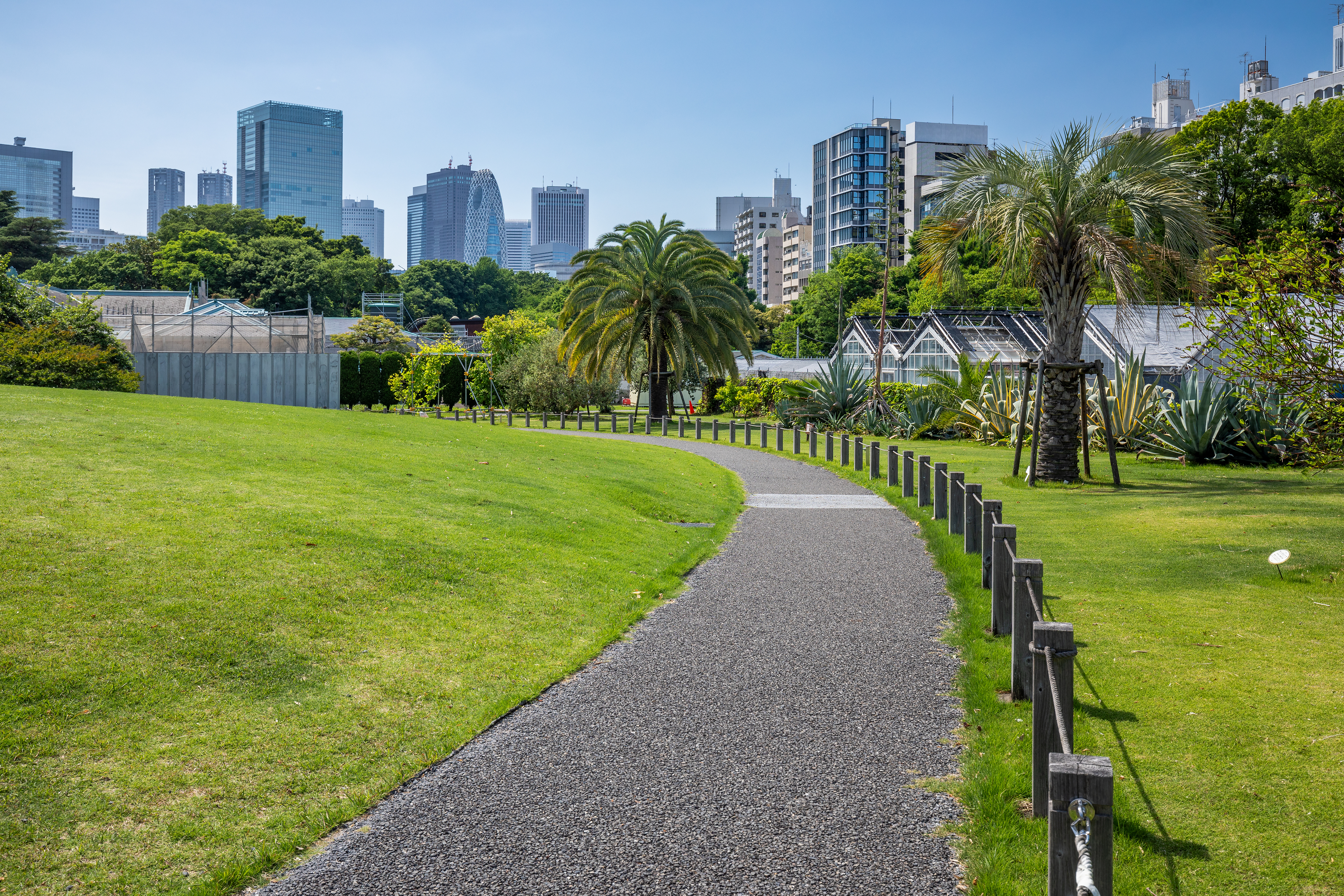
Shinjuku Gyoen has become as much a cultural landmark as a botanical one. Kawabata set scenes here. Director Makoto Shinkai chose the garden as the primary setting for his 2013 anime film 'The Garden of Words,' rendering its rain-soaked pathways and wooden shelters in luminous detail that drew a new generation of visitors tracing the film's locations. During the chrysanthemum season in the first half of November, the garden hosts an exhibition that continues a tradition established under the imperial court. The contrast between the garden's stillness and the vertical energy of the Shinjuku skyline visible above its tree line is one of Tokyo's most photographed juxtapositions -- a reminder that this city has always been a negotiation between density and space, between building upward and preserving what lies flat against the ground.
From the Air
Located at 35.685N, 139.710E in central Tokyo, straddling the Shinjuku and Shibuya ward boundary. From altitude, Shinjuku Gyoen is immediately recognizable as a large rectangular green space surrounded by dense urban development. The garden lies roughly 12 nautical miles west-northwest of Tokyo Haneda International Airport (RJTT). Narita International Airport (RJAA) is approximately 37 nautical miles to the east. The contrast between the garden's tree canopy and the Shinjuku skyscraper cluster immediately to the northwest makes it one of the most visually distinctive features in western Tokyo from 3,000-6,000 feet AGL. Shinjuku Station and the NTT Docomo Yoyogi Building's distinctive clock tower serve as nearby orientation landmarks.