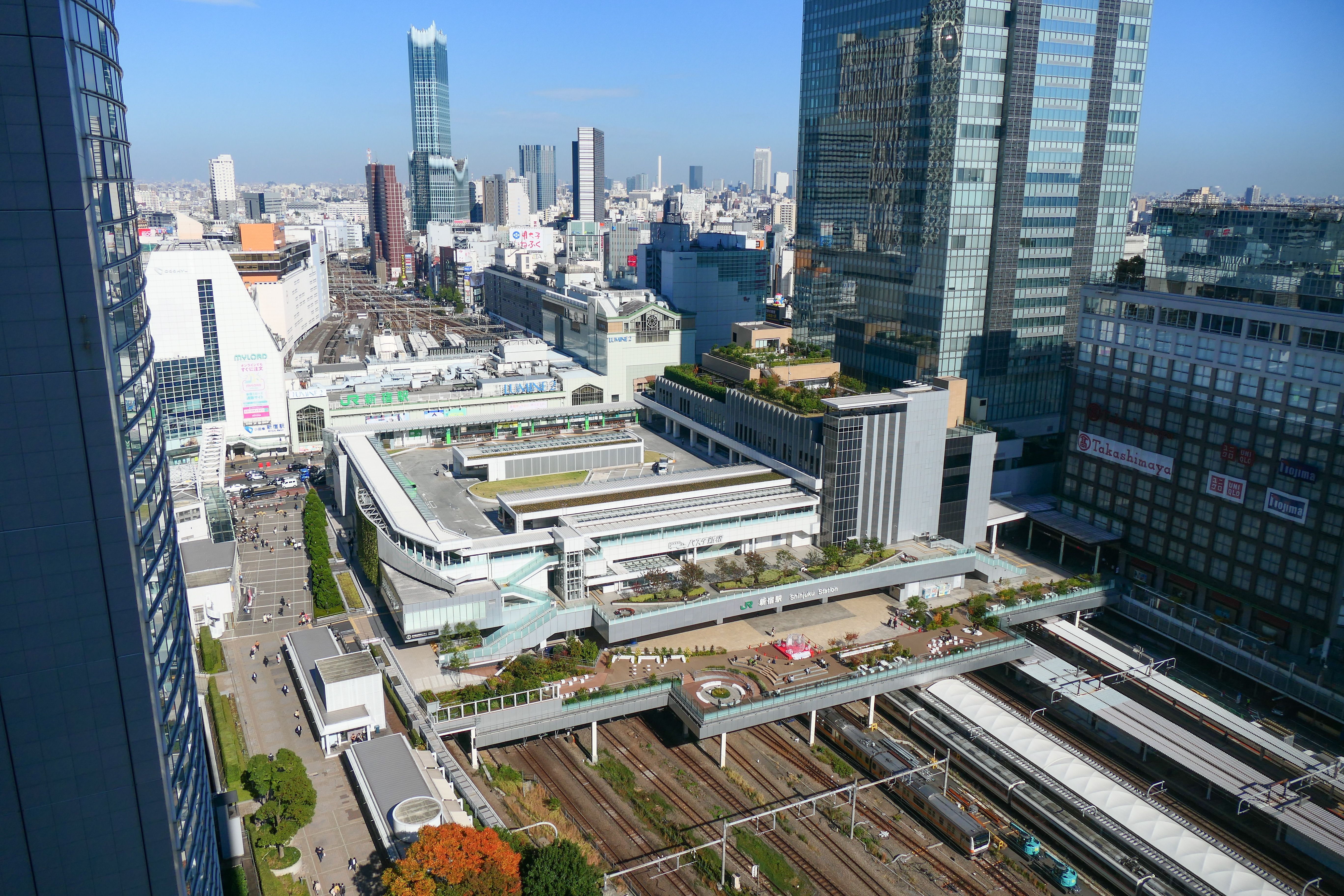
Shinjuku Station: The Labyrinth That Moves a City
Somewhere inside Shinjuku Station, a sign once read "West Exit Plaza." After anti-war protesters turned that plaza into a weekly folk-music gathering in 1969, riot police cleared the crowd with tear gas and quietly changed the sign to "West Exit Concourse." A public square became a hallway with the stroke of a pen. That small act of renaming captures the essence of Shinjuku Station: a place so vast, so layered, and so continuously reshaped by human pressure that its very identity shifts depending on who controls the labels. With 52 platforms, well over 200 exits, and an average of 3.59 million daily users as of 2018, it holds the Guinness World Record as the planet's busiest railway station -- a distinction that feels less like a superlative and more like a weather condition.
A Quiet Stop on a Country Line
Shinjuku Station opened in 1885 as a stop on Nippon Railway's Akabane-Shinagawa line, which would eventually become part of the Yamanote Line. The name itself -- the kanji meaning "new relay station" -- reflected Shinjuku's origins as a post town on the Koshu Kaido highway during the Edo period. Farms still surrounded the station when the Kobu Railway extended its line between Shinjuku and Tachikawa in 1889. Growth came gradually. The Keio Line connected from the west in 1915. Odakyu Electric Railway opened its Odawara Line to the mountains and coast in 1927. The Great Kanto Earthquake of 1923 proved a turning point: Shinjuku's east side suffered relatively little damage compared to the devastation in central Tokyo neighborhoods like Nihonbashi, and businesses began relocating near the station. Urban planner Kensaburo Kondo designed a major revamp in 1933, envisioning a grand public square and underground transit connections. World War II suspended those plans, but Kondo's blueprint shaped the station's bones for decades to come.
The Crossroads of Ten Railways
Today the station serves six JR East lines -- the Yamanote, Chuo Rapid, Chuo-Sobu, Saikyo, Shonan-Shinjuku, and Chuo Main Line limited expresses -- along with the private Odakyu Odawara Line, two Keio Corporation lines, the Toei Shinjuku Line, and the Toei Oedo Line, with five more stations reachable through underground passages. The JR section alone handles 1.5 million passengers daily across 16 tracks on eight island platforms. Odakyu's terminus, stacked on two levels beneath the Odakyu department store, moves 490,000 passengers a day through ten platforms. The Keio complex served 788,567 daily riders in 2019. Narita Express trains to the airport depart from the same platforms as suburban commuter services, while overhead, a 32-story office tower completed in 2016 rises above a bus terminal, taxi stands, and an underground arcade. The whole thing operates with the precision of a clockwork mechanism that nobody fully designed.
Protests, Poison, and the Underground Plaza
Shinjuku Station has been a stage for history beyond transit. On October 21, 1968, 290,000 marchers converged on the station during International Anti-War Day, forcing all train services to halt. The following spring, anti-Vietnam War activists from the group Beheiren -- self-styled "folk guerrillas" carrying guitars -- led weekly singalongs in the underground west-exit plaza, drawing crowds of thousands. Participants described the space as a "liberated zone" and a "community of encounter" until riot police dispersed the gatherings in July 1969. Less than three decades later, on May 5, 1995, members of the Aum Shinrikyo doomsday cult attempted a cyanide gas attack in the underground concourse, barely a month after the sarin attack on the Tokyo subway that killed 13 people. Quick-acting staff extinguished the burning device before the gas could disperse. The station absorbed these events as it absorbs everything -- folding them into its corridors and moving on.
Still Under Construction
Shinjuku Station has never really been finished. A major redevelopment launched in July 2021 aims to improve pedestrian flow between the east and west sides -- a crossing that until 2020 required a ten-minute detour. An east-west free passageway opened that year, but the broader reconstruction is expected to continue until 2047, more than 160 years after the first train stopped at this once-quiet country platform. The 1973 Shinkansen Basic Plan still technically reserves right-of-way beneath the station for a bullet-train connection to Niigata that was never built. The underground space sits waiting. That patience is perhaps the station's truest characteristic: a place perpetually becoming, absorbing new lines, new crowds, and new purposes into a labyrinth that 3.59 million people navigate daily without ever seeing its full shape.
From the Air
Located at 35.691N, 139.699E on the boundary between Shinjuku and Shibuya wards in central Tokyo. From altitude, the station complex is identifiable by the cluster of Nishi-Shinjuku skyscrapers immediately to the west, including the twin towers of the Tokyo Metropolitan Government Building. The large green rectangle of Shinjuku Gyoen park lies to the east-southeast. Shinjuku Station sits approximately 10 nautical miles north-northwest of Tokyo Haneda International Airport (RJTT) and 35 nautical miles west of Narita International Airport (RJAA). Best viewed from 3,000-5,000 feet AGL, where the rail corridors fanning out in multiple directions from the station are visible against the dense urban fabric.