Shinsaibashi
The name belongs to a bridge that no longer exists over a canal that was filled in decades ago, yet Shinsaibashi remains the beating commercial heart of Osaka. For four centuries, this district in Chuo-ku has drawn crowds with an almost gravitational pull, evolving from a cluster of merchant stalls around a wooden canal crossing into a covered shopping arcade stretching roughly 600 meters, flanked by international luxury brands, department stores, and the irrepressible energy of Amerika-mura, Osaka's American-themed youth culture hub. What makes Shinsaibashi remarkable is not just its longevity but how stubbornly its identity clings to the memory of one man and his bridge.
The Merchant and His Bridge
In 1622, during the excavation of the Nagahori-gawa canal, a merchant named Shinsai Okada built a wooden bridge 35 meters long and 4 meters wide. He was one of four merchants who financed the canal's construction, and the bridge bore his name. That original wooden crossing required constant maintenance from the townspeople who collectively owned it, but the arched structure became a beloved Osaka landmark and a favorite topic of conversation among locals. The bridge was a point of civic pride, a physical connection between neighborhoods that also bonded a community around shared ownership and upkeep. Like many place names in Osaka, Shinsaibashi belongs to the category of 'Machi-bashi,' or town bridges, built and maintained by local merchants rather than the government.
Eyeglasses Over Water
In 1909, the wooden bridge gave way to something grander. Accompanying the construction of a streetcar line along Nagahori-dori road, the iron bridge was replaced with Osaka's first stone bridge. It was a Western-styled, elegant double-arched structure with four-leafed clovers carved into its railings and eight gas lamps illuminating it at night. The townspeople nicknamed it the 'Eyeglasses Bridge' because its two stone arches, reflected in the canal water below, looked like a pair of spectacles. The image became iconic. But in 1964, the Nagahori-gawa canal was reclaimed and paved over as a road. The stone bridge was dismantled, though its carved railings and gas lamps were carefully preserved and incorporated into a pedestrian overpass. That overpass appeared in a scene in the 1989 Hollywood film Black Rain, giving Shinsaibashi a brief moment on the international screen.
A Bridge That Refuses to Disappear
When the overpass was itself removed during construction of Crysta Nagahori, an underground shopping mall that opened beneath Nagahori-dori road in 1997, the lamps and carved stone railings found yet another home. They were installed on a sidewalk bridge above the mall, with water flowing through the ceiling beneath it as a quiet echo of the vanished canal. Meanwhile, in 1973, to mark the centennial of its German-made iron predecessor, the bridge was reconstructed as a pedestrian overpass in Tsurumi Ryokuchi Park, where it stands today. Shinsaibashi's bridge has been wooden, iron, stone, and concrete. It has spanned water, air, and underground shopping corridors. It has been demolished and rebuilt multiple times across four centuries, each iteration carrying forward the carved clovers and gas lamps like relics in a secular cathedral.
The Arcade and the Avenue
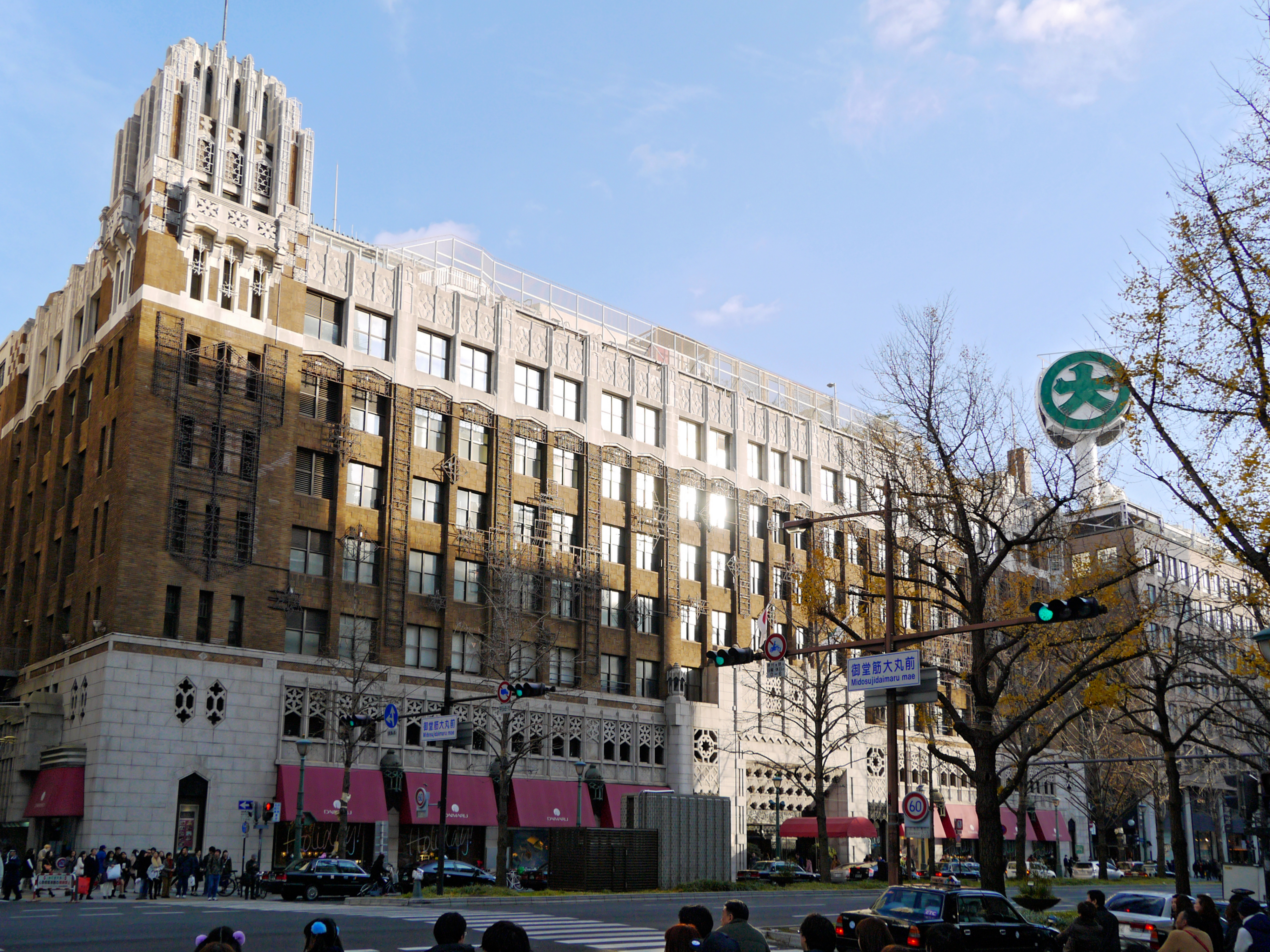
Today, Shinsaibashi-suji is a covered shopping arcade that runs roughly 600 meters, forming the spine of a retail district whose total connected streets stretch approximately two kilometers. The Daimaru department store anchors the area, surrounded by a constellation of international luxury houses. Running parallel to the arcade is Mido-suji street, one of Osaka's grandest boulevards. To the west of Mido-suji sits Amerika-mura, where Osaka's youth culture congregates around vintage clothing shops, street art, and independent cafes. The district sits just north of Dotonbori and Soemoncho, making it part of a continuous strip of commercial and entertainment energy that defines Osaka's Minami district. Two subway stations, Shinsaibashi and Yotsubashi, feed the crowds.
Where Commerce Meets Memory
Shinsaibashi is not a museum. It is a living, pulsing commercial district where the past survives in fragments rather than monuments. The gas lamps from 1909 still glow, though they illuminate shoppers heading to Uniqlo and H&M rather than merchants crossing a canal. The carved four-leafed clovers from the stone railings still stand, though now they adorn a bridge over a subterranean mall. What Shinsai Okada set in motion in 1622 with a wooden plank over a fresh canal has proven remarkably durable, not as architecture but as an idea: that a place can hold its name and its purpose across centuries, even as everything physical about it changes.
From the Air
Located at 34.673N, 135.500E in the Chuo-ku ward of Osaka. The Shinsaibashi-suji arcade runs north-south and is identifiable from the air as part of the dense commercial grid between Mido-suji boulevard and the Dotonbori canal area. Best viewed at low altitude over central Osaka. Nearest airports: Osaka Itami (RJOO), approximately 13 km north; Kansai International (RJBB), approximately 40 km south on a reclaimed island in Osaka Bay.