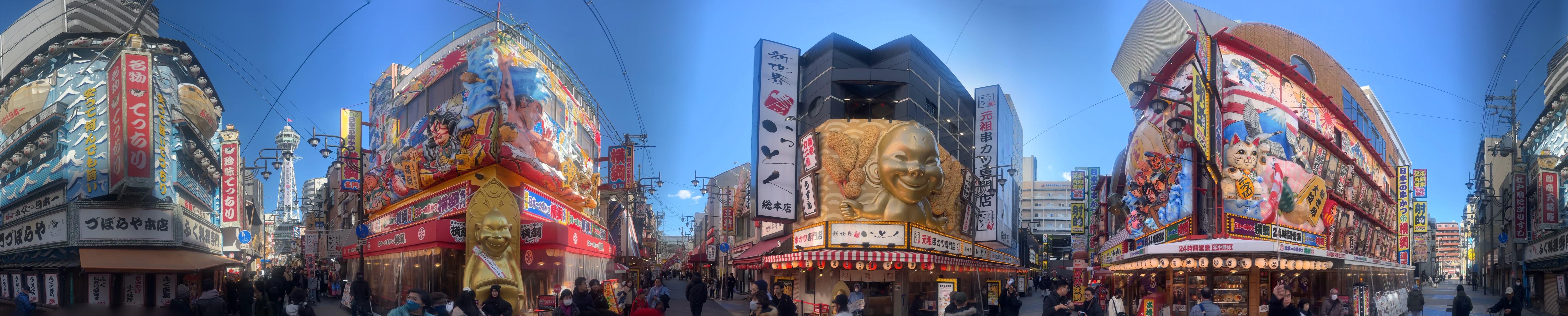
Shinsekai
The name means 'New World,' and in 1912 it was exactly that: a purpose-built neighborhood in south Osaka designed as a fantasy mash-up of New York's Coney Island for its southern half and Paris for its northern half. A Luna Park amusement park anchored the district, connected by tramway to a tower deliberately styled to combine the Eiffel Tower at its top with the Arc de Triomphe at its base. The ambition was extraordinary. That the neighborhood would become Osaka's grittiest, most storied quarter -- a place of deep-fried street food, pachinko parlors, and stubborn working-class identity -- is one of the great plot twists in Japanese urban history.
A Tower Reaching to Heaven
The original Tsutenkaku Tower, completed in 1912, was the centerpiece of Shinsekai's grand vision. Its name translates to 'tower reaching to heaven,' and the structure was designed to evoke both the Eiffel Tower and the Arc de Triomphe in a single vertical statement. A tramway ran from the tower to the Luna Park amusement grounds, and the neighborhood thrived as a tourist attraction showcasing Osaka's ambitions for modernity. Then the tower's luck ran out. Fire damaged it in 1943, and it was disassembled, its steel likely repurposed for the war effort. The neighborhood went thirteen years without its defining landmark. When the current Tsutenkaku was built in 1956, its architect was Tachu Naito, the same engineer who designed Tokyo Tower. The replacement stands 103 meters tall, and its observation deck still offers one of the most panoramic and unobstructed views of Osaka.
When the Laborers Came
Shinsekai's trajectory from glamorous amusement district to working-class stronghold began after World War II. The neighborhood became the entertainment zone for the laborers who were physically rebuilding Osaka from wartime devastation. Cheap restaurants, cinemas, shogi and mahjong clubs, and pachinko parlors replaced the amusement park glamour. Criminal activity took root. The area sits on the northern border of Nishinari, one of Japan's poorest districts, and that proximity shaped Shinsekai's character for decades. Homeless men, often elderly, migrated to Osaka from across Japan to escape the stigma of societal failure in their hometowns, and the streets around Shinsekai became a visible encampment of displacement and hardship.
Deep-Fried on a Stick
Shinsekai's culinary identity is inseparable from kushi-katsu: meat, fish, and vegetables breaded and deep-fried on small wooden skewers. The neighborhood is packed with kushi-katsu restaurants, each offering dozens of variations at modest prices. The unspoken rule -- never double-dip in the communal sauce -- is practically a local law. Fugu restaurants add an element of culinary danger, serving the blowfish whose toxin can kill if improperly prepared. These are not destination dining experiences for Michelin scouts. They are neighborhood joints with plastic food displays in the windows, paper lanterns overhead, and the clatter of skewers on steel trays. The food is honest, cheap, and deeply satisfying, which is exactly the point.
Amusement Parks and Borrowed Glamour
The original Luna Park closed in 1923, just eleven years after opening, and Shinsekai never fully recovered its original vision of cosmopolitan entertainment. Decades later, Festival Gate, a compact amusement park, was built to the south in an attempt to rejuvenate the area, but it too eventually closed. Spa World, a massive hot-spring themed complex, still operates nearby. To the east, Tennoji Zoo and Tennoji Park offer green space and the Osaka Municipal Museum of Art. These attractions frame Shinsekai without defining it. The neighborhood's real draw has never been its planned amusements but its unplanned character: the neon signs stacked vertically on narrow buildings, the elderly men playing shogi on folding tables in storefront parlors, the smell of frying batter drifting through streets that feel a generation removed from the polished Osaka of Umeda and Namba.
Osaka's New World, Old Soul
Shinsekai is not what its creators intended. The Paris-and-Coney-Island fantasy lasted barely a decade before economic reality reshaped the district into something more raw and more real. But that transformation is precisely what gives the neighborhood its magnetic pull. In a city known for its commercial energy and culinary obsession, Shinsekai distills both qualities to their essence: no pretension, no polish, just skewers and neon and a tower that still reaches for heaven. The 'New World' is now one of Osaka's oldest-feeling places, and that irony is part of its charm.
From the Air
Located at 34.652N, 135.506E in the Naniwa-ku ward of Osaka. Tsutenkaku Tower (103 meters) is a visible vertical landmark from the air, standing south of the Tennoji Park green space. The neighborhood sits between the JR Osaka Loop Line tracks and the park. Best viewed at low altitude over south-central Osaka. Nearest airports: Osaka Itami (RJOO), approximately 16 km north; Kansai International (RJBB), approximately 38 km south on a reclaimed island in Osaka Bay.