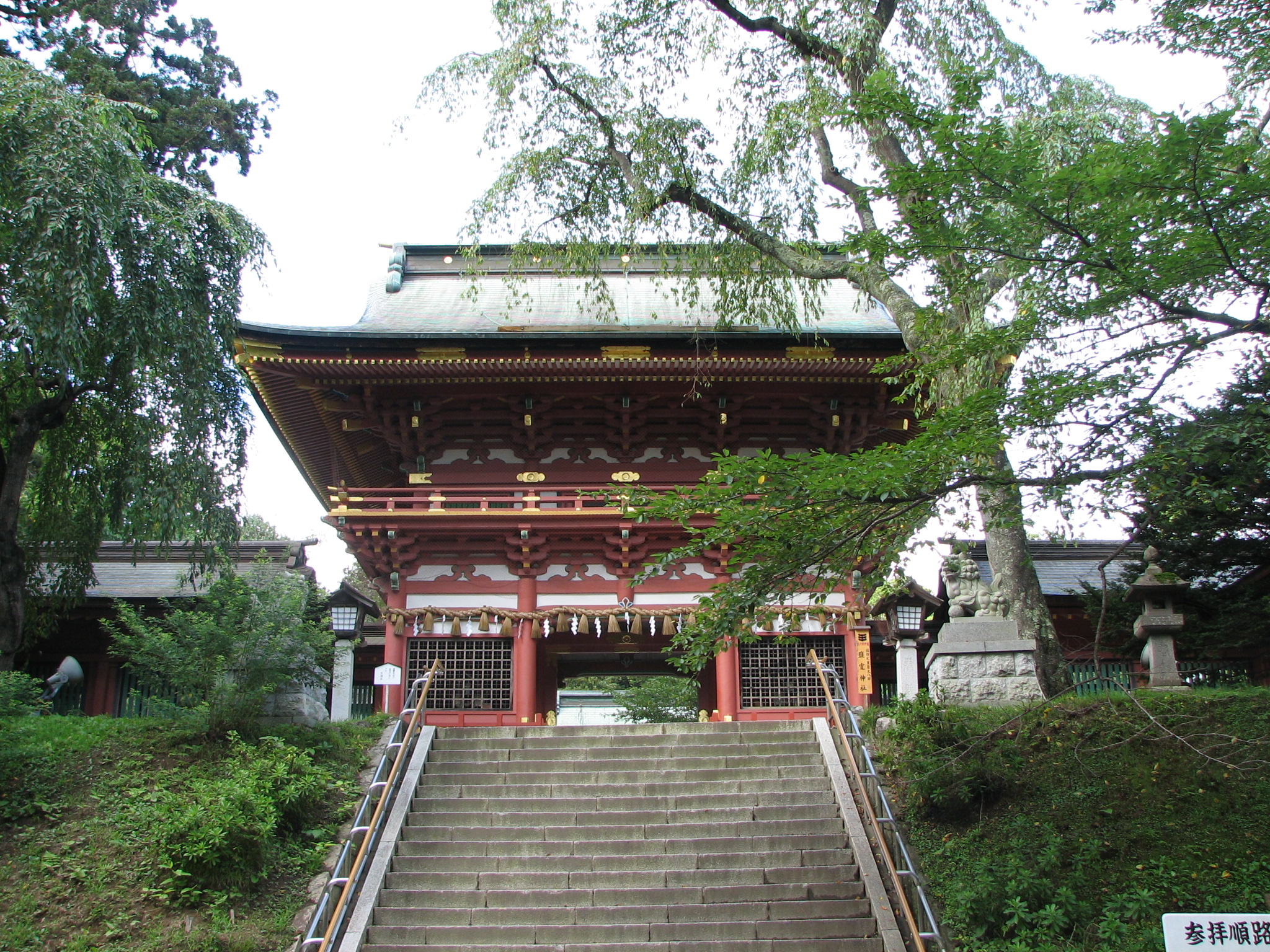
Shiogama Shrine
Two hundred and two stone steps, worn smooth by over a thousand years of footfall, climb steeply through cedar shade to a vermilion gate at the top of the hill. Beyond it, the morning sun catches lacquered surfaces in shades of red and gold. Matsuo Basho, Japan's most celebrated poet, climbed these same steps in 1689 during his epic journey through the northern provinces, and recorded what he found in his masterwork Oku no Hosomichi: magnificent pillars, a painted ceiling, votive lanterns, and the 'sparkle of the vermilion fence in the morning sun.' Shiogama Shrine, perched above the port city that shares its name in Miyagi Prefecture, has been drawing pilgrims, poets, and fishermen to this hillside since before written records began.
Salt from the Sea Gods
The shrine's origin story reaches back before the historical era and into the realm of divine myth. According to shrine legend, the Sun Goddess Amaterasu commanded two warrior kami, Takemikazuchi and Futsunushi, to develop the Tohoku region of northern Honshu. A third kami, Shiotsuchi-Oji, guided them to this spot on the coast of what is now Miyagi Prefecture. After the gods arrived and brought peace to the land, Shiotsuchi-Oji taught the local people a practical and precious skill: how to make salt from seawater. The name Shiogama itself means 'salt cauldron,' and the connection between the shrine and salt production endures to this day. During the Rensai festival held each July, salt is still ritually made from seawater on the shrine grounds, an unbroken thread linking the modern city to its mythological origins.
A Thousand Years of Patronage
Shiogama Shrine first appears in historical records in 820 AD, when it received an exemption from taxes, a mark of significant status. The 927 AD Engishiki, a compendium of government regulations, names it among Japan's officially recognized shrines, and it was appointed the ichinomiya, or first-ranked shrine, of the vast Mutsu Province. During the Heian period, various emperors sent donations, and local warrior clans including the powerful Northern Fujiwara became patrons. The shrine's fortunes rose further during the Edo period when it fell within the territory of the Date clan of the Sendai Domain. Starting with Date Masamune, the legendary 'One-Eyed Dragon' who founded Sendai as a castle town, the Date clan poured resources into the shrine. Most of the current buildings date from 1704, during the height of Date patronage, and fourteen of these structures are collectively designated as National Important Cultural Properties.
Vermilion, Wood, and Iron
The shrine complex is an architectural dialogue between austerity and opulence. Each of the three Honden, the innermost sanctuaries where the kami reside, is built of plain unfinished wood in the nagare-zukuri style of traditional Shinto architecture. The three surrounding worship halls, by contrast, blaze with vermilion lacquer in the more ornate Irimoya-zukuri style. A vermilion-lacquered Zuishinmon gate crowns the steep 202-step stone approach, and beyond it a second gate flanked by corridors leads into the sacred precincts. Notable artifacts within the grounds include a stone sundial dedicated in 1792 and a fourteen-foot-high lantern of iron and copper donated in 1807. A museum built in 1996 houses the shrine's treasury of swords, armor, documents, and art objects, along with materials related to the ancient practice of salt manufacture that gave both the shrine and the city their name.
Festivals and the Living Shrine
Shiogama Shrine is not a museum piece. Throughout the year, festivals bring the hillside to life with color, sound, and ritual. The Hana Matsuri, or Flower Festival, held on the fourth Sunday of April, originated in 1778 as a prayer for protection of crops against flooding. The Hote Matsuri in March, started by local townspeople in 1882, celebrates the protection and prosperity of Shiogama city. During Setsubun in February, participants scatter beans to drive out evil spirits and welcome good fortune. The grandest celebration is the week-long Rensai in July, the main festival of the shrine, when the ancient saltmaking ceremony is performed and yabusame, mounted archery contests, thunder through the grounds. As the head shrine of several hundred Shiogama shrines scattered across Japan, this hillside above the fishing port remains the spiritual center of a network of worship dedicated to the safety of seafarers and the protection of pregnant women.
From the Air
Shiogama Shrine sits at 38.319N, 141.012E on a prominent hill above the port city of Shiogama, approximately 15 km northeast of central Sendai. The shrine's forested hilltop is visible as a green rise near the coastline. Shiogama is on the western shore of Matsushima Bay, one of Japan's 'Three Views,' whose scattered pine-covered islands are a striking feature from altitude. Sendai Airport (RJSS) lies about 25 km to the south-southwest. The port area and fishing harbor below the shrine are clearly visible from 3,000-5,000 feet.