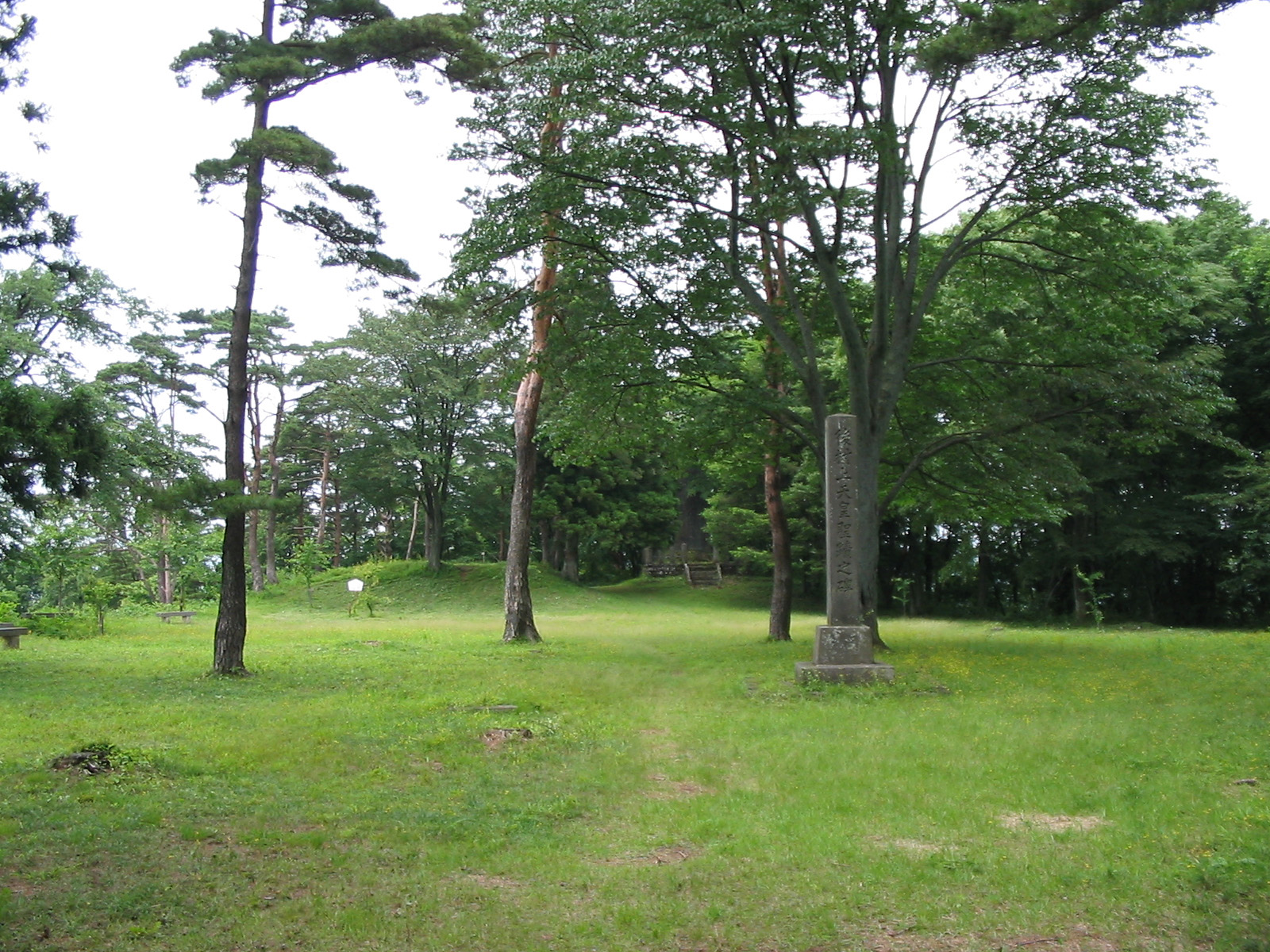
Shirakawa Castle
A woman nursed the infant who would become Japan's first shogun, and that simple act of care purchased a dynasty. The Yuki clan's connection to Minamoto no Yoritomo -- their kinswoman served as his wet nurse -- earned them estates, military commissions, and eventually a mountain fortress overlooking the Abukuma River in what is now Shirakawa, Fukushima Prefecture. Shirakawa Castle, perched on a 400-meter ridge in the forested hills southeast of town, controlled the borderlands between the provinces of Mutsu and Shimotsuke for over two centuries. Today, only clay ramparts and dry moats remain, tracing the outlines of a castle that was already old when Toyotomi Hideyoshi unified Japan in 1590 -- the same year the Yuki clan's luck finally ran out.
A Fortress Built on Favor
After the Kamakura shogunate took power in the late twelfth century, the Yuki clan leveraged their connection to Yoritomo into a growing portfolio of warrior estates. The cadet branch that settled in the Shirakawa region built Karame Castle as their headquarters and Komine Castle as a satellite stronghold, establishing a network of fortifications across the mountainous frontier of southern Mutsu Province. By the fifteenth century, the Shirakawa-Yuki controlled a swath of territory spanning two provinces. Their main fortress -- known also as Karame-jo or Yuki-Shirakawa-jo -- stretched 950 meters east to west and 550 meters north to south along the mountain ridge, its separate enclosures linked by clay ramparts in the style typical of Japanese mountain castles of the period.
Crushed Between Giants
The Sengoku period brought chaos to every corner of Japan, and the Shirakawa-Yuki found themselves caught in a three-sided vise. To the north, the Ashina clan pressed their borders. To the east, the Satake clan did the same. And within their own extended family, the Komine-Yuki branch turned hostile, fracturing what had once been a unified power base. For generations the Shirakawa-Yuki fought to hold their ground, but the decisive blow came not from a battlefield. When Toyotomi Hideyoshi summoned the lords of Japan to join his siege of Odawara Castle in 1590 -- the campaign that would crush the last independent daimyo in the east -- the Shirakawa-Yuki failed to appear. Hideyoshi did not forgive absences. The clan was stripped of its domains and reduced to vassals of the Date clan. Shirakawa Castle, their ancestral stronghold, was abandoned.
Centuries of Silence
For over four hundred years, the mountain ridge kept its secrets. The forest reclaimed the ramparts. The dry moats softened into shallow depressions in the hillside. When the Edo period brought peace and new castle construction to Shirakawa, it was Komine Castle -- the former branch fort two kilometers to the northwest -- that became the seat of power, eventually inheriting the name 'Shirakawa Castle' in common usage. The older fortress on the ridge faded from memory, its very identity confused with its successor. It was not until systematic excavations between 2010 and 2015 by the Shirakawa City Board of Education that the castle's full extent was mapped and artifacts from the fourteenth through sixteenth centuries recovered. The finds were significant enough to earn the site designation as a National Historic Site of Japan in 2016.
Reading the Ruins
Standing on the ridge today, the castle's logic becomes clear. The right bank of the Abukuma River provided a natural moat on one flank, while the mountain's elevation gave defenders commanding views of the approaches from every direction. The layout of separate enclosures -- each independently defensible behind its own earthworks -- reflects the pragmatic engineering of an era when alliances could shift overnight and a castle might need to resist attack from any quarter, including the forces of a former ally. The clay ramparts, though eroded, still rise high enough to suggest the scale of the original fortifications. No stone walls, no keep towers, no elegant plaster -- just earth and timber and tactical advantage, the architecture of survival in an age of perpetual war.
From the Air
Located at 37.126N, 140.211E on a forested mountain ridge about 2 km southeast of Shirakawa city center in Fukushima Prefecture. The castle ruins sit at roughly 400 meters elevation along the right bank of the Abukuma River. Look for a long, wooded ridge running east-west with no modern development. Komine Castle's reconstructed three-story keep is visible closer to the city center and serves as a useful landmark. Nearest airport: Fukushima Airport (RJSF), approximately 30nm to the north. The surrounding terrain is hilly and forested, with rice paddies in the river valleys below.