Shiramizu Amidado
Princess Tokuhime built it to hold her grief. In 1160, widowed by the death of her husband Iwaki Norimichi, the daughter of Fujiwara no Kiyohira -- the powerful patriarch of the Hiraizumi Fujiwara clan -- commissioned a temple called Ganjo-ji in the city now known as Iwaki, deep in Fukushima Prefecture. At its heart she placed the Amida-do, a chapel dedicated to Amida Buddha, ringed on three sides by ponds meant to evoke the Pure Land paradise where she believed her husband now dwelled. That small, square building with its thatched tented roof of thin wood shingles still stands today, more than 860 years later -- a National Treasure of Japan and one of only three surviving Heian-period structures in the entire Tohoku region.
A Widow's Vision of Paradise
The Amida-do was not merely a prayer hall. It was an architectural rendering of Buddhist cosmology. Ponds wrap around the chapel on three sides -- east, west, and south -- creating a landscape meant to mirror the Western Paradise described in Pure Land scripture. A worship path approaches from the south, guiding visitors across the water toward enlightenment. Inside, the walls once blazed with mural paintings, though only fragments survive today. Five wooden statues remain within, including Heian-period carvings of Jikokuten and Tamonten, two of the Four Heavenly Kings who guard the cardinal directions. The building itself is deceptively simple: a square structure topped by a pyramidal tented roof assembled from impossibly thin layers of wood shingle. No nails or metal fasteners hold the roof together. It is craftsmanship as devotion, built to last -- and it has.
The Last Three Standing
Northeastern Japan has endured more than its share of destruction. Earthquakes, tsunamis, wars, fires, and the slow erosion of centuries have claimed virtually every wooden structure from the Heian period across the Tohoku region. Only three survive: Motsu-ji in Hiraizumi, a structure at Kozo-ji in Kakuda, Miyagi, and the Shiramizu Amida-do. That this chapel remains is something close to miraculous. It outlasted the fall of the Hiraizumi Fujiwara clan, the turmoil of Japan's medieval civil wars, and the upheavals of the Meiji Restoration. Emperor Go-Toba granted the temple imperial status, and successive lords of Iwakitaira Domain under the Tokugawa shogunate protected and patronized it through the Edo period. At some point the temple converted from the Pure Land to the Shingon Buddhist denomination, though the paradise garden -- the theological heart of the original design -- remained intact.
Archaeology Beneath the Lilies
Between 1972 and 1982, archaeologists conducted extensive investigations of the paradise garden's pond, revealing a 12th-century landscape of remarkable sophistication. They uncovered the original pebble beach, ornamental stones arranged with deliberate artistry, a peninsula extending into the water, a central island, and the remnants of bridges that once connected these features. The excavations confirmed that what visitors see today closely matches the original Heian-period design -- a rare instance where a Japanese garden has survived more or less continuously for over eight centuries. The pond and its surrounding garden are now owned and managed by Iwaki City, separated administratively from the temple itself, which remains an active Shingon Buddhist institution. It is a peculiarly Japanese arrangement: the spiritual and the civic sharing stewardship of something that belongs, in a sense, to neither.
Shaken but Unbroken
On March 11, 2011, the magnitude 9.0 Tohoku earthquake struck northeastern Japan with devastating force. The Shiramizu Amida-do suffered damage and was closed to the public. For more than a year, restoration work proceeded carefully, balancing the urgency of repair with the delicate requirements of a National Treasure whose every timber carries irreplaceable historical value. In July 2012, the temple reopened. The chapel had survived its latest trial, just as it had survived every previous one across nearly nine centuries. Visitors approaching along the southern worship path today see essentially the same scene Princess Tokuhime designed in her grief: still water reflecting a thatched roof, pond lilies floating where ornamental stones mark the boundary between the human world and the paradise beyond.
From the Air
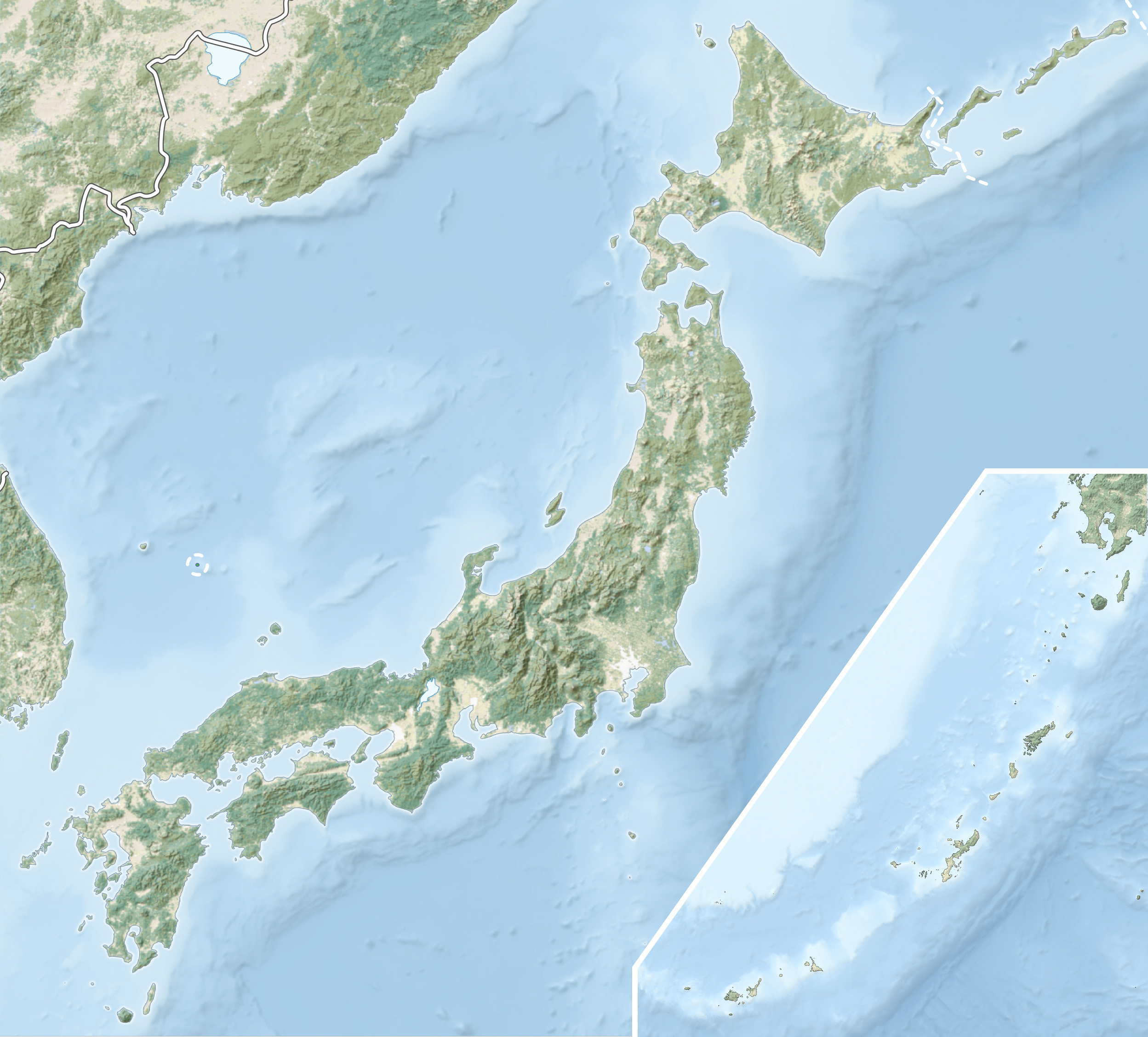
Located at 37.036N, 140.837E in Iwaki, Fukushima Prefecture, Japan. The temple complex is set in a low-lying area surrounded by suburban development and forested hills. From altitude, look for the distinctive pond system wrapping around a small structure amid otherwise dense residential neighborhoods. Nearest major airport: Fukushima Airport (RJSF), approximately 50nm to the west-northwest. Iwaki is situated along the Pacific coast of northeastern Honshu, roughly 40nm south of the Fukushima Daiichi exclusion zone. Weather is typically clear in spring and autumn, with humid conditions common in summer months.