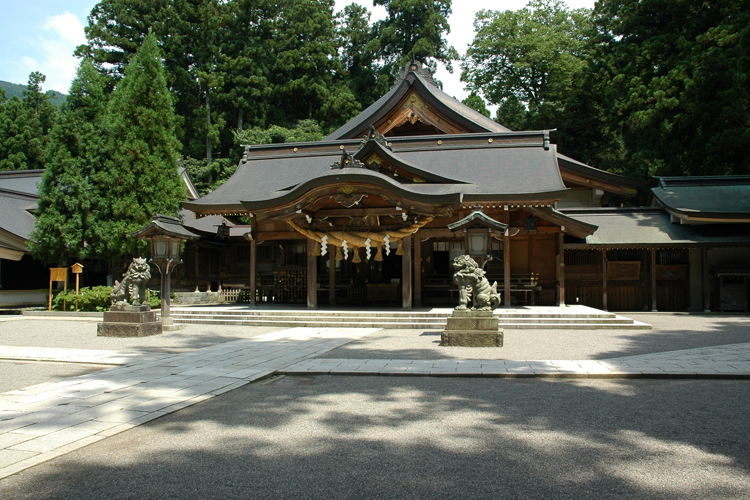
Shirayama Hime Shrine
Two thousand shrines across Japan carry the name Hakusan, and every one of them traces its spiritual lineage back here -- to a single sanctuary at the foot of a 2,702-meter volcano in Ishikawa Prefecture. Shirayama Hime Shrine sits where the Tedori River descends from the snow-heavy flanks of Mount Hakusan, one of Japan's Three Holy Mountains. The same two kanji characters -- white mountain, read as "Hakusan" in one context and "Shirayama" in another -- name both the peak and the shrine, binding them together in a linguistic knot that has persisted for centuries. The deity enshrined here is Kikurihime, a goddess who is the deified spirit of the volcano itself. She shares the sanctuary with Izanagi and Izanami, the creator gods of Japanese mythology. It is a place where geology becomes theology, where the mountain is not merely worshipped but understood as a living divine presence.
The Mountain and the Monk
Mount Hakusan has been an object of worship since prehistoric times, long before any shrine structure existed to formalize the devotion. The mountain stands on the border of Ishikawa and Gifu Prefectures, visible for dozens of kilometers in every direction, its snowcapped peak dominating the landscape for much of the year. According to shrine tradition, the sanctuary was first established during the legendary reign of Emperor Sujin, though no documentary evidence supports a date that early. What the records do confirm is that in 717, the shugendo monk Taicho became the first person to reach the summit of Hakusan, building a chapel at the Gozengamine peak. That ascent transformed the mountain from a distant object of awe into a destination for pilgrimage. The shrine itself splits into two parts: the Hakusan Hongu at the base of the mountain, where most visitors worship, and the Oku-no-miya at the summit, where the climb itself becomes the prayer.
Prosperity and Ashes
The shrine first appears in official records in 853, in the Nihon Montoku Tenno Jitsuroku, where it was granted third court rank -- a marker of significant imperial recognition. By the mid-Heian period, it had risen to the status of ichinomiya, the highest-ranking shrine in Kaga Province, a position of immense spiritual and political authority. During the Kamakura and early Muromachi periods, the shrine's influence expanded dramatically as Hakusan worship merged with Zen Buddhism, spawning the network of two thousand branch shrines that still exists today. But that golden age ended violently. The Kaga ikki, a militant uprising of Buddhist adherents that erupted in 1455, stripped the shrine of its estates and revenues. In 1480, the shrine -- then situated on the banks of the Tedori River -- was destroyed by fire. It lay in ruins for more than a century, its network of branch shrines carrying the Hakusan name forward while the mother shrine itself was reduced to ashes.
Restoration Under the Maeda
Shirayama Hime Shrine owes its survival to Maeda Toshiie, the powerful daimyo of Kaga Domain under the Tokugawa shogunate. In the early Edo period, Maeda rebuilt the shrine and placed it under the patronage of his clan, one of the wealthiest feudal families in Japan. The Maeda supported the shrine continuously until the Meiji Restoration reshaped the relationship between religion and state. Under the Meiji system of State Shinto, the shrine received an official ranking that formalized its importance. Today, the shrine preserves an extraordinary collection of cultural properties accumulated across those centuries of patronage. Its greatest treasure is a short sword forged by Toshiro Yoshimitsu during the Kamakura period -- a blade just 22.9 centimeters long and 2.2 centimeters wide at the base, designated a National Treasure. Yoshimitsu, believed to be the son of master swordsmith Awataguchi Kuniyoshi, was renowned above all for these compact, exquisitely crafted short blades.
Sacred Objects, Living Faith
Beyond the Yoshimitsu blade, the shrine holds eleven works classified as National Important Cultural Properties, spanning the Heian through Muromachi periods. A Kamakura-era painting depicts the shrine's three deities in a synthesis of Shinto and Buddhist imagery -- the Eleven-Headed Kannon hovers above the central female deity, while Dainichi Nyorai and the Thousand-Armed Kannon attend the flanking figures. Paired wooden guardian dogs from the Heian and Kamakura periods, lacquered saddles inlaid with mother-of-pearl, historical documents stretching back to the Nanbokucho period, and 766 individual items of Ishikawa Prefecture-designated cultural property fill the shrine's collection. The annual festival on May 6 draws worshippers who have traveled from across the country, many of them connected to the vast network of branch Hakusan shrines. For them, the pilgrimage to this spot at the foot of the white mountain is a journey back to the source -- a place where the line between the natural world and the sacred dissolves entirely in the mist that rolls down from the volcanic peak above.
From the Air
Located at 36.43°N, 136.64°E in the city of Hakusan, Ishikawa Prefecture, at the foot of Mount Hakusan (2,702 m). The shrine complex sits in forested terrain along the Tedori River valley. Nearest airport is Komatsu Airport (RJNK), approximately 25 km to the northwest. Mount Hakusan's snow-covered peak is the dominant visual landmark from altitude. Approach from the north along the Tedori River valley for the best perspective on the shrine's relationship to the mountain. Be aware of mountain weather and terrain; maintain safe altitude above 4,000 feet in the river valley. The shrine's torii gates and forested grounds are visible among the surrounding settlement.