Shisen-do
Every few minutes, a sharp clap breaks the silence of the garden. Water trickles into a bamboo tube balanced on a pivot, slowly filling it until gravity takes over. The tube tips, spills its water, then swings back upright and strikes a rock with a crack that echoes across the moss. This is the sozu, a type of shishi-odoshi originally designed to startle deer away from the garden, and it has been marking time at Shisen-do for nearly four centuries. The temple it guards was never meant to be a temple at all. It began as the private retreat of a samurai-turned-scholar who fell from favor, found philosophy, and poured his remaining decades into building one of Kyoto's most intimate and perfectly realized landscapes.
The Samurai Who Chose Exile
Ishikawa Jozan was born in 1583 into the service of Tokugawa Ieyasu, the man who would unify Japan. But after an incident during the Siege of Osaka, Jozan was placed under house arrest -- a humiliation for a warrior. Rather than wither in disgrace, he reinvented himself. He entered the Myoshin-ji monastery, studied Neo-Confucianism under the scholar Fujiwara Seika, and cultivated ties to Hayashi Razan, one of the foremost intellectuals of the age. For a time he served the Asano clan in Hiroshima Domain, but after his mother's death he surrendered his position entirely and retreated to Kyoto. He lived first in a hermitage near Shokoku-ji, then in 1641, at the age of 58, he moved to a hillside in Sakyo-ku and began building the place he would inhabit for the remaining 31 years of his life.
The Hall of Thirty-Six Poets
Jozan initially called his retreat the 'Concave-Convex Shelter' -- a wry reference to the uneven hillside terrain. But the villa's defining feature soon gave it a better name. Kinoshita Katsutoshi, a patron and friend, conceived the idea of a hall honoring great poets, and Jozan commissioned the master painter Kano Tan'yu to create portraits of 36 celebrated Chinese poets. Arranged nine per wall on the second floor, these portraits transformed the building into the Shisen-do -- the 'Hall of Poet Immortals.' The name stuck. Jozan was no mere collector; he was deeply accomplished in the tea ceremony and in garden design, and he surrounded himself with the leading artistic minds of his era. Among his close friends were Shokado Shojo, one of the 'Three Calligraphers of the Kan'ei Era,' and Suminokura Soan, the wealthy entrepreneur and eldest son of the merchant Suminokura Ryoi. Through these connections, Jozan's hillside refuge became a salon where science, art, and literary culture intersected.
A Garden That Listens
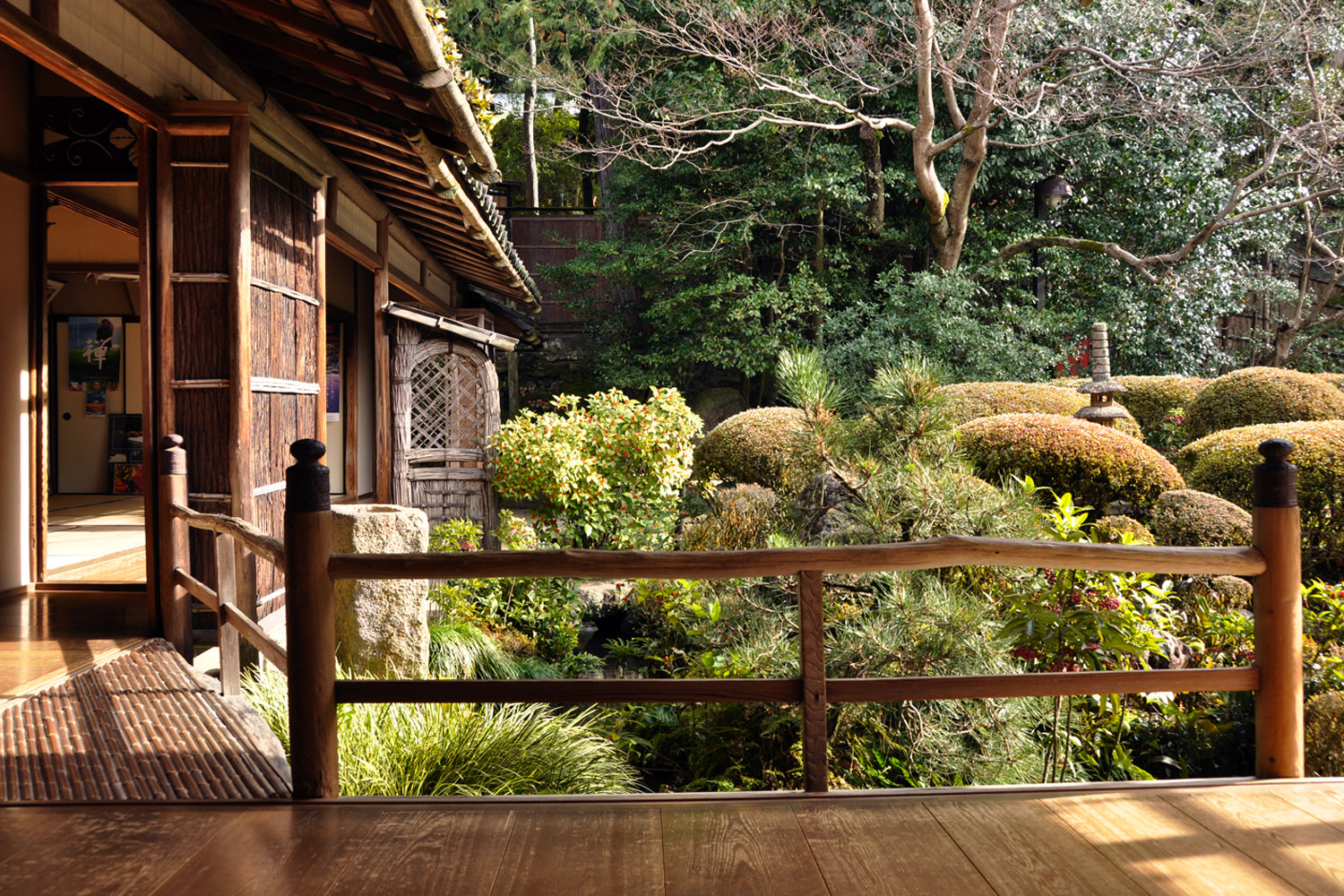
The garden at Shisen-do is among the most admired in Kyoto, a layered composition of clipped azalea bushes sculpted into soft mounds, white sand raked into contemplative patterns, and the gentle rustling of surrounding maple trees that blaze crimson each autumn. The sozu punctuates the quiet at regular intervals, its bamboo clap carrying across the garden like a metronome. Jozan designed the landscape himself, and its genius lies in compression. The garden is not large, but it creates the illusion of depth through careful manipulation of elevation -- the building sits on the hillside slope, and the eye is drawn downward through layered planes of greenery toward a lower pond. From the veranda, you look out at what feels like a private valley. The temple today belongs to the Soto school of Japanese Zen, and its honzon is an image of Merofu Kannon. But the atmosphere remains profoundly secular -- this is a scholar's garden, not a monk's.
Ninety Years of Quiet Devotion
Ishikawa Jozan lived to 90, dying in 1672 after more than three decades at Shisen-do. He was buried roughly 500 meters northeast of his beloved villa, and his grave is registered as a National Historic Site, as is the temple itself, which received its designation in 1928. The full formal name of the complex is Rorozan Shisen-do Jozan-ji, reflecting both its literary identity and its later conversion to a Buddhist temple. What Jozan built was something rare: a place where the disciplines of warrior, scholar, poet, and gardener fused into a single aesthetic vision. The villa he shaped on a difficult hillside -- concave and convex, as he first noted -- became a space where the sound of water and bamboo, the gaze of painted poets, and the quiet geometry of clipped shrubs all work together to induce a particular state of mind. Four centuries later, the sozu still claps. The poets still watch from their walls. And the garden still listens.
From the Air
Located at 35.044N, 135.796E in Sakyo-ku, the eastern hills of Kyoto. The temple sits on a wooded hillside in the Ichijo-ji neighborhood, east of the city center near the base of the Higashiyama mountains. The nearest major airport is Osaka Itami (RJOO), approximately 40km south. Kansai International (RJBB) lies about 100km southwest. Recommended viewing altitude: 2,000-3,000 feet. From the air, look for the forested eastern slopes of Kyoto; the temple is nestled among trees on the hillside and not easily distinguished individually, but the Higashiyama ridgeline provides excellent orientation.