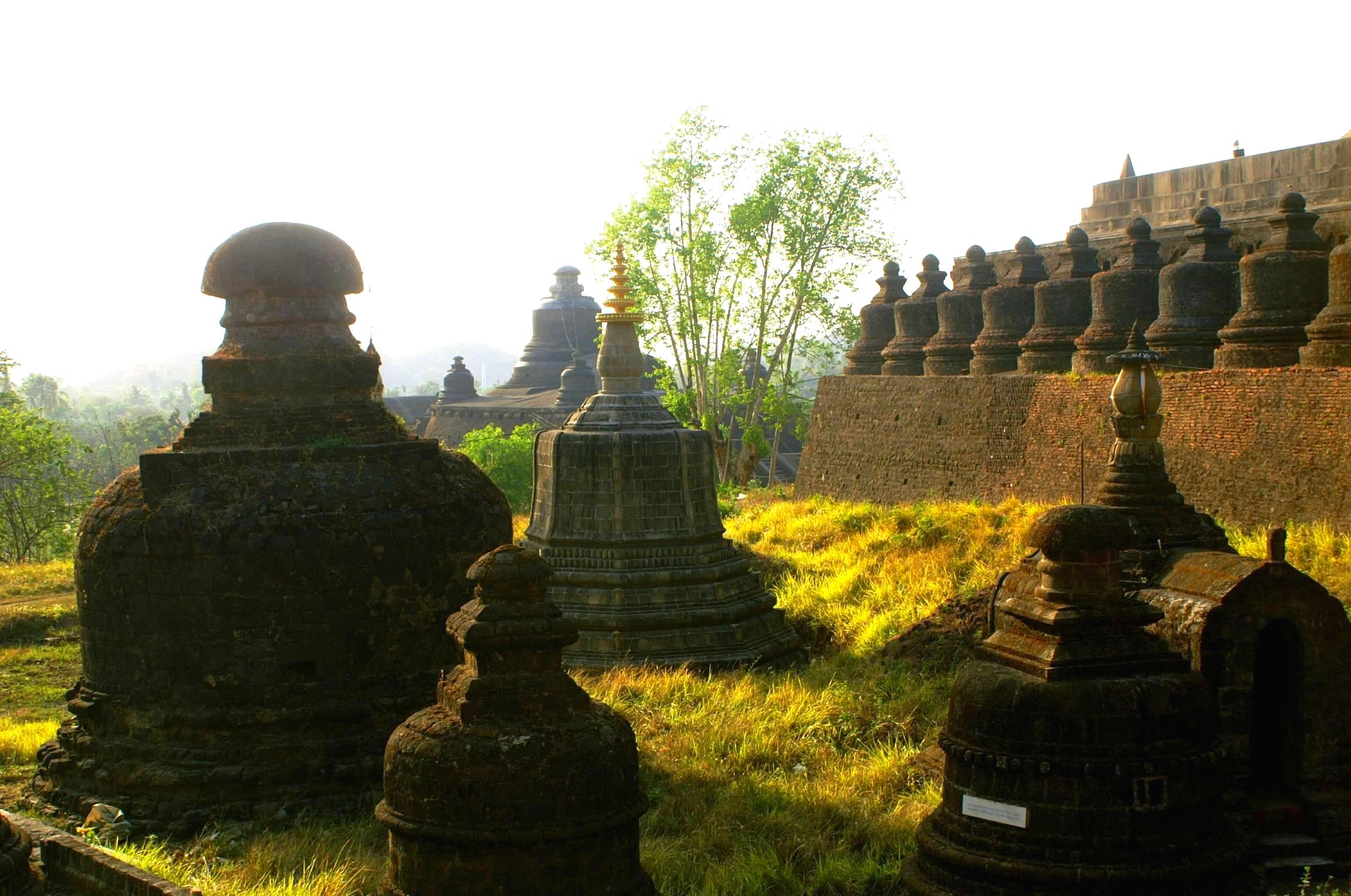
Shite-thaung Temple
Two names, one temple, and a choice that reveals everything. The Arakanese call it the Temple of 80,000 Buddha Images. They also call it the Temple of Victory. Built in 1535-1536 by King Min Bin to commemorate his conquest of Bengal, the Shite-thaung Temple sits on the western face of Pokhaung Hill in Mrauk U, and it serves both titles equally. Step inside and you enter three concentric rings of maze-like corridors, their walls covered with reliefs of Buddhas, Bodhisattvas, guardian spirits, kings of celestial realms, and all 550 Jataka tales -- the past lives of the Buddha rendered in stone. Victory and devotion, it turns out, were the same project.
A Conqueror's Gift to the Faith
Min Bin was the most militarily successful king of the Mrauk U Kingdom. His conquest of parts of Bengal expanded Arakanese territory to its greatest extent, and the Shite-thaung Temple was his thanksgiving -- a victory monument dressed in the language of Buddhist piety. The design follows a familiar Burmese pattern: a central bell-shaped stupa flanked by four smaller stupas at the corners, with a multitude of even smaller ones surrounding them. A flight of stairs and a tazaung were added to the eastern side roughly 75 years later. But the conventional layout masks an unconventional interior. Where most temples offer a single processional space, Shite-thaung wraps its central hall in three concentric corridors, each dense with carved imagery that mixes the sacred and the secular, the celestial and the distinctly Arakanese.
Three Corridors Deep
The central hall is easy enough to find. Hundreds of Buddha statues line its walls, some in their original positions, others relocated from nearby excavation sites. But the heart of the Shite-thaung experience lies in the three layers of corridors that encircle this hall. The innermost ring is the most densely carved, its walls bearing reliefs of Buddhas and Bodhisattvas in formal poses. The middle corridor introduces the 550 Jatakas -- episodes from the Buddha's previous incarnations, rendered in narrative panels that unfold like a stone picture book. The outermost ring shifts further into the earthly realm: scenes of Arakanese daily life, depictions of animals both real and mythical, images of Devas and guardian spirits watching over the human world below. To walk all three corridors is to move through the full cosmology of Theravada Buddhism as the Arakanese understood it -- from the everyday to the transcendent, one stone panel at a time.
Concrete Over Sandstone
Mrauk U sits in one of the wettest corners of monsoon Asia, receiving over 3,600 millimeters of rain annually. In 2003, archaeologists discovered that the central stupa had begun to leak, and monsoon water was dissolving the intricate statues in two interior chambers. The local archaeological department faced an impossible choice. They poured concrete over the stupas, sealing the leaks and preserving the carvings inside -- but destroying the original exterior appearance of the temple's focal pagoda. The decision drew criticism from Arakanese who saw it as a defacement of their most treasured monument. Yet the alternative was worse: without intervention, the rain would have erased irreplaceable sixteenth-century reliefs. It is a preservation dilemma with no clean answer, the kind that haunts archaeological sites in tropical climates around the world. The outer form is lost; the inner art survives.
The Main Attraction Endures
The Shite-thaung Temple has always been the centerpiece of Mrauk U. Adjacent to it stands the Htukkanthein Temple, an ordination hall whose fortified design earned it comparisons to a bunker. Together with the massive Koe-thaung Temple and the Andaw-thein, they form a constellation of religious architecture that rivals Bagan and prompted an international commission in 2017 to urge Myanmar toward UNESCO World Heritage nomination. But Mrauk U's significance runs deeper than tourism or designation. For the Rakhine people, these temples anchor a distinct cultural identity that predates the modern nation-state of Myanmar. The Shite-thaung, with its maze of corridors and its thousands of carved images, is not merely an archaeological curiosity. It is living evidence that the Arakanese built a civilization capable of carving its worldview into stone -- and that the stone, despite monsoons, conquest, and concrete, has not yet given way.
From the Air
Located at 20.598N, 93.193E on the western face of Pokhaung Hill in Mrauk U, western Myanmar's Rakhine State. The temple complex is visible among the cluster of ancient ruins on the hillside, north of the Royal Palace site. Best viewed at 3,000-5,000 feet AGL. The nearest airport is Sittwe (VYSW), approximately 65 km to the west via the Kaladan River valley. Terrain is hilly with surrounding marshes and mangroves. Extreme monsoon rainfall (May-October) limits visibility during wet season.