Shiveluch
The Itelmen people named it suelich -- "smoking mountain" -- and the name has never stopped being accurate. Shiveluch, the northernmost active volcano on the Kamchatka Peninsula, has been erupting more or less continuously for as long as anyone has been watching. It produces roughly 0.015 cubic kilometers of magma per year, building and destroying lava domes at its summit in a cycle that generates pyroclastic flows, ash plumes, and aviation warnings with a regularity that would be terrifying if it were not so relentless. Along with Karymsky, it is one of the two most active volcanoes in Kamchatka -- and one of the most active on Earth.
Sixty Thousand Years of Violence
Shiveluch began forming during the Late Pleistocene, somewhere between 60,000 and 70,000 years ago. In the geological record since then, at least 60 large eruptions have been identified during the Holocene alone. The volcano produces a remarkably diverse chemical menu: basalt, mafic andesite, hornblende andesite, hornblende dacite, and rhyolite all appear in its eruptive history. It belongs to the Kliuchevskaya volcanic group in central Kamchatka, sitting 84 kilometers northwest of the town of Ust-Kamchatsk. The nearest settlement, Klyuchi, lies 50 kilometers from the summit -- close enough to be dusted with ash regularly, small enough to be evacuated quickly when the mountain escalates. Catastrophic eruptions in 1854 and 1964 collapsed the lava dome and sent debris avalanches cascading down the flanks.
April 2023: Ash Reaches the Stratosphere
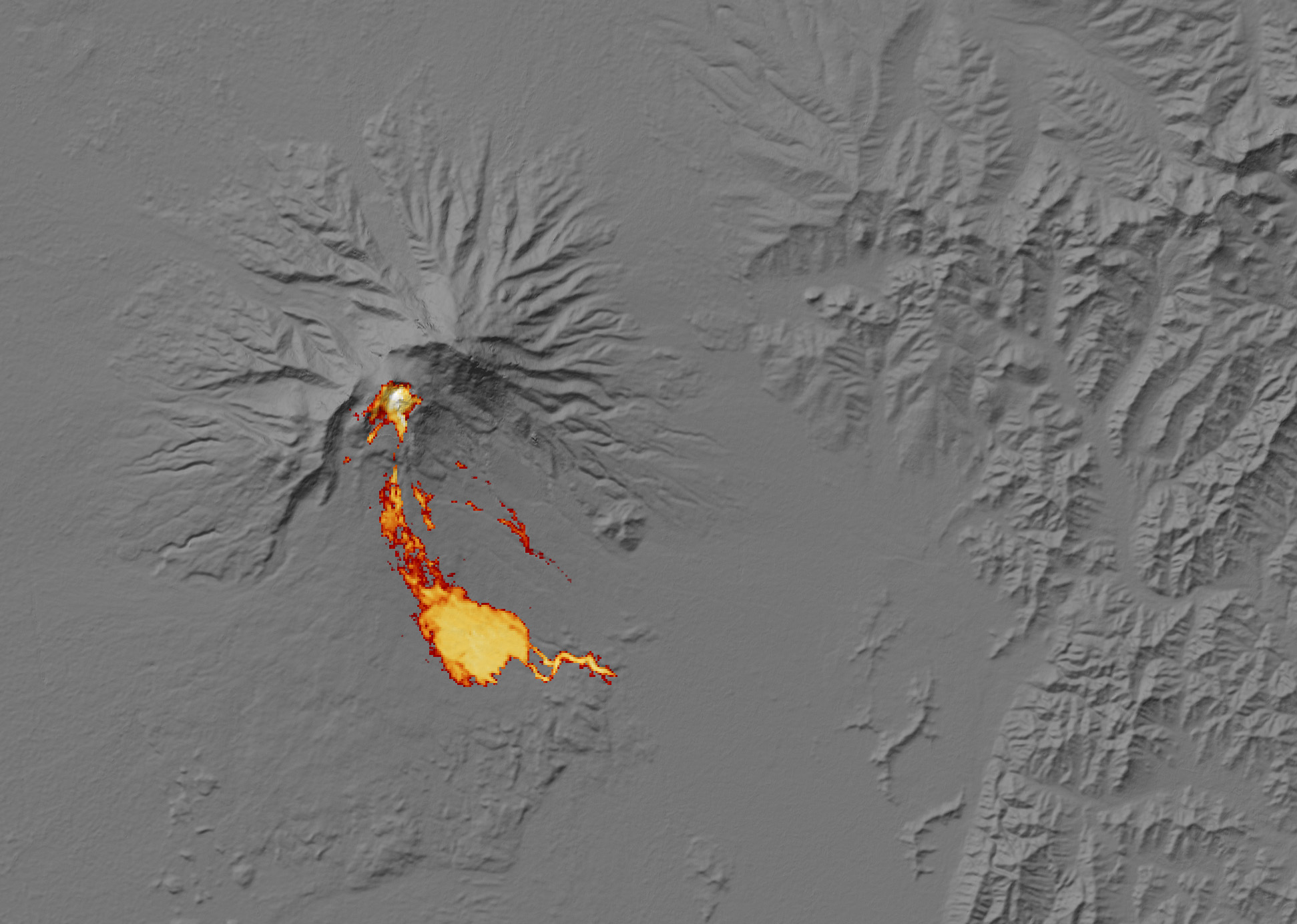
Volcanologists had been on alert since mid-2022, watching Shiveluch's lava dome grow increasingly unstable. Activity intensified through late March 2023 -- continued extrusion, fumarole venting, rising ash emissions. Then, at 12:54 AM local time on April 11, the volcano erupted with paroxysmal force. A column of volcanic gas and ash shot 20 kilometers into the sky, breaching the stratosphere and spreading over an area of 108,000 square kilometers. The eruption released an estimated 200,000 tons of sulfur dioxide into the upper atmosphere. On the ground, the village of Klyuchi disappeared under a blanket of gray ash. Russia's aviation authority immediately ordered airlines to reroute flights on trans-Pacific corridors. By April 16, infrared satellite imagery showed a new lava dome forming inside the freshly carved crater -- Shiveluch already rebuilding what it had just destroyed.
The Volcano That Grounds Airplanes
Shiveluch's ash emissions are not just a local hazard. The volcano sits beneath some of the busiest air routes connecting Asia and North America, and volcanic ash -- invisible to radar, abrasive to turbine blades, capable of stalling jet engines -- makes every eruption a concern for aviation authorities worldwide. When Shiveluch sends a plume above 10,000 meters, code-red warnings go out to airlines operating across the North Pacific. In August 2024, following a magnitude 7.0 earthquake off the Kamchatka coast, the volcano erupted again, lofting ash 8 kilometers high in a plume stretching 490 kilometers to the east and southeast. Another eruption followed in November 2024. Each event rippled outward through flight schedules and routing tables far beyond Kamchatka.
Living With a Restless Neighbor
For the residents of Klyuchi and the surrounding settlements, Shiveluch is not an abstraction or a headline. It is the mountain on the horizon that periodically coats their roofs, their gardens, and their cars in fine gray powder. The town is small enough to evacuate rapidly -- a deliberate calculation in a region where volcanic risk is a fact of daily life rather than an extraordinary event. A regiment of Mil Mi-4 helicopters was once stationed at Klyuchi to support military operations at the nearby Kura Missile Test Range, but the helicopters served double duty as lifelines during volcanic emergencies. Scientists from the Institute of Volcanology and Seismology monitor Shiveluch continuously, feeding data into eruption forecasts that keep both local residents and international flight crews informed. The mountain smokes, the instruments record, and life goes on at its base -- until the next time it does not.
From the Air
Located at 56.65N, 161.36E in central Kamchatka, part of the Kliuchevskaya volcanic group. The volcano rises to approximately 3,283 m and is frequently obscured by its own ash and steam plumes. Nearest settlement is Klyuchi, 50 km to the south. Nearest airport is Ust-Kamchatsk or Petropavlovsk-Kamchatsky (UHPP), approximately 400 km to the south-southwest. CRITICAL: Check volcanic ash NOTAMs before approaching -- Shiveluch eruptions regularly trigger code-red aviation warnings on trans-Pacific routes. Maintain safe distance and altitude; pyroclastic activity is frequent. Best viewed from the south at 10,000+ ft in clear conditions.